UK environmental law and automotive waste management are governed by six interlocking pieces of legislation. Every bodyshop must classify waste correctly, store hazardous materials on impermeable bunded surfaces, use only registered waste carriers, and complete a consignment note for every hazardous waste movement – retaining records for a minimum of three years. Bodyshops handling scrap or write-off vehicles must hold Authorised Treatment Facility (ATF) status. Non-compliance carries unlimited fines, criminal prosecution, and a permanent public enforcement record on GOV.UK.
Why Bodyshops Face Greater Regulatory Scrutiny Than Almost Any Other Trade
Most small businesses generate one or two types of waste. A café produces food waste and packaging. A plumber generates pipework offcuts and general rubbish. A working bodyshop, on a typical morning, produces all of the following before the first customer even collects their vehicle:
- Solvent-based paint waste and primer residue from spray operations.
- Water-based paint remaining in mixing cups, spray guns, and booth filters.
- Oil-soaked rags and contaminated wipes generated during vehicle preparation.
- Waste engine oil, gearbox oil, and hydraulic fluid drained during repair work.
- Lead-acid and lithium-ion batteries from vehicles currently being worked on.
- Aerosol cans from cleaning, priming, and surface preparation products.
- Brake fluid and coolant removed as part of mechanical repair work.
- Contaminated plastic packaging from paint tins, mixing containers, and primer bottles.
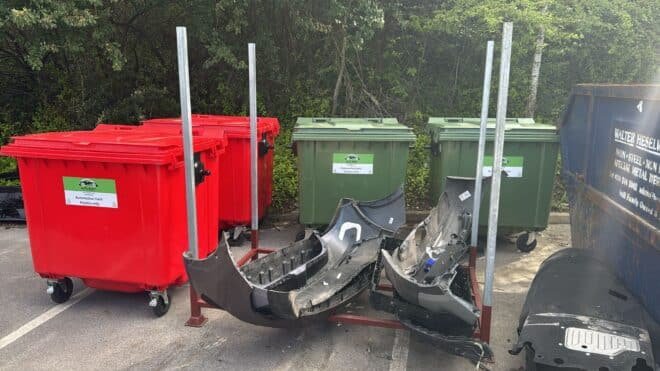
- Damaged bumpers, plastic trims, and body panels removed during bodywork repairs.
- Alloy wheels and scrap metal from replaced or written-off components.
That volume and variety – generated simultaneously in a single premises – places UK bodyshops in a categorically different legal position from almost every other trade operating at a comparable scale.
Why the Environment Agency Targets Bodyshops Specifically
The Environment Agency classifies automotive repair and bodyshop premises as high-risk operations under its risk-based compliance model. This distinction means two important things in practice:
- Bodyshops are not simply inspected reactively after an incident or complaint.
- They are proactively scheduled for inspection based on the types and volumes of hazardous waste they generate – regardless of whether anything has visibly gone wrong.
What the Data Says
According to the Environment Agency’s Chief Regulator’s Report:
- Over 90% of all enforcement notices issued in 2024 were directed at the waste sector.
- 55% of the most serious permit breaches recorded in that period were attributed to poor general management – specifically inadequate storage systems, poor waste handling practices, and the absence of organised compliance processes.
These are not problems exclusive to large industrial facilities. They are precisely the issues that surface repeatedly during bodyshop inspections across England, Scotland, and Wales.
The Direction of Travel Is Towards More Scrutiny, Not Less
Three developments confirm that enforcement pressure is increasing, not easing:
- 2025: The Environment Agency tightened hazardous waste disposal regulations across automotive repair businesses specifically.
- September 2025: The House of Lords Environment and Climate Change Committee declared waste crime “critically under-prioritised” and called for significantly greater enforcement resources.
- 2026: New government investment is being directed at the waste enforcement sector. The estimated cost of waste crime to the English economy alone stands at £1 billion per year.
The Brexit Misconception That Puts Bodyshops at Risk
A widely repeated belief in the trade is that leaving the European Union relaxed UK environmental requirements. It did not.
The Environment Act 2021 established the Office for Environmental Protection (OEP) – a statutory watchdog with powers to investigate ministers, public bodies, and government departments for failures in environmental law. This role was previously held by the European Commission. Rather than being lost on Brexit, it was replicated domestically in a structurally stronger form.
- UK environmental standards were retained under the EU Withdrawal Act 2018.
- In several areas, those standards were strengthened after 2020.
- For bodyshops, the practical regulatory landscape is unchanged or slightly more stringent compared to the pre-2020 position.
The Six Laws That Govern UK Environmental Law and Automotive Waste
UK environmental law and automotive waste compliance is not built on one piece of legislation. It is constructed from six interlocking laws, each covering a distinct aspect of how waste must be handled, stored, documented, and disposed of.
Understanding which law governs which activity is the essential first step – because the obligations, penalty thresholds, and enforcing bodies differ between them.
The Six Laws Every UK Bodyshop Operates Under
-
The Environmental Protection Act 1990, Section 34
- Establishes the Waste Duty of Care – the foundational obligation in all UK waste law.
- Applies to every business that produces, carries, treats, keeps, or disposes of waste.
- Every other compliance obligation in this article flows directly from this single provision.
- If a bodyshop owner reads one piece of legislation, it must be this one.
-
The Hazardous Waste (England and Wales) Regulations 2005
- Governs how bodyshops must handle, store, transfer, and document hazardous waste.
- Establishes the consignment note system for every hazardous waste movement.
- Defines all classification requirements for hazardous waste streams.
- Creates the absolute prohibition on mixing hazardous and non-hazardous waste.
-
The Environmental Permitting (England and Wales) Regulations 2016
- Governs operating permits for activities capable of causing environmental harm.
- Spray booths, surface coating operations, and on-site waste storage can all trigger permit requirements.
- Operating a permittable activity without holding a permit is a criminal offence.
-
The End-of-Life Vehicles Regulations 2003
- Applies directly to any bodyshop that handles scrap or write-off vehicles.
- Requires Authorised Treatment Facility (ATF) status before any vehicle can be depolluted.
- Mandates a legally prescribed depollution sequence before any scrap vehicle can be dismantled or processed.
-
The Water Resources Act 1991
- Makes it a criminal offence to cause or permit polluting matter to enter controlled waters.
- Applies to contaminated drainage – oil, paint, brake fluid, or solvent reaching any drain or watercourse.
- Operates on strict liability: prosecution requires no proof of negligence or intent.
-
The Batteries and Accumulators Regulations 2008 and 2009
- Governs the storage and disposal of all vehicle batteries.
- Covers both traditional lead-acid batteries and lithium-ion packs from EVs and hybrids.
- Standard hazardous waste contractors are not always authorised to transport EV battery packs.
What Brexit Changed – and What It Absolutely Did Not
| Aspect | Position After Brexit |
| The six laws above | All retained in full under EU Withdrawal Act 2018 |
| EWC (European Waste Catalogue) codes | Retained in UK domestic waste law |
| Environmental enforcement watchdog | Replaced by Office for Environmental Protection (OEP) – 2021 |
| Overall compliance burden for bodyshops | Unchanged or slightly more stringent |
Who Enforces UK Automotive Waste Law – By Nation
| Nation | Regulatory Body | Website |
| England | Environment Agency (EA) | environment.data.gov.uk |
| Scotland | SEPA – Scottish Environment Protection Agency | sepa.org.uk |
| Wales | Natural Resources Wales (NRW) | naturalresources.wales |
| Northern Ireland | NIEA – within DAERA | daera-ni.gov.uk/niea |
Practical Tip: NetRegs (netregs.org.uk) is the UK Government’s national compliance guidance platform, operated jointly by all four environment agencies. It translates complex legislation into practical guidance for businesses including bodyshops and automotive workshops. Bookmark it and check it whenever a regulation changes.
Hazardous Waste Classification: What Your Workshop Produces and What the Law Demands
Under UK environmental law, waste is classified as hazardous if it displays one or more of fifteen Hazard Properties (HP codes) as defined in the List of Wastes (England) Regulations 2005.
The Three HP Codes Most Relevant to Bodyshop Operations
| HP Code | Hazard Type | Bodyshop Waste Types Affected |
| HP3 | Flammable | Solvent-based paints, thinners, reducers |
| HP6 | Acutely Toxic | Certain paint components, brake fluid, isocyanate primers |
| HP14 | Ecotoxic | Paints, coolant, solvent residues harmful to aquatic/soil environments |
The moment waste is classified as hazardous, a strict chain of legal obligations activates:
- Storage on an impermeable, bunded surface.
- A new consignment note for every individual collection.
- A carrier specifically authorised for hazardous waste.
- Documentation retained for a minimum of three years.
Misclassifying a hazardous waste as non-hazardous – even unintentionally – is a criminal offence under the Hazardous Waste Regulations 2005.
The Classification Principle Most Bodyshops Get Wrong
The rule: Classification depends on the state of the waste as generated – not the state of the original product.
- Virgin paint in a sealed tin on a shelf = a product.
- Paint residue in a mixing cup at the end of a job = waste that must be classified.
The same material at different stages holds entirely different legal status. Getting this wrong is the most common and most costly classification error in bodyshop environments.
Every Waste Stream Your Bodyshop Produces – and Its Legal Classification
Hazardous Waste Streams
Solvent-Based Paints, Primers, and Lacquers
- Hazardous under HP3 and HP14 – without exception.
- Require bunded storage on an impermeable surface.
- Require a consignment note at every collection.
- Cannot enter a general skip, mixed waste container, or any non-hazardous stream.
Water-Based Paints
- The most frequently misclassified waste stream in UK bodyshops.
- “Water-based” does not mean non-hazardous in liquid form.
- Liquid water-based paint typically contains biocides, metallic pigments, and film-forming polymers that trigger hazardous classification.
- Only fully dried and cured water-based paint as solid waste may qualify as non-hazardous.
Paint Thinners and Reducers
- Classified hazardous under HP3 (flammable) and HP6 (toxic).
- Require flammable-rated storage in addition to standard hazardous waste containment.
- Must never be mixed with any other waste stream.
Oil-Soaked Rags, Wipes, and Absorbents
- Become hazardous waste the moment they are contaminated with any hazardous substance.
- Cannot be placed in general commercial waste bins.
- A metal, self-closing bin for oil-contaminated rags is a legal and fire safety requirement – not a workshop convenience.
Waste Engine, Gearbox, and Hydraulic Oils
- Among the most commonly produced hazardous waste streams in any bodyshop.
- Must be kept completely separate from all other waste types.
- Many registered waste oil collectors will collect clean, segregated waste oil at no charge – because it retains recovery value.
- Mixed or contaminated oil incurs disposal charges across the entire combined volume.
Lead-Acid Vehicle Batteries
- Classified hazardous under HP8 (corrosive) and HP6 (toxic).
- Must be stored upright in secondary containment to prevent acid leakage.
- Must be collected by a Battery Regulation-approved scheme.
Lithium-Ion Batteries (EV and Hybrid Vehicles)
- Classified as hazardous waste.
- Carry the additional risk of thermal runaway – an uncontrollable self-heating reaction in damaged cells producing intense fire and toxic gas.
- Standard hazardous waste carriers are not necessarily equipped or insured for EV battery transport.
- Specialist EV battery waste contractors are required for any damaged or end-of-life lithium-ion battery pack.
Aerosol Cans
- Classified as hazardous even when apparently empty – residual propellant and product content remain.
- Pressurised container regulations apply even after discharge.
- Placing aerosol cans from automotive use in a general commercial waste bin is non-compliant and creates a documented fire risk for waste handlers.
Non-Hazardous But Still Regulated Waste Streams
Damaged Bumpers, Plastic Trims, and Hard Plastic Components
- Classified as non-hazardous automotive plastic waste under UK waste law when removed during bodywork.
- The Waste Duty of Care still applies – every transfer requires a Waste Transfer Note and a registered carrier.
- These materials cannot go in a general skip without proper documentation.
- A specialist automotive plastic waste collection service provides a compliant, documented, and traceable disposal route for bumpers, trims, and hard plastics – keeping the workshop clear and the compliance record complete. You can also explore car bumper collection and car bumper recycling as dedicated services for this specific waste stream.
Alloy Wheels
- Non-hazardous scrap – but subject to the Waste Duty of Care and the Scrap Metal Dealers Act 2013.
- Every transfer requires a Waste Transfer Note and a registered carrier or scrap metal dealer.
- Dedicated alloy wheel collection under documented carrier registration provides a compliant and low-admin disposal route for this regular bodyshop waste stream.
Scrap Metal and Bodywork Panels
- Generally non-hazardous but require a Waste Transfer Note and a registered carrier at every point of transfer.
The Mirror Entry Rule – The Classification Concept Most UK Bodyshops Have Never Encountered
In the UK List of Wastes, certain codes are known as mirror entries – where the same material can be classified as either hazardous or non-hazardous depending on whether hazardous properties are actually present.
The legal obligation: The waste producer must formally assess which classification applies before disposal.
A practical bodyshop example:
- Paint-contaminated wash water has a mirror entry code.
- If the solvent concentration exceeds the HP14 threshold → classified as hazardous waste requiring a consignment note and registered hazardous carrier.
- If below that concentration → may be classified non-hazardous (though trade effluent consent may still apply).
How to assess a mirror entry without laboratory testing:
- Identify the product the waste originates from.
- Obtain the product’s Safety Data Sheet from the supplier.
- Cross-reference the SDS with the concentration at which the product was used.
- If components trigger HP codes at sufficient concentration → classify as hazardous.
- Where uncertainty remains → classify as hazardous until evidence confirms otherwise.
Important: Misclassifying a mirror entry waste without a formal assessment carries the same legal exposure as deliberately misclassifying a clearly hazardous waste. The obligation to assess is not discharged by assuming the best-case outcome.
The Waste Duty of Care: Your Cradle-to-Grave Legal Responsibility
The Waste Duty of Care, established under Section 34 of the Environmental Protection Act 1990, is the most fundamental legal obligation in all of UK environmental law and automotive waste management.
What it means in plain terms: You are legally responsible for every piece of waste your workshop generates – from the moment it is created until it reaches its final, lawful destination. Not until a contractor picks it up. Not until it leaves your gate. Until it arrives at a facility holding a valid permit to receive it.
If a contractor collects your waste and dumps it illegally, you can face prosecution – because you failed to take the steps the law requires to prevent it.
The Four Legal Pillars of Waste Duty of Care
Pillar 1 – Prevention
You must take reasonable steps to prevent waste from:
- Escaping containment or secure storage.
- Being accessed by or transferred to unauthorised persons.
- Causing pollution of the land, air, or water.
Secure, labelled storage is a legal requirement embedded in the Duty of Care – not a health and safety suggestion.
Pillar 2 – Description
When transferring waste to any carrier, you must provide a written description that is accurate enough for the recipient to:
- Handle the waste safely.
- Store it correctly.
- Dispose of it lawfully.
Examples of descriptions that fail this standard:
- “Workshop waste.”
- “General rubbish.”
- “Mixed waste.”
A compliant description must include:
- The specific waste type in plain language.
- The EWC (European Waste Catalogue) code.
- The hazard classification where applicable.
- Any specific handling requirements.
Pillar 3 – Transfer to Authorised Persons Only
Waste may only be transferred to one of the following:
- A registered waste carrier with a current, verified registration.
- A permitted waste facility authorised to receive the specific waste type.
- A registered exempt operator operating within the terms of their exemption.
The following provide zero legal protection:
- Branded vehicles and company logos.
- Professional uniforms or presentation.
- Verbal assurances of registration.
- Company-headed invoices or receipts.
Only verified, current, documentary registration on the EA public register counts.
Pillar 4 – Documentation
Every waste transfer must be documented. No exceptions.
- Non-hazardous waste: Requires a Waste Transfer Note (WTN).
- Hazardous waste: Requires a Consignment Note – a new one for every individual collection.
These documents are the legal evidence that your Duty of Care was met. Without them, you have no defence.
Waste Transfer Notes vs. Consignment Notes – Side-by-Side Comparison
| Feature | Waste Transfer Note (WTN) | Consignment Note |
| Applies to | Non-hazardous waste | Hazardous waste only |
| Required frequency | Can cover a 12-month rolling period | Required for every individual collection |
| Parties who sign | Waste producer and carrier jointly | Consignor, carrier, and consignee all sign |
| Minimum retention | 2 years | 3 years |
| Legal basis | EPA 1990, Duty of Care Code of Practice | Hazardous Waste Regulations 2005 |
| Pre-notification required | No | Yes – in some circumstances |
Inspection risk: An Environment Agency inspector can request consignment notes for any hazardous waste transfer made in the past three years. Missing, incomplete, or inconsistent records are evidenced Duty of Care failures. No explanation is accepted as a remedy.
The Reasonable Enquiry Standard – What Protection It Provides and Where It Ends
The law accepts that you cannot guarantee the future conduct of every contractor you engage. What it requires instead is that you take reasonable steps to verify legitimacy – both before engaging a contractor and throughout the relationship.
What reasonable enquiry looks like in practice:
- Check the carrier’s registration on the Environment Agency public register before first engaging them.
- Retain a copy of the registration certificate, including the expiry date.
- Re-verify registration at minimum annually – not just once at the start of a contract.
- Record each verification check with the date it was carried out.
- Keep this record in the contractor’s compliance file.
Red flags that invalidate the reasonable enquiry defence:
- Cash-only payment requested.
- No documentation offered at point of collection.
- Pricing significantly below market rates.
- Inability to provide a registration number when asked.
Deliberately choosing not to ask questions because you prefer not to know the answers is treated as actual knowledge for the purposes of environmental liability.
The 7-Step Compliance Checklist for UK Bodyshop Waste Management
UK environmental law and automotive waste compliance for a bodyshop reduces to seven specific daily operational practices. Each is backed by a distinct legal requirement. Together, they form a system that converts potential unlimited legal liability into a documented, defensible, and inspection-ready daily practice.
Step 1 – Classify: Identify Every Waste Stream Before It Leaves the Premises
Conduct a waste stream audit of your workshop. For every area – spray booth, prep bay, mechanical area, wash bay, waste compound – record the following for each waste type:
- Plain-language waste description.
- EWC (European Waste Catalogue) code from the UK List of Wastes.
- Classification – hazardous or non-hazardous.
- Whether it is an absolute entry or a mirror entry requiring formal assessment.
- Applicable HP codes where hazardous.
- Current storage method – container type, location, labelling status.
- Current disposal route – contractor name, registration number, collection frequency.
Use your supplier Safety Data Sheets to support all classification decisions. Document every mirror entry assessment and retain it as compliance evidence.
Step 2 – Segregate: Keep Hazardous and Non-Hazardous Waste Permanently Separated
Mixing hazardous and non-hazardous waste is one of the most financially damaging compliance failures in bodyshop operations. Adding a small amount of solvent paint waste to a general skip means the entire skip contents must legally be treated and disposed of as hazardous waste – at significantly higher cost.
Combinations that must never be mixed:
- Solvent-based paint waste with oil waste – different disposal routes and potential chemical reaction.
- Oxidising cleaning agents with any solvent or flammable waste – fire and explosion risk.
- Acid-containing products with alkaline waste – chemical reaction generating heat and toxic gases.
- Any hazardous waste stream with general non-hazardous waste.
Practical segregation requirements:
- Dedicated, clearly labelled containers for each hazardous waste stream.
- Physical separation between hazardous and non-hazardous storage areas.
- No general waste bins positioned in areas where hazardous waste is generated.
- Colour-coded containers as a best-practice measure to reduce accidental contamination.
Step 3 – Contain: Store Waste to the Legal Containment Standard
Impermeable surface requirements:
- Unsealed concrete is not impermeable – it becomes increasingly porous under repeated chemical exposure.
- The surface must have a sealed or coated finish to meet the legal standard.
- Bare earth, tarmac, and block paving do not meet this standard for hazardous waste storage.
Bunding requirements:
- Secondary containment must hold a minimum of 110% of the largest single container’s volume, or 25% of total stored volume – whichever is greater.
- No open drain connections within or from the bunded area.
- The bund lining must be inspected regularly and repaired at the first sign of cracking or degradation.
Outdoor storage requirements:
- Hazardous waste stored outdoors must be covered or weatherproofed to prevent rainfall contaminating bund contents.
- A waterproof canopy is sufficient – a full building is not required.
- Minimum separation distances from site boundaries, drains, and watercourses apply under EA Pollution Prevention Guidance Note PPG26 for vehicle repair premises.
Practical Tip: Having purpose-built, correctly sized storage containers for each waste stream makes bunding compliance significantly easier to maintain. Specialist automotive waste bins and stillage designed for bodyshop environments keep each material stream separated, correctly contained, and ready for scheduled collection – taking the daily management effort out of storage compliance.
Step 4 – Label: Every Container Must Be Correctly Identified at All Times
Minimum required label information for every waste container:
- Plain-language waste description (not just the original product name).
- EWC waste code.
- Hazard classification – including hazard pictograms for hazardous waste.
- Date waste was first placed in the container.
- Name and full address of the generating premises.
The most common labelling failures identified during Environment Agency inspections:
- Unlabelled slop buckets or catch trays positioned beneath equipment.
- Containers identified only by the original product brand name.
- Re-used containers with the old product label still visible or only partially covered.
- Multiple different waste types stored in a single unlabelled container.
- Labels damaged, faded, or illegible due to exposure to chemicals or weather.
Step 5 – Document: Complete the Right Paperwork for Every Collection
Do not permit any waste to be loaded until the correct document is completed and signed.
For non-hazardous waste collections:
- Complete or confirm a valid Waste Transfer Note covering this collection.
- Season ticket arrangements can cover a 12-month rolling period for regular collections of the same non-hazardous waste type from the same site.
- Confirm the season ticket is current and that this specific collection falls within its terms.
For hazardous waste collections:
Complete a new Consignment Note for this specific individual collection. The note must include:
- Waste description and EWC code.
- Quantity collected (in kilograms or litres as appropriate).
- Carrier’s registration number.
- Consignee (receiving facility) name, address, and permit number.
- Date and location of the transfer.
- Signature from you (as consignor) and from the carrier – at the point of collection.
File the note immediately after collection. Do not leave it on a workbench, in a vehicle, or on a counter.
Digital records are legally valid under current UK guidance and create a timestamped, tamper-evident audit trail – superior to paper systems for inspection readiness.
Step 6 – Verify: Confirm Contractor Registration Before Every Collection
Carrier registrations carry expiry dates. An expired registration is legally identical to no registration – and the consequence for your bodyshop is identical in both cases.
How to verify carrier registration – the exact process:
- Go to the Environment Agency’s electronic public register: environment.data.gov.uk.
- Search by contractor name or registration number.
- Confirm the registration is current and covers the specific waste types being collected.
- Record the registration number, expiry date, and the date of your verification check.
- File this record in the contractor’s dedicated compliance file.
- Set a calendar reminder 30 days before each registration expiry date.
Red flags that should immediately stop a collection:
- Contractor cannot provide or confirm a registration number when asked.
- The EA register search returns no matching entry.
- The registration is marked as expired or revoked.
- The contractor collects a waste type not covered by their registration.
Step 7 – Drain: Ensure Workshop Drainage Cannot Carry Contamination Off-Site
Before relying on your workshop drainage as compliant, confirm all of the following:
- Workshop floor drainage connects to a foul sewer via a properly maintained oil separator.
- Wash bay drainage operates through either a closed-loop water recycling system or a properly consented trade effluent discharge arrangement.
- Hazardous waste storage areas drain to a bund or sump – not to any drain connection.
- Oil separator inspection and maintenance records are current and on file.
- The oil alarm system is operational and has been recently tested.
Workshop Drainage and Water Pollution Law: The Risk That Sends Owners to Court
Water pollution from bodyshop premises is one of the most frequently prosecuted environmental offences in the UK automotive sector. The reason it consistently results in court proceedings rather than advisory letters is straightforward: it is physically visible. A contaminated stream, drain blockage, or oil sheen on a watercourse generates public complaints, council referrals, and sometimes local media coverage.
The Water Resources Act 1991 makes it an offence to “cause or knowingly permit” polluting matter to enter controlled waters. Courts have interpreted “cause” broadly. The operator of a premises from which pollution escapes can face liability even where:
- The immediate cause was a mechanical failure or equipment defect.
- The pollution resulted from an accidental spillage during normal repair work.
- The drainage defect was unknown to the operator at the time.
This is strict liability in practice: The legal obligation is to prevent pollution – not merely to avoid causing it deliberately.
Are Oil Separators Legally Required in UK Bodyshops?
Direct answer: Yes – in the vast majority of bodyshop situations, an oil separator is effectively a legal requirement.
Under Pollution Prevention Guidance Note 3 (PPG3) and the British Standard BS EN 858, an oil separator is required wherever drainage from vehicle working areas, fuel handling areas, or oil storage areas has any potential to reach a surface water drain or watercourse. That description covers virtually every operating bodyshop in England, Scotland, and Wales.
The two classes of separator under BS EN 858:
| Class | Type | Required When |
| Class I | Full retention separator | Workshop floor drainage in all areas where vehicles are worked on |
| Class II | Bypass separator | Lower-risk drainage only – e.g., surface car park runoff |
Class I is the correct and required standard for bodyshop workshop floor drainage.
Oil Separator Maintenance – The Legal Obligations
Fitting a separator and then ignoring it provides no legal protection. The following maintenance obligations apply:
- Inspect at minimum annually by a qualified contractor.
- Pump out sludge when it reaches 50% of the sludge storage volume.
- Confirm the oil alarm system is operational at each inspection.
- Repair any detected defects promptly – a cracked, blocked, or full separator is treated as equivalent to no separator.
- Retain all inspection and maintenance records – these are reviewed during Environment Agency inspections and must be available on demand.
On Landlord vs. Tenant Liability for Drainage
This question arises frequently in leased bodyshop premises.
The legal answer is clear: The occupier bears operational responsibility for drainage compliance – not the building owner.
- If a landlord installed defective drainage infrastructure, the tenant may have a civil contractual claim against them.
- That civil claim does not remove regulatory liability to the Environment Agency.
- Address compliance first. Pursue the landlord separately if warranted.
Trade Effluent Consent – When Your Bodyshop Needs One
A Trade Effluent Consent is formal permission from the local sewerage undertaker to discharge trade wastewater into the public sewer.
Any water that has contacted automotive trade processes is trade effluent, including:
- Wash bay water.
- Workshop floor wash water.
- Water that has run across or through hazardous waste storage areas.
- Rinse water from cleaning paint equipment.
Discharging trade effluent without consent is a criminal offence under the Water Industry Act 1991. Sewerage undertakers hold powers to:
- Issue formal enforcement notices.
- Disconnect the sewer connection.
- Pursue criminal prosecution – with unlimited fines available on conviction.
How to apply for Trade Effluent Consent:
- Contact the sewerage undertaker responsible for your area (Severn Trent, Thames Water, Anglian Water, Yorkshire Water, or equivalent).
- Submit a Trade Effluent application describing discharge nature, volume, and contaminant content.
- Receive and review consent conditions – specifying permitted volumes, maximum contaminant concentrations, and any monitoring requirements.
- Comply continuously with all conditions from the date of consent.
- Retain the consent document and make it available during any regulatory inspection.
Closed-loop wash water recycling systems eliminate the need for Trade Effluent Consent entirely for wash bay operations, reduce mains water costs, and remove ongoing monitoring obligations – making them a sound compliance and operational investment for any high-throughput bodyshop.
End-of-Life Vehicles and ATF Regulations: Where Bodyshops Get Caught Out
An End-of-Life Vehicle (ELV) is, in law, any vehicle that its owner has discarded or intends to discard. This includes:
- Insurance write-off vehicles – all categories.
- Vehicles beyond economical repair.
- Vehicles being broken for parts where no repair is intended.
A vehicle does not need to have reached a scrapyard to qualify as an ELV. It becomes one the moment the owner’s intent shifts from repair to disposal – regardless of its physical location.
Under the End-of-Life Vehicles Regulations 2003, only businesses holding Authorised Treatment Facility (ATF) status can legally depollute, dismantle, or process ELVs. Carrying out these activities without ATF registration is a criminal offence – regardless of the bodyshop’s intent, knowledge, or the circumstances of the vehicle’s arrival.
Insurance Write-Off Categories and ELV Status
| Category | Description | ELV Status | Non-ATF Bodyshop Permitted to Process? |
| A | Crush only – no parts to be reused | Definitionally an ELV | No |
| B | Parts may be reused; shell must be crushed | Definitionally an ELV | No |
| S | Structural damage – repairable | ELV if subsequently scrapped | Only if repair remains the intent |
| N | Non-structural damage – repairable | ELV if subsequently scrapped | Only if repair remains the intent |
What ATF Registration Requires
ATF status is an environmental permit issued by the Environment Agency under the Environmental Permitting Regulations 2016. To obtain it, a site must demonstrate:
- Planning permission from the local council for the intended activities.
- An appropriate site layout capable of containing all vehicle fluids and hazardous materials.
- Adequate depollution equipment for every fluid type – plus secure component storage.
- A documented management system covering depollution logs, ELV records, and Certificate of Destruction (CoD) documentation.
- Successful completion of an Environment Agency pre-application assessment.
Once granted, the business name and permit details appear on the Environment Agency’s public ATF register – accessible by anyone.
The Mandatory ELV Depollution Sequence
Every ELV must be depolluted completely before dismantling or processing. The legally required sequence is:
- Remove all batteries and capacitors – including high-voltage EV packs requiring specialist handling.
- Remove or neutralise all explosive safety devices – airbags and seatbelt pre-tensioners.
- Remove LPG tanks and pressurised fuel system components.
- Drain and separately collect all fuel.
- Drain and separately collect engine oil, transmission oil, and power steering fluid.
- Drain and separately collect hydraulic fluid and brake fluid.
- Drain and separately collect coolant and antifreeze.
- Recover air conditioning refrigerant – requires an F-gas certified operative under F-gas Regulations.
- Remove all other hazardous fluids or components.
- Remove the catalytic converter.
- Remove tyres as a separate waste stream.
- Remove large plastic components where reasonably practicable.
Partial depollution does not constitute compliance. A vehicle from which only some fluids have been removed remains classified as hazardous waste and cannot be processed as general scrap.
What a Non-ATF Bodyshop Can and Cannot Legally Do
Permitted without ATF status:
- Accept a damaged vehicle for repair assessment.
- Store a vehicle while an insurer or owner decides between repair and write-off.
- Remove parts from a vehicle as part of an active, intended repair.
Not permitted without ATF status:
- Drain any fluid from a vehicle where the intent is to scrap rather than repair it.
- Accept a Category A or B insurance write-off for any purpose beyond temporary storage.
- Strip a vehicle of usable parts where the remaining shell will be scrapped.
- Issue a Certificate of Destruction.
Best practice for non-ATF bodyshops: Maintain a written referral arrangement with a registered ATF for all write-off vehicles. Document each referral. Do not begin any fluid removal until the ATF has formally accepted the vehicle and confirmed its legal status.
Environmental Permits for Bodyshops: Do You Need One?
Whether a UK bodyshop needs an environmental permit depends on what activities it carries out and at what scale. The Environmental Permitting (England and Wales) Regulations 2016 create a three-tier framework applicable across England and Wales.
Operating an activity that requires a permit without holding one is a criminal offence. The Environment Agency does not accept “I was unaware a permit was needed” as mitigation – it is treated as evidence of management failure.
The Three Tiers of the Permit Framework
Tier 1 – Registered Exemptions
- Cover low-risk, small-scale activities.
- Not automatic – must be formally registered with the Environment Agency before the activity begins.
- From 2025, the EA has proposed introducing charges for registration and compliance monitoring.
- Activities in the highest-risk exemption band may no longer qualify for exemption status and require a full permit.
- Operating under an exemption whose conditions are not being met = operating without a permit.
Tier 2 – Standard Rules Permits
- Cover defined categories of activity under pre-set, non-negotiable conditions.
- Either all conditions are fully met or the permit does not apply – there is no partial qualification.
- Faster and less expensive to obtain than bespoke permits.
- Most bodyshop spray painting and surface treatment operations fall within standard rules categories.
Tier 3 – Bespoke Permits
- Required for operations that cannot fit within any standard rules category – typically due to scale, complexity, or site-specific characteristics.
- Large bodyshops with high solvent consumption, or operations combining bodyshop activities with waste treatment or storage, may require a bespoke permit.
- Individually assessed by the Environment Agency – significantly more time-consuming and costly to obtain.
The Solvent Emissions Threshold – The Trigger Most Bodyshops Miss
The most commonly relevant permit trigger for bodyshops is the use of a spray booth and the VOC (Volatile Organic Compound) emissions generated by vehicle refinishing.
The key threshold: Surface coating activities consuming more than 5 tonnes of organic solvents per year require an environmental permit.
How to calculate your annual solvent consumption:
- List every paint, primer, lacquer, and cleaning product used in the workshop.
- Obtain the VOC content percentage from each product’s technical data sheet (from your supplier).
- Multiply the VOC percentage by the annual quantity purchased for each product.
- Add all totals – divide by 1,000 to convert kilograms to tonnes.
- Compare the result against the 5-tonne threshold.
What the result means:
- Below 5 tonnes: A registered exemption may be appropriate – but it must still be registered before use.
- Close to 5 tonnes: Apply for a standard rules permit. The margin of error is not worth the risk of an unlimited fine.
- Above 5 tonnes: A standard rules permit is required before the activity continues.
Permit Authorities by Nation
- England: Environment Agency – environment.data.gov.uk.
- Scotland: SEPA, under the Environmental Authorisations (Scotland) Regulations 2018 – sepa.org.uk.
- Wales: Natural Resources Wales, applying the same EPR 2016 framework – naturalresources.wales.
- Northern Ireland: NIEA, under the Pollution Prevention and Control Regulations (Northern Ireland) 2003 – daera-ni.gov.uk.
Fines, Prosecution, and Enforcement: Real Consequences for UK Bodyshops
Environmental offences are not treated as administrative oversights. They sit at the serious end of UK regulatory law – with penalties including unlimited fines, director personal liability, and criminal records that follow individuals regardless of company status.
The House of Lords Environment and Climate Change Committee confirmed in September 2025 that waste crime costs the English economy an estimated £1 billion per year. Following that report, the government committed new investment specifically to Environment Agency enforcement activity in the waste sector.
The Penalty Framework – UK Bodyshop Environmental Offences
| Offence | Magistrates’ Court | Crown Court | Legislation |
| Depositing waste without permit | Unlimited fine | Unlimited + 5 years imprisonment | EPA 1990, s.33 |
| Breach of Waste Duty of Care | Up to £5,000 / unlimited | Unlimited fine | EPA 1990, s.34 |
| Breach of Hazardous Waste Regulations | Unlimited + 12 months | Unlimited + 5 years | HWR 2005 |
| Operating without environmental permit | Unlimited + 12 months | Unlimited + 12 months | EPR 2016 |
| Causing water pollution | Unlimited + 12 months | Unlimited + 12 months | WRA 1991 |
| Processing ELV without ATF status | Unlimited fine | Unlimited fine | ELVR 2003 |
Variable Monetary Penalties – The Fast-Track Enforcement Route
Variable Monetary Penalties (VMPs), introduced under the Regulatory Enforcement and Sanctions Act 2008, allow the Environment Agency to impose civil financial penalties of up to £250,000 without initiating criminal proceedings.
Key points about VMPs:
- Can be issued significantly faster than criminal prosecution.
- Appear permanently on the EA’s public enforcement register – searchable online by anyone at any time.
- Are not criminal convictions but are permanent public records visible to customers, insurers, and networks.
- Are increasingly the initial enforcement response before prosecution is considered.
Director Personal Liability – The Risk That Survives Company Restructuring
Section 157 of the Environmental Protection Act 1990 provides that where a corporate offence is committed with the consent, connivance, or neglect of a director, manager, or secretary of that company, the individual is personally liable and may be prosecuted separately.
Every bodyshop director must understand the following:
- A company entering administration, being wound up, or transferring assets does not extinguish personal director liability for environmental offences committed before dissolution.
- A director who was aware of compliance failures and allowed them to continue is at direct personal legal risk.
- Personal prosecution results in an individual criminal record with implications for future directorship eligibility, professional standing, and insurance.
Three Real-World Enforcement Scenarios
Scenario A – The Lapsed Carrier Registration
- A bodyshop engaged a hazardous waste contractor with current registration at the outset.
- The registration lapsed after six months. The bodyshop never re-verified.
- Fourteen hazardous waste collections were made on expired carrier authority over the following eight months.
- Defence offered: “We assumed they were still registered.”
- Outcome: Variable Monetary Penalty issued. The reasonable enquiry standard was not met.
Scenario B – The Cracked Bund
- A bunded waste oil storage area developed hairline cracks over three years without inspection.
- Following heavy rainfall, accumulated water and pressure caused the bund to overflow.
- Contaminated run-off reached a storm drain and entered a local brook.
- The business had no spill response plan and did not report the incident.
- Outcome: Criminal prosecution under the Water Resources Act 1991. Strict liability applied – no proof of negligence required.
Scenario C – The Unlicensed Parts Operation
- A vehicle repair and parts dealership accepted Category B insurance write-offs.
- Fluids were drained and usable parts stripped without ATF registration.
- Twenty-plus vehicles were processed over several months before an intelligence-led inspection.
- Outcome: Substantial fine and a prohibition order preventing any ELV handling without the correct environmental permit.
The Permanent Reputational Consequence
Every Environment Agency prosecution result, formal caution, and enforcement notice is published permanently on GOV.UK – indexed by search engines and accessible indefinitely.
What this means in commercial practice:
- A fleet operator searching your business name before awarding a contract will find any enforcement record.
- An insurance network conducting a supplier compliance audit will flag an enforcement notice.
- A manufacturer’s approved repairer assessment will fail a business with an active enforcement record.
- Pollution liability insurance claims may be contested or declined where the business was operating in breach of environmental regulations at the time of the incident.
The revenue loss from a single fleet contract cancellation will in most cases exceed the financial penalty imposed. The reputational consequence lasts considerably longer.
8 Dangerous Compliance Myths That Circulate in the UK Automotive Trade
Several widely repeated beliefs about UK environmental law and automotive waste compliance place bodyshops at serious and unnecessary legal risk. Every one of the following has been cited as a defence during Environment Agency enforcement proceedings. None of them succeeded.
Myth 1: “Water-based paint is safe to pour down the drain.”
The truth:
Water-based automotive paints in liquid form are not simply coloured water. They contain:
- Biocides to prevent microbial growth.
- Metallic pigments – often zinc, titanium, or aluminium compounds.
- Film-forming polymers and surfactants.
- pH modifiers and preservatives.
In liquid form, these components can trigger hazardous classification. Pouring liquid water-based paint waste down a drain can constitute both a hazardous waste offence and a water pollution offence simultaneously. “It’s water-based” has never succeeded as a defence.
Myth 2: “A branded van and a company receipt proves they’re a registered carrier.”
The truth:
- Commercial branding, uniforms, headed invoices, and professional presentation provide zero legal protection.
- Registration is a separate administrative process recorded on the Environment Agency’s public register.
- An unregistered operator can look completely indistinguishable from a registered one.
- Verification takes under two minutes at environment.data.gov.uk.
- Skipping it costs you your entire Duty of Care defence.
Myth 3: “Small volumes of hazardous waste mean different rules apply.”
The truth:
Volume thresholds affect some specific administrative requirements, but they do not remove:
- Duty of Care obligations.
- Consignment note requirements.
- The need to use a registered carrier for hazardous waste.
- Storage and labelling standards.
A bodyshop generating 30kg of solvent waste per month has identical legal obligations to one generating 3,000kg.
Myth 4: “The landlord is responsible for drainage and waste storage – it’s their building.”
The truth:
Environmental liability attaches to the occupier – the business operator – not the building owner.
-
- Drainage compliance, waste storage standards, and permit conditions are the tenant’s responsibility.
- A contractual claim against a landlord for defective infrastructure is a civil matter.
- That civil claim does not remove regulatory liability to the Environment Agency.
Myth 5: “We’ve operated this way for 20 years without any issues – so we must be compliant.”
The truth:
- The absence of enforcement does not confirm compliance.
- The EA’s inspection model is risk-based and changes as priorities and data shift.
- A public complaint, a neighbour’s report, a pollution incident, or a scheduled risk-based inspection can bring scrutiny to a business that has operated u
- ndisturbed for decades.
- “We’ve always done it this way” is not a legal defence. It is not even evidence of compliance.
Myth 6: “Brexit relaxed UK environmental law – things are less strict now.”
The truth:
- The Environment Act 2021 established the Office for Environmental Protection – with stronger domestic enforcement powers than wer
- e available under EU supervision.
- UK environmental standards were retained under the EU Withdrawal Act 2018.
- In several areas, those standards were strengthened after 2020.
- For bodyshops, the practical regulatory landscape is unchanged or slightly more stringent than it was in 2019.
Myth 7: “If my contractor disposed of waste illegally, I can’t be prosecuted – I didn’t know.”
The truth:
- The Duty of Care is proactive – not passive.
- “I didn’t know” is not a defence where the reason for not knowing is failing to take the required reasonable steps.
- Not verifying registration, not retaining documentation, and not responding to obvious red flags all constitute Duty of Care failures.
- Deliberately choosing not to ask questions is treated as actual knowledge for the purposes of environmental liability.
Myth 8: “Empty aerosol cans can go in the general commercial waste bin.”
The truth:
- Aerosol cans from automotive use are classified as hazardous waste even when apparently empty.
- Residual propellant and product content remain in cans that appear visually spent.
- They create a documented fire and explosion risk if crushed or punctured in waste collection vehicles.
- Placing them in general commercial waste bins is non-compliant, creates a safety risk for waste handlers, and carries liability if an incident results.
How to Build a Bodyshop Waste Compliance System That Survives Inspection
A compliance system is not a policy poster on the workshop wall. It is the set of daily practices, documented procedures, verified contractor relationships, physical storage arrangements, and records that means your bodyshop passes an unannounced Environment Agency inspection – not by chance, but because the system was built to pass one.
There are five components to a functional UK bodyshop compliance system. Each is buildable in any workshop, regardless of its current state of compliance.
Component 1 – The Waste Stream Audit
Walk the workshop as if conducting an Environment Agency inspection. For every area – spray booth, prep bay, mechanical bay, wash area, waste compound – record the following:
- Waste type and plain-language description.
- EWC code.
- Classification – hazardous or non-hazardous.
- Current storage method – container type, location, labelling status.
- Current disposal route – contractor, registration number, collection frequency.
- Documentation type in use – Waste Transfer Note or Consignment Note.
Prioritise identified gaps in this order:
- Drainage risks – carry the greatest potential for environmental harm and the most severe legal consequences.
- Documentation gaps – consignment note failures are the most commonly cited breach in bodyshop enforcement cases.
- Storage deficiencies – bunding condition, surface integrity, and labelling compliance.
Component 2 – Written Waste Management Procedures
For each waste stream, create a simple one-page written procedure covering:
- What the waste is and its legal classification.
- Where it must be stored and in what type of container.
- How the container must be labelled.
- Who collects it and on what schedule.
- What documentation is completed at each collection.
- Where that documentation must be filed immediately after collection.
Review and update procedures when:
- A new product is introduced (which may change classification).
- A contractor changes.
- A regulatory update occurs.
- A near-miss or inspection reveals a gap.
Record the date of the last review on the document itself.
Component 3 – Staff Training
The Waste Duty of Care Code of Practice requires that all staff handling waste understand their obligations. Every technician, every apprentice, and every person who places anything in a waste container requires this training.
Minimum training topics for all workshop staff:
- Which waste types are hazardous in your specific workshop – and why.
- Where each waste type must be stored and how containers must be labelled.
- What to do if a contractor arrives without documentation.
- How to respond to a spill – kit location, containment steps, who to call.
What to record for every training session:
- Names of all staff trained.
- Topics covered.
- Date of training.
- Name of the person who delivered the training.
Training records are reviewed during Environment Agency inspections and are one of the clearest indicators of genuine management commitment to compliance.
Component 4 – Contractor Management
Maintain a dedicated compliance file for each waste contractor, containing:
- A copy of the current carrier registration certificate.
- The registration number and its expiry date.
- The specific waste types the registration covers.
- A record of each individual collection – date, waste type, quantity, and document reference.
- The date on which registration was last independently verified.
Annual contractor review checklist:
- Reconfirm registration is current via the EA public register.
- Confirm registration covers all waste types currently being collected.
- Review pricing for consistency with market rates – unusually low prices are a red flag.
- Confirm documentation at every collection has been complete, signed, and consistent.
For the non-hazardous automotive waste streams regularly generated by bodyshops – including car bumpers, plastic trims, and alloy wheels – working with a specialist automotive waste collection partner that operates under documented registered carrier status simplifies contractor management significantly. A single scheduled service covering multiple non-hazardous material streams removes the administrative burden of managing separate contractors for each type – and keeps the Waste Transfer Note record complete and inspection-ready automatically. View the full range of collection services available for UK bodyshops.
Component 5 – The Spill Response Plan
Every UK premises handling hazardous substances is legally required to have a spill response plan. For a bodyshop, this means knowing exactly what to do in the first fifteen minutes after an oil drum is knocked over, a paint container splits, or brake fluid is accidentally released.
Minimum contents of a bodyshop spill response plan:
- Location of each spill kit – one in every area where hazardous waste is generated or stored.
- Appropriate absorbent materials for each waste type – dedicated oil absorbents for oil waste; neutralising agents for acid-containing products.
- Named responsible staff member for each workshop area.
- The Environment Agency 24-hour incident reporting number: 0800 80 70 60 (England).
- An incident recording form to document: what occurred, the time, what was contained, and when the Agency was notified.
On self-reporting:
- Calling the Environment Agency before they find out is a formally recognised mitigating factor in enforcement decisions.
- Attempting to clean up a known pollution incident without notifying the Agency is treated as an aggravating factor that substantially increases enforcement risk.
- If in doubt, call. The call cannot make your position worse. Not calling can.
Turning Compliance Into Cost Savings: The Business Case
Most discussions about UK environmental law and automotive waste frame compliance as an unavoidable operational cost. The practical reality is more useful: a well-designed compliance system in a bodyshop can meaningfully reduce operating costs, eliminate certain disposal charges entirely, and generate competitive advantages that protect and grow revenue.
Where Compliance Saves Money
- Waste Oil – From Disposal Cost to Free Collection
- Clean, segregated waste oil retains residual recovery value.
- Many registered waste oil collectors will collect uncontaminated waste oil at no charge.
- Some will pay for high-quality, uncontaminated oil.
- Mixed or contaminated oil incurs disposal charges across the entire combined volume.
- Correct segregation eliminates collection costs entirely for this high-volume waste stream.
- Accurate Paint Mixing – Less Waste, Lower Disposal Costs
- Every gram of mixed paint not applied becomes hazardous waste with a disposal cost.
- Digital tinting and precision mixing technology reduces paint waste by an estimated 15–30% in high-volume bodyshop environments.
- Savings occur simultaneously on material cost and hazardous waste disposal.
- Solvent Recovery Units
- Recondition contaminated solvent from spray gun cleaning – returning it to reusable condition.
- At typical bodyshop solvent volumes and current disposal costs, units generally recoup their capital cost within 12 to 24 months.
- After payback, savings on both solvent purchasing and disposal are ongoing and indefinite.
- Closed-Loop Wash Bay Water Recycling
A closed-loop system for wash bay water eliminates:
- The need for a Trade Effluent Consent application and ongoing monitoring requirements.
- Trade effluent discharge costs from the sewerage undertaker.
- A meaningful portion of mains water supply costs through continuous recycling.
- Non-Hazardous Waste Streams – Simplify and Consolidate
For non-hazardous automotive waste streams generated daily in bodyshops – bumpers, plastic trims, hard plastics, and alloy wheels – consolidating collection under a single specialist partner removes multiple contractor management tasks from the compliance workload.
- Car bumper recycling and collection keeps your workshop clear, generates Waste Transfer Notes automatically, and removes one recurring compliance task entirely.
- Automotive hard plastic collection covers dashboards, trims, wheel arch liners, and grilles – keeping floor space free and documentation complete.
- Alloy wheel collection provides a documented, compliant disposal route for replaced or written-off alloy wheels with no additional administrative effort.
All collections come with documented Waste Transfer Notes – keeping your compliance file complete and your inspector-facing records in order without any additional administrative step.
Compliance as a Commercial Differentiator
Fleet operators, insurance networks, and manufacturer-approved repairer schemes are all increasingly conducting formal supplier compliance audits as conditions of contract.
A bodyshop with a demonstrable compliance record:
- Wins contracts that non-compliant competitors lose.
- Retains contracts through periodic re-audits without risk of removal.
- Differentiates itself when tendering for fleet and insurance repair work.
- Protects existing revenue from the disruption that follows any enforcement action.
The revenue protected by systematic compliance – and the revenue at risk without it – substantially exceeds the cost of operating correctly. Compliance is not a burden the business carries in addition to generating revenue. It is a condition of accessing the contracts that generate the most revenue.
Regulations by Nation: England, Scotland, Wales, and Northern Ireland
UK environmental law and automotive waste regulation is partially devolved. The enforcing body, regulatory instruments, and in some areas the procedural requirements differ between nations. Assuming that Environment Agency guidance written for England applies universally across the UK is a compliance risk – particularly for multi-site operators.
England
- Regulator: Environment Agency (EA).
- Primary legislation:
- Environmental Protection Act 1990.
- Hazardous Waste (England and Wales) Regulations 2005.
- Environmental Permitting (England and Wales) Regulations 2016.
- End-of-Life Vehicles Regulations 2003.
- Permit and carrier registration portal: environment.data.gov.uk.
- 24-hour incident line: 0800 80 70 60.
- Primary guidance resource: netregs.org.uk.
Scotland
- Regulator: SEPA – Scottish Environment Protection Agency (sepa.org.uk).
- Primary legislation: Environmental Authorisations (Scotland) Regulations 2018 – a consolidated framework that replaced multiple separate licensing regimes. Works procedurally differently from the English system in several important respects. Do not assume EA guidance applies directly.
- Waste terminology note: Scotland uses the term “special waste” in some legislative contexts. HP codes and EWC classifications are consistent with the rest of the UK.
- 24-hour incident line: 0800 80 70 60.
Auto Body Collections Ltd provides automotive waste collection services across both England and Scotland – with documented collections and registered carrier status operating in both nations. For bodyshops with sites across both jurisdictions, this provides a single compliant collection arrangement without separate contractor management for each regulatory environment.
Wales
- Regulator: Natural Resources Wales – NRW (naturalresources.wales).
- Primary legislation: The Hazardous Waste (England and Wales) Regulations 2005 and the Environmental Permitting (England and Wales) Regulations 2016 both apply in Wales.
- Additional context: The Well-being of Future Generations (Wales) Act 2015 shapes NRW’s regulatory priorities and enforcement culture. Some NRW guidance documents and advisory thresholds differ from EA equivalents – always consult NRW directly for Welsh operations.
- Incident line: 0300 065 3000.
Northern Ireland
- Regulator: NIEA – Northern Ireland Environment Agency within DAERA (daera-ni.gov.uk/niea).
- Primary legislation:
- Waste and Contaminated Land (Northern Ireland) Order 1997.
- Controlled Waste Regulations (Northern Ireland) 2002.
- The Pollution Prevention and Control Regulations (Northern Ireland) 2003.
- Post-Brexit note: Under the Windsor Framework, Northern Ireland maintains alignment with certain EU environmental regulations that no longer apply in Great Britain. Legal advice from a Northern Ireland-based environmental law practitioner is recommended for any business operating there – particularly those spanning the Irish border.
- Incident line: 0800 807060.
Frequently Asked Questions
What waste regulations apply to UK bodyshops?
UK bodyshops operate under six primary pieces of legislation:
- The Environmental Protection Act 1990 (Waste Duty of Care).
- The Hazardous Waste Regulations 2005.
- The Environmental Permitting Regulations 2016.
- The End-of-Life Vehicles Regulations 2003.
- The Water Resources Act 1991.
- The Battery Regulations 2008 and 2009.
Each covers a distinct aspect of how waste must be classified, stored, transferred, and documented.
What counts as hazardous waste in a bodyshop?
The following are all classified as hazardous waste under UK law:
- Solvent-based paints, primers, and lacquers.
- Liquid water-based paint waste.
- Paint thinners and reducers.
- Waste engine, gearbox, and hydraulic oils.
- Oil-soaked rags, wipes, and contaminated absorbents.
- Lead-acid and lithium-ion batteries.
- Brake fluid and coolant.
- Aerosol cans (even when apparently empty).
- Paint-contaminated plastic packaging.
Each requires storage on an impermeable bunded surface and collection by a registered hazardous waste carrier.
How do you dispose of hazardous waste from a car bodyshop in the UK?
The correct disposal process for hazardous bodyshop waste:
- Store separately in labelled containers on an impermeable bunded surface.
- Engage only a carrier registered with the Environment Agency for hazardous waste transport.
- Complete a Consignment Note for every individual collection.
- Retain the consignment note for a minimum of three years.
- Verify carrier registration remains current before each collection.
What is the Waste Duty of Care and does it apply to bodyshops?
Yes – the Waste Duty of Care under Section 34 of the Environmental Protection Act 1990 applies to every UK business that produces waste, including all bodyshops. It makes the business legally responsible for its waste from generation to final disposal – requiring registered carriers, correct documentation, and secure storage that prevents environmental harm.
How long do you have to keep waste consignment notes in the UK?
- Hazardous waste consignment notes: Minimum 3 years from the date of transfer.
- Non-hazardous Waste Transfer Notes: Minimum 2 years from the date of transfer.
Both the waste producer and the carrier must retain their copies independently.
What are the fines for breaking UK waste regulations?
- Variable Monetary Penalties: Up to £250,000 – issued by the EA without criminal proceedings.
- Magistrates’ Court: Unlimited fines for most waste offences, plus up to 12 months’ imprisonment for serious breaches.
- Crown Court: Unlimited fines plus up to 5 years’ imprisonment for offences such as depositing controlled waste without a permit.
Do bodyshops need an environmental permit for a spray booth?
It depends on annual solvent consumption. Surface coating activities consuming more than 5 tonnes of organic solvents per year require an environmental permit. Below this threshold, a registered exemption may apply – but it must be registered before use. Check your annual VOC consumption figures from your paint supplier’s technical data sheets to determine which applies to your operation.
Do I need an ATF licence to handle scrap or write-off vehicles at my bodyshop?
Yes. Only businesses holding Authorised Treatment Facility (ATF) status – granted as an environmental permit by the Environment Agency – can legally depollute, dismantle, or process End-of-Life Vehicles. A bodyshop without ATF registration cannot legally:
- Drain fluids from a vehicle intended for scrap.
- Strip a Category B write-off for parts.
- Issue a Certificate of Destruction.
Your Four Actions This Week
UK environmental law and automotive waste compliance is entirely achievable for bodyshops of any size. The operations that face enforcement action are not, in most cases, deliberately ignoring the law. They are running on outdated assumptions, using informal arrangements that were never properly designed, and trusting processes that were never legally scrutinised.
The bodyshops that pass inspections consistently share four characteristics:
- They know exactly what they generate and how it must be managed.
- They use verified, registered contractors and keep the documentation to prove it.
- They have trained their staff to maintain the system without prompting.
- They have physical storage arrangements that meet the legal standard – not approximately, but precisely.
Environmental compliance is not something that runs alongside professional bodyshop operation. It is a defining feature of it. In a market where fleet operators, insurance networks, and manufacturer-approved repair schemes conduct formal supplier compliance audits as conditions of contract, a demonstrable, systematic compliance record is both a legal safeguard and a direct commercial advantage.
Take These Four Actions Before the End of the Week
Action 1 – Verify Every Waste Contractor’s Registration Today
- Go to environment.data.gov.uk.
- Search for every contractor currently used for any waste collection.
- Record each registration number and expiry date.
- Set a calendar reminder 30 days before the earliest expiry.
- If any contractor cannot be found on the register – stop using them immediately.
Action 2 – Walk Your Hazardous Waste Storage Area Against the Legal Standard
- Check bunding for any cracks, degradation, or open drain connections.
- Confirm the surface beneath storage containers is impermeable and sealed.
- Check that every container is correctly labelled with all minimum required information.
- These three issues appear more frequently on bodyshop inspection notices than any others.
Action 3 – Pull Every Consignment Note From the Last Three Years
- Confirm a complete and consistent record exists for every hazardous waste collection made in that period.
- Missing consignment notes are an evidenced Duty of Care failure for which no defence is available.
- If records are incomplete, begin correcting the system immediately – and do not wait for an inspection to prompt it.
Action 4 – Trace Your Workshop Drainage Route
- Confirm whether your floor drain connects to a foul sewer via a maintained oil separator.
- Confirm whether your wash bay has a compliant discharge arrangement or recycling system.
- If you cannot answer either question with certainty – find out before the Environment Agency does.
For UK bodyshops looking to simplify the management of their non-hazardous automotive waste streams, working with a specialist partner that provides documented, scheduled collections with correct Waste Transfer Notes removes one category of compliance management entirely.
Auto Body Collections Ltd provides car bumper collection and recycling, automotive hard plastic disposal, alloy wheel collection, automotive plastic recycling, and waste bins and stillage provision for bodyshops and automotive workshops across England and Scotland – each with compliant documentation and a registered carrier standard built in. Get in touch with the team to discuss a regular collection arrangement for your workshop.
Auto Body Collections Ltd is committed to providing the UK bodyshop sector with practical, accurate compliance guidance. This article is part of an ongoing resource series on the operational and regulatory standards that define professional bodyshop practice across England, Scotland, and Wales.
Legal Disclaimer: This article provides general guidance on UK environmental law and automotive waste management as it applies to bodyshop operations. It does not constitute legal advice. Legislation is subject to amendment, and its application may vary by jurisdiction and individual circumstance. Specific legal or compliance advice for any particular operation should be obtained from a qualified environmental consultant or solicitor.
[…] in England recorded 1.26 million fly-tipping incidents – a 9% rise on the previous year. Automotive waste, including bumpers, is a recognised and growing component of this […]
[…] car bumper collection must be documented with a Waste Transfer Note. UK law requires bodyshops to meet all three of the following […]
[…] decades, UK automotive waste regulations required paper-based documentation. Every transfer of waste from a workshop to a carrier required a Waste Transfer Note (WTN), signed by both parties and […]
[…] a fuller breakdown of the legislation behind this, our guide to UK environmental law and automotive waste covers the six key pieces of law that bodyshops need to be aware of, including storage requirements […]
[…] to move through an Authorised Treatment Facility. For the wider legislative picture, our guide to UK environmental law and automotive waste covers this in more […]
[…] notes for everything else too. For the full legal background behind these obligations, our UK environmental law and automotive waste guide covers the legislation in more […]
[…] store waste securely, hand it only to a registered carrier, describe it accurately, and complete a waste transfer note for every […]
[…] any business that produces, stores, transfers, or disposes of controlled waste, and that includes every bodyshop generating bumper waste. In practical terms, this means a business […]
[…] the first time you hear it, and it’s one reason so many workshops now check a carrier’s Environment Agency registration before ever signing a […]
[…] written in more depth about this in our breakdown of UK environmental law and automotive waste, which covers how these obligations apply across different types of workshop waste, not just […]