
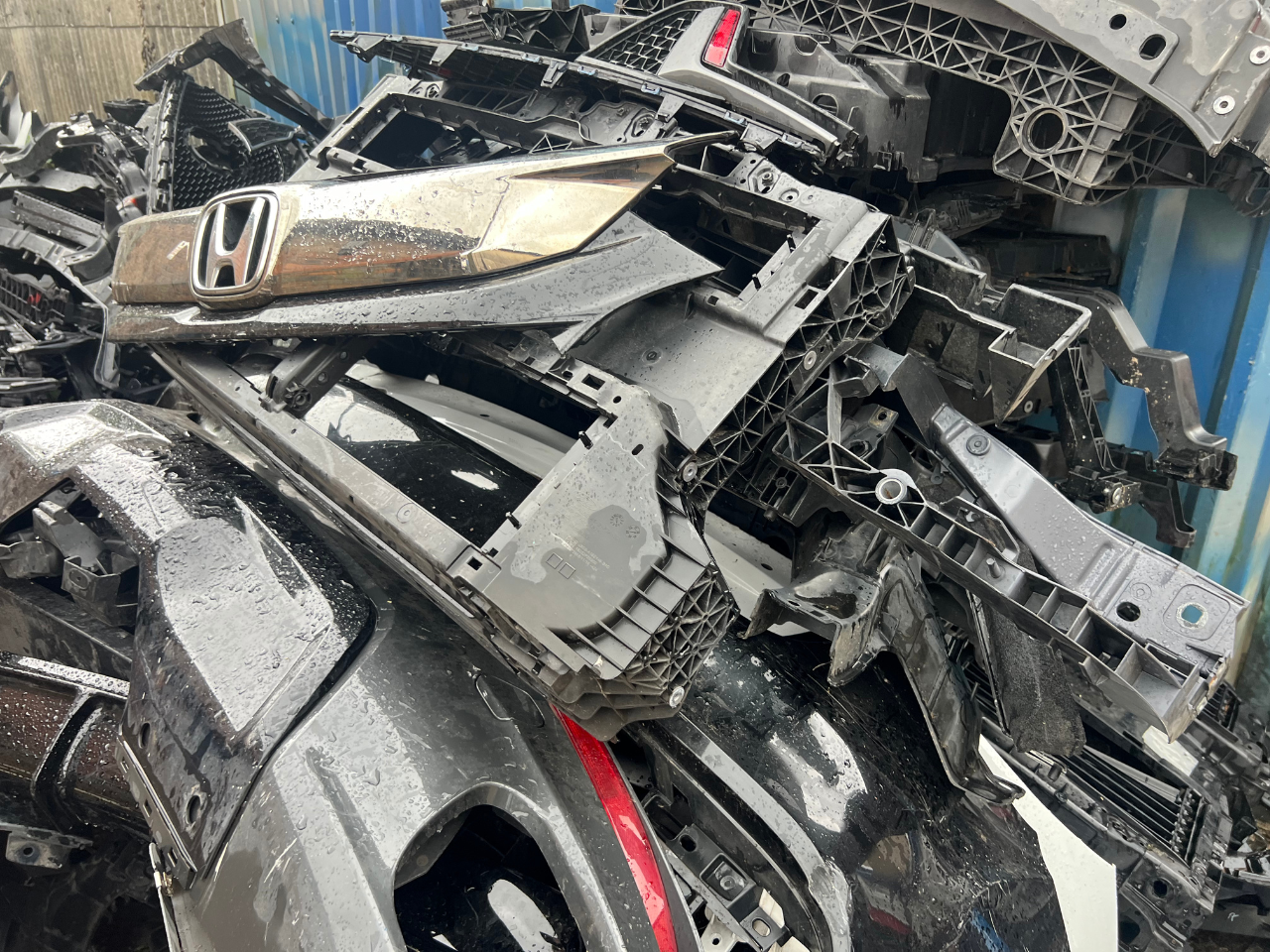
Automotive plastic recycling services in the UK collect, sort, and process plastic waste generated by bodyshops, accident repair centres, and vehicle workshops. Auto Body Collections Ltd provides scheduled, fully compliant collection of car bumpers (PP/TPO), headlight units, interior trim, wheel arch liners, and mixed hard plastics across England and Scotland. Collected materials are transported to approved recycling facilities where they are sorted by polymer type, cleaned, granulated, and compounded into recycled polymer pellets for re-entry into manufacturing supply chains. Every collection includes a fully compliant Waste Transfer Note issued under the UK Duty of Care, as required by Section 34 of the Environmental Protection Act 1990.
Why Automotive Plastic Recycling Matters for Your Business
Walk through any busy bodyshop in England or Scotland and you will almost certainly find the same scene: a growing collection of cracked bumpers stacked along the wall, broken headlight units piled in a corner, and mixed hard plastic trim filling whatever space is left. Most of it goes into the general waste skip. Almost none of it needs to.
Modern vehicles are constructed from an increasing proportion of plastic. According to research published in the Journal of Cleaner Production (2025), plastics now make up a significant portion of total vehicle volume by weight – and the vast majority of those materials are technically recoverable using today’s recycling technology. The challenge has never been whether automotive plastic can be recycled. It has been whether a practical, reliable, and legally compliant collection service exists to make it happen for individual workshops.
That is precisely what automotive plastic recycling from Auto Body Collections is built to do – scheduled, documented, and built around the way real bodyshops actually operate.
What Automotive Plastic Recycling Services Cover
Car Bumpers – Polypropylene (PP) and TPO
Car bumpers are the single largest recyclable plastic stream in any UK bodyshop. Most modern bumpers are manufactured from polypropylene (PP), identifiable by the resin code ▷PP◁ stamped on the inner face, or from thermoplastic polyolefin (TPO) – a blend of PP with elastomeric modifiers designed for flexibility and impact absorption.
Both PP and TPO are fully recoverable. Key points every workshop team should know:
- Paint coatings do not prevent recycling. Both cellulose-based and modern waterborne paint systems are stripped mechanically at the processing facility.
- Bumpers can arrive with fixings, number plates, and brackets still attached – they are removed before granulation.
- Oil and fluid contamination is the main disqualifier. A bumper soaked in workshop oil or coolant cannot be processed to a clean specification.
- The resin stamp on the inner face confirms the polymer type and is the first thing a processor checks on arrival.
Our dedicated car bumper collection service is structured around these material realities, with flexible scheduling to match your workshop throughput.
Headlight Units – Polycarbonate (PC) and PMMA
Headlight recycling is one of the most overlooked opportunities in the UK bodyshop sector. The outer lens on most modern headlights is polycarbonate (PC) – a premium engineering plastic with high optical clarity and mechanical strength. Older-style lenses use PMMA (polymethyl methacrylate), commonly called acrylic.
Both are recyclable. The headlight housing body is typically ABS or a PC/ABS blend.
- UV coating on lenses does not prevent recycling – it is removed during processing.
- Headlights should be stored separately from bumpers to maintain resin stream purity.
- Damaged, cracked, and incomplete units are accepted – they do not need to be in working order.
Automotive Hard Plastics – ABS, PP, HDPE
The term automotive hard plastics covers a wide range of vehicle components beyond the bumper. Our automotive hard plastic collection service accepts:
- Dashboard consoles and instrument panel surrounds – typically ABS (acrylonitrile butadiene styrene).
- Door cards and pillar trim panels – usually PP or ABS depending on construction.
- Wheel arch liners and underbody cladding – almost universally pure PP, often among the cleanest recyclable streams.
- Grilles and front fascia trim – PP or ABS, accepted with paint still applied.
- Interior trim panels and glovebox bodies – PP or ABS, depending on vehicle type.
- Air ducts, washer bottles, and under-trays – typically PP or HDPE.
- Side skirts and crash protection cladding – PP, accepted in most conditions.
These materials represent a significant volume of plastic waste in any workshop handling accident repairs or vehicle dismantling – and the majority are currently being disposed of in general waste skips unnecessarily.
Alloy Wheels
Our alloy wheel collection service provides a separate, dedicated stream for damaged, surplus, and end-of-life alloy wheels from bodyshops, accident repair centres, and dismantlers across England and Scotland. Alloy wheels require their own collection arrangement distinct from plastic recycling – contact our team to discuss how both services can be coordinated for your site.
How Our Automotive Plastic Recycling Service Works – Step by Step
Getting started with a scheduled automotive plastic recycling collection is straightforward. Here is exactly what the process looks like from first contact to ongoing collection.
Step 1 – Request a Collection Assessment
Contact our team with your location and a basic description of the plastic types your workshop generates. You do not need precise weights or volumes – an approximate description of what you produce and how often is enough to establish the right collection arrangement.
We cover all major towns and cities across England and Scotland, with flexible scheduling to accommodate workshops of all sizes.
Step 2 – On-Site Storage Equipment Provided
Once your collection arrangement is confirmed, we provide purpose-built bins and stillages at no additional charge. Our waste bins and stillage service includes:
- Stillage cages for car bumpers and larger plastic components.
- Smaller bins for headlights, trims, and mixed hard plastic pieces.
- Flexible sizing – from single bins for lower-volume sites to full multi-container setups for high-throughput workshops.
Proper on-site storage keeps your workshop clear, prevents material contamination, and ensures collections are fast and efficient when your driver arrives.
Step 3 – Scheduled Collection at Your Convenience
Choose the collection frequency that works for your operation:
- Weekly – for high-volume bodyshops and multi-bay workshops.
- Fortnightly – for medium-throughput repair centres.
- Monthly – for lower-volume or smaller independent workshops.
- One-off collections – for workshops starting out or clearing a backlog.
Our drivers arrive on schedule, swap your full cage or bin for an empty one, and complete all necessary paperwork before leaving your premises. There is no disruption to your workshop workflow.
Step 4 – Waste Transfer Notes Issued at Every Collection
Every collection includes a fully compliant Duty of Care Waste Transfer Note, issued under the requirements of Section 34 of the Environmental Protection Act 1990 and the Environmental Protection (Duty of Care) Regulations 1991.
Your WTN records:
- The type and description of waste transferred, including the EWC code.
- The quantity collected.
- The date, time, and location of transfer.
- Full details of both the waste producer (your business) and the collector.
- Our registered waste carrier registration number.
You retain a copy. We retain a copy. Both parties keep their records for the legally required minimum of two years.
Step 5 – Responsible Processing at Approved Facilities
Collected automotive plastics are transported to approved recycling facilities where they undergo:
- Pre-sorting – manual removal of metal fixings, number plates, and non-plastic components.
- NIR spectroscopy sorting – near-infrared technology identifies each polymer type at speed and separates material into clean, single-resin streams.
- Cleaning – paint stripping, washing, and contamination removal.
- Granulation – material is reduced to uniform plastic flake or chips.
- Compounding – clean flake is extruded and pelletised into recycled polymer to specification.
- Quality testing – finished pellets are assessed against mechanical benchmarks before sale to manufacturers.
The recycled output – primarily PP, ABS, and HDPE pellets – re-enters manufacturing supply chains for automotive components, packaging, construction products, and consumer goods.
UK Legal Requirements: What Every Workshop Must Know
The Duty of Care – Environmental Protection Act 1990
Every business in the UK that generates, handles, or transfers commercial waste – including automotive plastic – operates under the Duty of Care established by Section 34 of the Environmental Protection Act 1990.
This requires your business to:
- Store waste safely so it does not escape your control or cause harm to people or the environment.
- Transfer waste only to an authorised, registered waste carrier – a business holding a valid Environment Agency waste carrier registration.
- Obtain and retain a Waste Transfer Note for every waste transfer.
- Produce your WTNs within seven days of a formal request from the Environment Agency or local authority.
Failure to comply is a criminal offence. Courts have no upper limit on fines for Duty of Care breaches. Local authorities can also issue fixed penalty notices without the need for a court process.
Using an unregistered collector does not protect you. If an unregistered carrier illegally disposes of your plastic waste – fly-tipping, for example – you remain the original waste producer of record and can face enforcement action accordingly.
Why Choosing a Registered Collector Matters
All Auto Body Collections Ltd operations are conducted as a registered UK waste carrier, and Waste Transfer Notes are issued at every collection as standard. If you are ever unsure whether a waste collector is registered, verify their registration on the Environment Agency’s public waste carrier register at environment.data.gov.uk before allowing them to collect from your premises.
UK Simpler Recycling Reform (From March 2025)
Under DEFRA’s Simpler Recycling Reform, businesses with 10 or more employees have been required since 31 March 2025 to arrange separate collection of all core waste streams, including plastic. Workshops operating a scheduled automotive plastic recycling collection already satisfy this requirement for their plastic stream. Businesses that are not yet collecting plastic separately are now operating outside the regulatory requirement.
End-of-Life Vehicle Regulations and Plastic Recovery Targets
The End-of-Life Vehicles Regulations 2003 (transposing EU Directive 2000/53/EC into UK law) set binding recovery targets for vehicle producers – currently 95% recovery and 85% recycling by average weight of each end-of-life vehicle. These targets create regulatory pressure across the entire automotive recycling supply chain, including the dismantlers, ATFs, and bodyshops feeding into it.
According to Plastics Europe (2024), the industry currently captures only around 19% of the plastic in each end-of-life vehicle – a gap that specialist plastic recycling services are specifically designed to close.
Who We Serve Across UK
Our automotive plastic recycling service is built for:
- Independent bodyshops – generating regular volumes of bumpers, headlights, and hard plastic trim from day-to-day repair work.
- Accident repair centres and multi-bay workshops – requiring reliable, high-frequency scheduled collections and full compliance documentation.
- Franchised dealer bodyshops – increasingly required by manufacturer and insurance network sustainability standards to demonstrate documented plastic recycling.
- Vehicle dismantlers and salvage operators – generating the full range of plastic types across all vehicle categories.
- Authorised Treatment Facilities (ATFs) – regulated under the ELV Regulations and required to demonstrate plastic recovery across all streams.
- Insurance repair networks – seeking approved repairers with verifiable environmental compliance for their panel requirements.
- Fleet operators and fleet management companies – generating plastic waste across multiple sites and required to report on Scope 3 environmental performance.
If your business removes, replaces, or generates automotive plastic as part of normal operations, we have a collection arrangement that fits. Get in touch with our team to discuss your site.
Why Workshops Across England and Scotland Choose Auto Body Collections
Our automotive waste collection services are built around what bodyshops and workshops actually need – not a generic recycling collection adapted for automotive use.
What sets us apart:
 Nationwide coverage across England and Scotland – with consistent service quality at every location.
- Multiple plastic streams in a single collection – bumpers, headlights, hard plastics, and alloy wheels handled together where appropriate.
- On-site storage equipment provided – stillage cages and specialist bins supplied as part of your collection arrangement.
- Fully compliant Waste Transfer Notes at every collection – your Duty of Care documentation is handled as standard.
- Flexible scheduling – weekly, fortnightly, monthly, or one-off collections to match your volume.
- 24/7 customer service – available around your workshop hours, not ours.
- Professional UK-based drivers – experienced with bodyshop environments and respectful of your operational schedule.
- No credit card required – straightforward service, no upfront commitment barriers.
For businesses wanting to understand how we compare against other service elements, our why choose us page outlines the full picture. For background on who we are and how the service has been built, visit our about us page.
The Business Case: Why Automotive Plastic Recycling Benefits Your Workshop
Reducing Your Waste Disposal Costs
Every bumper and plastic panel diverted from your general waste skip reduces its fill rate – extending the time between expensive skip lifts. For a bodyshop generating a consistent volume of bumpers per month, the reduction in general waste volume is immediate and meaningful.
The UK standard landfill tax rate currently stands at £103.70 per tonne (England and Northern Ireland, 2024), rising annually in line with the Retail Price Index. Every tonne of recyclable plastic processed through your general waste skip carries this cost embedded in your skip hire invoice. A dedicated plastic recycling collection removes that contribution entirely.
Protecting Your Business from Compliance Risk
The consequences of improper automotive plastic waste disposal extend beyond the immediate cost:
- Unlimited fine on conviction for Duty of Care breaches under the Environmental Protection Act 1990.
- Environment Agency enforcement notices – publicly searchable records that can be reviewed by insurance networks and dealer groups assessing your approved supplier status.
- Risk of liability if waste you transferred to an unregistered carrier is subsequently fly-tipped and traced back to your business.
A documented, compliant recycling programme with a registered carrier is the most straightforward way to eliminate these risks entirely.
Strengthening Your Position with Insurance Networks and Fleet Clients
The commercial value of a documented automotive plastic recycling programme extends beyond compliance:
- Insurance network approved repairer tenders increasingly include specific environmental compliance requirements – and ask for documented evidence rather than general sustainability statements.
- Fleet operator contracts are beginning to include Scope 3 emissions requirements for their workshop suppliers. A bodyshop with documented plastic recycling records contributes verifiable environmental data to fleet clients in a way that skip-disposing competitors cannot.
- OEM dealer group sustainability programmes are extending into franchised bodyshop networks, with plastic waste management becoming a measured performance metric.
A programme built on Waste Transfer Notes, collection records, and a named registered carrier is the kind of specific, auditable evidence these requirements need.
Supporting UK Sustainability Targets
The UK’s commitment to a circular economy – reinforced by the Plastic Packaging Tax (charged at £223.69 per tonne from April 2025 on packaging containing less than 30% recycled content) and the ELV recovery framework – depends on consistent, high-quality automotive plastic feedstock entering the recycling supply chain. Every bodyshop contributing its plastic waste to a compliant recycling collection is contributing directly to that system. The recycled PP and ABS produced from your workshop’s bumpers and trim re-enters UK manufacturing supply chains as genuine recycled content – keeping material in use and reducing the demand for virgin polymer production.
Automotive Plastics That Can – and Cannot – Be Recycled
Recyclable Through Our Service
Material | Common Application | Polymer Type | Resin Code |
Car bumpers | Front and rear bumpers | PP / TPO | ▷5◁ |
Headlight lenses | Outer lens, housing | PC / ABS | ▷7◁ |
Wheel arch liners | Underbody, arches | PP | ▷5◁ |
Dashboard panels | Instrument surround | ABS | ▷7◁ |
Door cards and pillar trim | Interior panels | PP / ABS | ▷5◁ / ▷7◁ |
Grilles and front fascia | Exterior trim | PP | ▷5◁ |
Side skirts and cladding | Lower body trim | PP | ▷5◁ |
Under-trays and splash guards | Underbody protection | PP / HDPE | ▷5◁ / ▷2◁ |
Interior trim panels | Glovebox, centre console | ABS | ▷7◁ |
Washer bottles and fluid reservoirs | Under-bonnet | HDPE | ▷2◁ |
Not Currently Recyclable Through Standard Collections
The following automotive materials cannot be collected through standard automotive plastic recycling services:
- Windscreens – laminated glass with a PVB interlayer; require specialist glass recycling.
- Rubber-plastic composite seals – door seals and weatherstripping bonded to plastic carriers; economically unviable to separate mechanically.
- GRP (glass-reinforced plastic) body panels – permanently integrated glass fibre matrix; incompatible with mechanical recycling.
- Heavily oil-saturated components – fall below the contamination threshold most processors can accept.
- Multi-layer cross-linked fuel system components – molecular structure designed for impermeability prevents mechanical recycling.
If you are unsure whether a specific material from your workshop qualifies for collection, contact our team with a description and we will advise directly.
Automotive Plastic Recycling Across England and Scotland
Auto Body Collections Ltd provides automotive plastic recycling services across mainland England and Scotland, covering all major metropolitan areas, county towns, and rural locations. Our collection routes are structured to provide:
- Consistent collection frequency regardless of your distance from major urban centres.
- Single-contact service management – one team handles your collection schedule, documentation, and any changes to your arrangement.
- Scalable collections – your collection frequency grows with your business volume.
Whether you operate a single bodyshop in a market town or manage multiple accident repair sites across two countries, we provide the same standard of compliant, reliable service. To check coverage for your specific location, get in touch with our team.
Related Services
If your workshop generates other automotive waste streams alongside plastic, the following services are available through Auto Body Collections:
- Car Bumper Recycling – dedicated collection and processing for car bumpers, the primary plastic stream in most bodyshops.
- Car Bumper Collection – structured bumper pickup service with flexible scheduling for workshops of all sizes.
- Automotive Hard Plastic Collection – collection of dashboards, trim, wheel arch liners, grilles, and mixed hard plastic components.
- Alloy Wheel Collection – a separate, dedicated collection stream for damaged and surplus alloy wheels.
- Waste Bins and Stillage Providing – on-site storage equipment supplied to keep your workshop clear and your waste organised ahead of collection.