
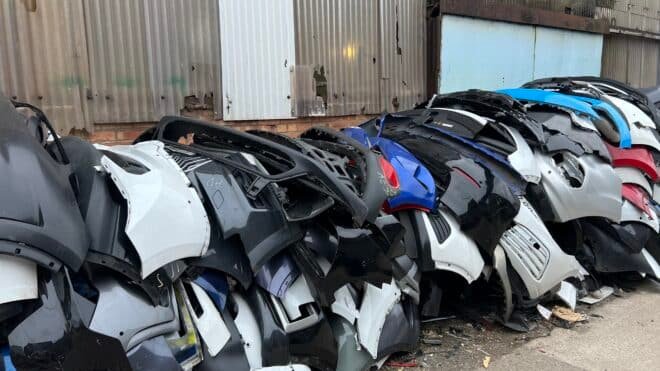
Car bumper recycling is the process of collecting used, damaged, or replaced plastic bumpers from vehicle repair workshops and processing them into reusable polymer materials – primarily Polypropylene (PP) and Acrylonitrile Butadiene Styrene (ABS) – which re-enter UK manufacturing as recycled-grade raw material. Under the Environmental Protection Act 1990 and the End-of-Life Vehicles Regulations 2003, every UK bodyshop has a legal duty of care to ensure automotive plastic waste is handled by a registered waste carrier and properly documented at every point of transfer.
Every week, UK bodyshops remove thousands of bumpers. Front-end collisions, low-speed parking impacts, panel replacements – the plastic fascias on modern cars take a constant beating. Once a damaged bumper comes off the vehicle, most workshops face the same unavoidable question: what happens to it now?
For a significant number of bodyshops across England and Scotland, the honest answer is that the bumper ends up in a general skip. It gets hauled away, mixed in with other commercial waste, and eventually makes its way to landfill. Nobody asks too many questions. The skip gets emptied, the workshop floor gets cleared, and the same cycle repeats week after week.
The problem is that this approach is increasingly expensive, legally risky, and entirely avoidable. The UK vehicle recycling market was valued at USD 2.0 billion in 2024 and is projected to reach USD 3.1 billion by 2033, driven by tightening environmental legislation, rising landfill disposal costs, and growing commercial demand for recycled automotive polymers (IMARC Group, 2024). The infrastructure to handle bumper waste properly already exists across the UK. Accessing it costs nothing and takes a single conversation.
What Is Car Bumper Recycling? A Clear Definition for UK Bodyshops
Car bumper recycling is the systematic collection, processing, and material recovery of plastic bumpers removed from vehicles at bodyshops, repair centres, dealerships, and accident repair workshops across the UK. Rather than sending these materials to landfill as general commercial waste, car bumper recycling routes them to specialist facilities where the polymer is recovered, granulated, and sold back into manufacturing as recycled-grade plastic.
The term covers a broader process than just collection. It includes all of the following stages:
- Collection – bumpers are picked up directly from the bodyshop or vehicle repair site.
- Transportation – materials are moved by a registered waste carrier with full legal documentation at every step.
- Processing – bumpers arrive at a specialist automotive plastic recycling facility for sorting and preparation.
- Polymer recovery – the plastic is cleaned, granulated, and converted into reusable raw material.
- Re-entry into manufacturing – recovered polymer is used to produce new automotive parts and plastic products.
For UK bodyshops specifically, car bumper recycling delivers three distinct benefits:
- Legal compliance – it satisfies your Duty of Care obligation under the Environmental Protection Act 1990.
- Cost reduction – it eliminates avoidable landfill tax, reduces skip hire frequency, and frees up workshop floor space.
- Sustainability credentials – it demonstrates responsible operations to customers, insurers, fleet clients, and network bodies.
What Are Car Bumpers Made Of – and Why Does the Material Type Matter?
Modern car bumpers are not made from a single material. They are typically constructed from one of four plastic polymer types, each with its own recycling pathway – which is precisely why they cannot go into a general mixed-plastics skip alongside other commercial waste.
A standard mixed-waste skip cannot segregate automotive polymers. When bumpers end up in mixed waste streams, the valuable polymer material is lost entirely, becomes contaminated, and ends up in landfill. You have paid to send recyclable material to waste.
The Four Plastic Types Found in UK Car Bumpers
Polypropylene (PP) – the most common
Polypropylene is the dominant material in modern car bumpers. It is a semi-rigid thermoplastic with strong impact resistance, which is why vehicle manufacturers use it extensively across front and rear fascias.
Key facts about PP bumpers:
- Most widely used polymer in the UK automotive repair industry.
- One of the most recyclable automotive plastics available.
- Recovered PP is granulated and sold back as rPP pellets for new automotive components, packaging, and industrial products.
- Identified by the >PP< resin code stamped on the bumper’s inner face.
Thermoplastic Olefin (TPO)
TPO is a blend of Polypropylene and rubber-like elastomers used specifically where a bumper must flex without cracking.
Key facts about TPO bumpers:
- Typically found on lower valances, bumper extensions, and flexible trim sections.
- Requires specialist handling to separate it from the PP stream during processing.
- Mixing TPO with pure PP batches reduces the quality and value of recovered material.
- Identified by the >TPO< or >PP+EPDM< resin code on the inner face.
Acrylonitrile Butadiene Styrene (ABS)
ABS is most commonly found on older vehicles and some premium OEM applications.
Key facts about ABS bumpers:
- Harder and more rigid than PP – requires its own dedicated recycling stream.
- Mixing ABS with PP batches contaminates both materials and reduces recovery value.
- Commonly found on pre-2005 vehicles and certain premium European marques.
- Identified by the >ABS< resin code on the inner face.
Polycarbonate Blends (PC/ABS)
PC/ABS blends are increasingly found in newer vehicles and electric cars.
Key facts about PC/ABS bumpers:
- Combine the toughness of polycarbonate with the processability of ABS.
- Typically command higher value on the recycled polymer market than standard PP grades.
- Increasingly common on post-2015 vehicles, EVs, and hybrid models.
- Identified by the >PC+ABS< resin code on the inner face.
How to Identify the Polymer Type on Any Bumper
Every car bumper carries a moulded-in resin identification code on its inner face, standardised under ISO 11469. You will see markings such as >PP<, >ABS<, or >PC+ABS< stamped directly into the plastic surface.
Three things bodyshop teams should understand about these codes:
- Specialist processing facilities use these codes to sort incoming materials automatically – your team does not need to sort bumpers before collection.
- Keeping different plastic types in separate containers on site helps maximise material recovery and reduces contamination at the processing facility.
- Any bumper without a visible code should be treated as PP by default, as this is by far the most common material in use.
The practical conclusion: Automotive plastics require an automotive-specific recycling route. General waste contractors are not equipped to handle them correctly. Sending bumpers to a mixed waste stream means recyclable value is permanently and irreversibly lost.
How Does Car Bumper Recycling Work in the UK? – The Full Process, Step by Step
Car bumper recycling in the UK works through six clear stages. Understanding this end-to-end process shows exactly where your legal obligations sit and why the choice of car bumper collection partner determines whether you are compliant or exposed.
On-Site Storage at Your Workshop
Replaced bumpers are stored in a dedicated stillage or purpose-built container supplied directly by the collection service. No capital outlay is required from the bodyshop.
Benefits this step delivers for your workshop:
- ✔ A defined, tidy location for bumpers – no accumulating pile in the corner of the yard.
- ✔ Efficient loading when the collection vehicle arrives – no staff time wasted moving loose bumpers.
- ✔ A contained footprint that keeps workshop floor space available for vehicles and productive work.
- ✔ No capital purchase – the storage equipment is supplied as part of the service.
Workshops across England and Scotland use purpose-built bins and stillages designed specifically for automotive plastic waste – making on-site storage safe, organised, and ready for collection without any additional effort from workshop staff.
Scheduled Collection by a Registered Waste Carrier
A registered waste carrier visits the workshop on an agreed schedule – weekly, fortnightly, or monthly, depending on throughput.
What happens at every collection visit:
- The specialist vehicle – typically a flat-bed or curtain-sider suited to bulky automotive plastics – arrives at the agreed time.
- Bumpers are loaded directly from the stillage – no bagging, labelling, or preparation required.
- The entire process is quick, clean, and causes no disruption to the working day.
- Workshop staff are not required to be involved beyond ensuring the stillage is accessible.
The car bumper collection service covers bodyshops across England and Scotland – from large city-centre accident repair centres to smaller independent workshops. Drivers depart early to meet scheduled collection windows, ensuring the service fits around your operations rather than the other way around.
Waste Transfer Note Issued at the Point of Collection
This is the most important step from a compliance perspective – and the one most commonly overlooked by UK bodyshops.
A Waste Transfer Note (WTN) is a legally required document recording the transfer of controlled waste from your premises to the registered carrier. It must be completed at the point of every collection, without exception.
A correctly completed WTN must include all of the following:
- A description of the waste type and its European Waste Catalogue (EWC) code – automotive plastic bumpers fall under EWC code 16 01 19.
- The quantity or estimated weight of material transferred.
- The full name and address of the waste producer – your bodyshop.
- The full name, address, and Environment Agency registration number of the waste carrier.
- The date of the transfer.
- Signatures from both parties at the point of transfer.
A professional car bumper recycling service issues fully compliant WTNs with every single collection, automatically – your compliance evidence trail builds itself with each pickup, without any extra admin from your team.
Material Sorting at the Processing Facility
Once bumpers arrive at the specialist processing facility, the work of separating and recovering value begins.
The sorting and preparation process at the facility involves:
- Identifying polymer type using ISO 11469 resin codes stamped on each bumper.
- Removing all non-plastic components – number plate frames, metal brackets, bolts, foam backing, adhesive strips, and rubber seals.
- Segregating materials by polymer type to prevent cross-contamination between recycling streams.
- Preparing clean, uniform batches of single polymer type, ready for granulation.
The scale of specialist capacity operating across the UK is significant. Some automotive plastic processors handle over 3,000 bumpers per day from bodyshops nationwide (Auto Plas Bumper Recycling, facility data).
Polymer Recovery and Granulation
Cleaned and sorted bumpers are fed into industrial shredders and granulated into uniform flake – typically around 10mm pieces. These granules are then compounded and processed into recycled-grade polymer pellets.
Outputs from the granulation process:
| Polymer Type | Recycled Grade Label | Primary End Use |
| Polypropylene | rPP | New automotive parts, packaging |
| Thermoplastic Olefin | rTPO | Flexible automotive trim |
| Acrylonitrile Butadiene Styrene | rABS | Interior components, consumer goods |
| Polycarbonate blend | rPC/ABS | Premium automotive and electronics |
Re-Entry into the Manufacturing Supply Chain
Recovered polymer pellets re-enter the manufacturing supply chain and are used to produce:
- New automotive bumpers, trims, and plastic components for vehicle manufacturers.
- Consumer and industrial packaging for retail and logistics.
- Construction materials and plastic sheet products for the building industry.
- A wide range of manufactured plastic goods across multiple industrial sectors.
This is the circular economy completing its loop. Material that would have gone permanently to landfill becomes raw material again. The bodyshop that handed over those bumpers holds a documented, auditable evidence trail confirming its role – which matters increasingly for compliance inspections, network audits, and sustainability reporting.
UK Regulations Every Bodyshop Must Know for Car Bumper Recycling Compliance
UK bodyshops are legally required to manage bumper waste under three principal frameworks. Together, these create a clear, enforceable legal obligation – not a recommendation – to handle automotive plastic waste through properly documented, registered channels.
“We have always done it this way” is not a legal defence.
The Environmental Protection Act 1990, Section 34: Duty of Care
This is the foundational legislation governing waste management for every UK business. Under Section 34, all businesses producing, handling, or transferring controlled waste must satisfy the following four requirements:
- Store waste securely on-site – preventing escape, spillage, or unauthorised access.
- Transfer waste only to a registered waste carrier – verified via the Environment Agency public register.
- Accompany every transfer with a correctly completed Waste Transfer Note – no exceptions.
- Describe the waste accurately on that note, including its EWC code.
Automotive plastic bumpers fall under EWC code 16 01 19 – plastics from end-of-life vehicles – and are classified as controlled waste under UK law.
Penalties for non-compliance – what you are actually risking:
| Breach Type | Penalty |
| Minor documentation failure | Fixed Penalty Notice – from £300 |
| Serious violation or illegal disposal | Unlimited fine via Magistrates Court |
| Using an unregistered waste carrier | Duty of Care void – full legal liability remains with bodyshop |
| Published enforcement notice | Reputational damage beyond any financial penalty |
Critical point: Using an unregistered carrier – even accidentally – removes your Duty of Care protection entirely. The legal responsibility for that waste remains with your workshop regardless of what the carrier does with it afterwards.
Waste Transfer Notes – Your Two-Year Compliance Evidence Trail
Every car bumper collection must be documented with a Waste Transfer Note. UK law requires bodyshops to meet all three of the following obligations:
- Retain WTNs for a minimum of two years from the date of each transfer.
- Produce them on demand if the Environment Agency or a local authority requests them.
- Keep them accessible – a physical folder or digital archive both satisfy the requirement.
Failure to produce WTNs for recent waste collections is a Duty of Care breach in its own right – independent of whether the waste itself was disposed of correctly.
The End-of-Life Vehicles Regulations 2003 (UK-Retained Post-Brexit)
The End-of-Life Vehicles (ELV) Regulations 2003, retained in UK law after Brexit, set the following statutory material recovery targets for the automotive industry:
- 95% of a vehicle by weight must be reusable or recoverable at end of life.
- A minimum 85% must go to genuine material recycling – not energy recovery or landfill disposal.
What this means for bodyshops in practical terms:
- These targets apply across the entire vehicle supply chain, including parts removed during repair.
- They are a primary driver of commercial demand for recovered PP and ABS from bodyshop collections.
- The UK government’s ongoing consultation is expected to increase minimum recycled content requirements for new vehicle parts – making automotive polymer from bodyshop collections progressively more valuable.
The Environment Act 2021
The Environment Act 2021 introduced legally binding environmental targets and expanded enforcement powers that directly affect UK businesses.
Key provisions relevant to bodyshops:
- A statutory commitment to halve residual waste going to landfill by 2042.
- Expanded Environment Agency powers to pursue waste crime, including increased inspection activity.
- Strengthened reporting requirements for businesses operating at scale.
- A broader framework for resource efficiency creating sector-level pressure on documented waste practices.
The regulatory direction is clear and consistent:
- Compliance requirements are increasing, not relaxing.
- Enforcement activity is growing, not declining.
- The commercial cost of non-compliance is rising every year.
At a glance – the three regulations and what they require:
| Legislation | Core Requirement | Penalty for Breach |
| Environmental Protection Act 1990 | Registered carrier, WTN for every transfer, 2-year retention | Up to unlimited fine |
| ELV Regulations 2003 | 95% vehicle recovery, 85% material recycling target | Supply chain-wide obligation |
| Environment Act 2021 | Halve landfill waste by 2042, expanded EA enforcement powers | Escalating compliance scrutiny |
| Controlled Waste Regulations 1991 | WTNs retained for 2 years, produced on demand | Breach of Duty of Care if undocumented |
The Real Cost of NOT Recycling Car Bumpers – A UK Bodyshop Financial Breakdown
A UK bodyshop disposing of bumpers through general skips faces four direct, measurable cost categories that compliant car bumper recycling eliminates entirely. And the key comparison is not between paying for recycling and paying for disposal – a professional car bumper collection service is free for regular workshop volumes. The real choice is between free recycling and ongoing, rising, avoidable disposal costs.
UK Landfill Tax: £126.15 Per Tonne (Rising to £130.75 from April 2026)
The UK standard rate of landfill tax from 1 April 2025 is £126.15 per tonne, rising to £130.75 per tonne from 1 April 2026 (GOV.UK, Autumn Budget 2025; Office for Budget Responsibility, 2025). This is charged on top of the landfill gate fee – not instead of it.
What this means in numbers for a typical UK bodyshop:
| Workshop Volume | Weekly Bumper Weight | Annual Bumper Waste | Landfill Tax Exposure |
| 8 bumpers/week | ~32–56 kg | ~1.7–2.9 tonnes | ~£214–£366/year |
| 15 bumpers/week | ~45–105 kg | ~2.3–5.5 tonnes | ~£290–£694/year |
| 20 bumpers/week | ~60–140 kg | ~3.1–7.3 tonnes | ~£391–£921/year |
This figure rises from April 2026 and increases annually in line with RPI – it will not go down.
Unnecessary Skip Hire Frequency
Bumpers are large, irregular shapes that do not compact. A single front bumper occupies approximately 0.05 to 0.10 cubic metres of skip space, and a standard 6-yard skip holds approximately 4.5 cubic metres.
The direct financial consequences for a busy bodyshop:
- A workshop replacing 20 bumpers per week can consume a significant proportion of a 6-yard skip’s capacity with bumpers alone – before any other workshop waste is added.
- A 6-yard general waste skip in the UK typically costs between £150 and £350 per hire, depending on location and contractor.
- Skips containing bumpers are emptied more frequently than necessary, because bulky plastic takes up disproportionate volume.
- Remove bumpers from the general skip – place them in a dedicated stillage for free collection – and the same skip lasts considerably longer.
The saving is immediate and requires zero capital investment.
Lost Workshop Floor and Yard Space
This is the cost that accumulates quietly rather than appearing on a single invoice – but experienced workshop managers recognise it immediately.
How unmanaged bumper waste affects your workshop:
- Bumpers pile up against walls, across yard space, and into areas intended for vehicle movement or parts storage.
- For a bodyshop paying commercial rent of £10 to £25 per square foot annually, even 20 square feet of permanently occupied space represents £200 to £500 per year in dead, unproductive floor space.
- In urban workshops where floor space carries a commercial premium, this figure is considerably higher.
- A single dedicated stillage from a professional car bumper recycling service takes up the footprint of one standard pallet – and the space around it remains fully usable.
Compliance Penalty and Commercial Risk
Direct financial penalties from non-compliance:
- Fixed Penalty Notices for minor Duty of Care breaches start at £300 to £400.
- Prosecution for serious violations can result in unlimited fines plus legal defence costs.
- Environment Agency enforcement notices are published publicly, creating reputational damage that extends beyond any financial proceedings.
Indirect commercial penalties – often more costly than any fine:
- Approved repairer applications increasingly require documented evidence of compliant waste management.
- A compliance breach can jeopardise or disqualify a bodyshop from approved repairer network membership – a commercial loss that far exceeds any fixed penalty notice.
- Fleet operators and leasing companies are now including waste management criteria in repairer audits.
- Corporate clients sourcing repair services under ESG procurement policies expect demonstrably responsible operations.
The comparison in plain terms:
| Disposal Method | Annual Cost | Compliance Status | WTN Documentation |
| General skip – bumpers in mixed waste | Landfill tax + inflated skip hire + dead floor space + penalty risk | Risk of Duty of Care breach | Not automatically provided |
| Free car bumper recycling collection | Free for regular volumes | Fully compliant | Issued automatically with every collection |
There is no scenario in which the general skip approach is the financially sensible option.
Beyond Bumpers – What Other Automotive Plastics Should UK Bodyshops Recycle?
Car bumper recycling is the most visible element of automotive plastic waste management – but it is far from the only recyclable plastic a bodyshop generates. Workshops that have started recycling bumpers often overlook a range of other materials that carry exactly the same legal obligation and exactly the same recyclable value.
Six Automotive Plastic Categories That Require Specialist Collection
Wheel Arch Liners (PP/PE)
- Made from Polypropylene or Polyethylene – both fully recyclable.
- Their awkward shape means they tend to pile up in corners rather than going anywhere useful.
- Can be stored alongside bumpers in the same stillage for collection in the same stream.
- High turnover in workshops carrying out suspension repairs, tyre changes, and body panel replacements.
Headlight and Tail Light Units (Polycarbonate lens + ABS housing)
- Two distinct recyclable materials in one unit: a Polycarbonate lens and an ABS housing.
- These are higher-value recycled materials than standard PP bumpers.
- Units should be kept whole – specialist processors separate the lens from the housing in-facility.
- Cracked, moisture-damaged, and fully replaced headlight assemblies are all suitable for collection.
Dashboard Trims and Interior Panels (Mixed Polymers)
- Often involve mixed polymer construction: PP foam combined with ABS fascia, vinyl covering, and bonded fabric.
- These require specialist sorting and cannot be mixed with bumper waste.
- A dedicated automotive hard plastic collection service handles interior plastics through the correct, accredited processing channels.
Grilles and Front Splitters (PP or ABS)
- Regularly replaced after frontal impacts – often removed as part of the same repair job as the bumper.
- If PP-coded on the inner face, they can be stored alongside bumpers in the same stillage.
- ABS grilles should be kept separate from PP bumpers where possible to maintain stream quality.
Wing Mirror Housings (ABS)
- Typically ABS construction – requires segregation from PP bumpers for maximum material value recovery.
- A small, clearly labelled container keeps the ABS stream clean without creating any operational burden.
- Accumulates steadily in a busy repair workshop carrying out cosmetic and collision repairs.
Door Sill Covers and Kick Strips (PP or ABS)
- Replaced during door panel repairs, lower body work, and cosmetic refurbishments.
- Usually Polypropylene – can be stored with bumper waste if PP-coded on the inner face.
- High enough frequency in a busy bodyshop to make deliberate, managed collection worthwhile.
The Simplest Operational Approach for Managing All of It
Consolidating all automotive plastic waste with a single, managed collection partner means:
- One relationship to manage – not multiple contractors and multiple points of contact.
- One set of Waste Transfer Notes – not separate documentation for each individual waste stream.
- One collection schedule – coordinating all materials rather than separate arrangements.
- One compliance record – simplifying ESG reporting, audit preparation, and network assessments.
A full automotive plastic recycling service covering bumpers, hard plastics, headlights, and trim means the majority of a bodyshop’s plastic waste is managed through a single, compliant, documented service relationship.
How Car Bumper Recycling Supports the UK’s Net Zero and Circular Economy Goals
Car bumper recycling directly supports the UK’s legally binding net zero 2050 target by reducing demand for virgin plastic production – which generates approximately 1.9 tonnes of CO₂ per tonne of Polypropylene manufactured – and by keeping high-value polymer material in active circulation rather than sending it permanently to landfill.
This is not abstract environmental positioning. It is a supply chain reality that is beginning to have direct, measurable commercial consequences for UK bodyshops.
The Carbon Reduction Case – By the Numbers
Manufacturing virgin Polypropylene from crude oil is an energy-intensive, high-carbon process. Recycled polymer production consistently generates significantly less CO₂ per tonne.
Key figures to understand:
- Virgin PP production: approximately 1.9 tonnes of CO₂ per tonne produced.
- Recycled PP production: generates between 30% and 70% less carbon than virgin equivalent production, depending on the specific processing route (WRAP UK, polymer lifecycle analysis).
- When recovered rPP from bodyshop collections displaces virgin PP in manufacturing, the carbon saving is real, attributable, and documentable – which matters for ESG reporting and carbon accounting.
In 2024, MBA Polymers UK launched a dedicated car bumper recycling initiative to intercept bumpers before they reach end-of-life vehicle shredders, enabling the production of high-performance recycled polymer grades for use back in new vehicle exterior parts – demonstrating the direction of travel for the entire automotive plastics supply chain (Waste Advantage Magazine, 2024).
The Circular Economy Loop – Applied to a UK Bodyshop
The circular economy model describes a system where materials remain in use as long as possible and re-enter production at the end of each use cycle.
Applied to a UK bodyshop, the full loop for a car bumper works as follows:
- Polymer – increasingly using recycled content – is manufactured into a new bumper.
- The bumper is fitted to a vehicle at the point of manufacture.
- The vehicle is involved in a collision. The bodyshop removes the damaged bumper.
- The bumper is placed in the dedicated on-site stillage.
- A registered waste carrier collects it as part of the scheduled service.
- The bumper is processed at a specialist facility and granulated into rPP pellets.
- Those pellets become raw material for the next generation of automotive components.
The bodyshop is the critical link between step 3 and step 4. Without workshop participation, the loop breaks and the material goes permanently to landfill.
Who Is Now Scrutinising Bodyshop Waste Management Practices
The commercial pressure to demonstrate sustainable operations is no longer arriving only through legislation. It is coming through the supply chain itself.
The organisations now reviewing bodyshop environmental practices include:
- Fleet operators and leasing companies managing corporate vehicle portfolios under sustainability reporting obligations – they need their repair supply chain to be documentably responsible.
- Motor insurers with approved repairer networks beginning to incorporate environmental criteria into repairer approval assessments and tender evaluations.
- Bodyshop network membership bodies embedding sustainability requirements into group-level reporting and accreditation frameworks.
- Corporate and public sector clients sourcing repair services under ESG procurement policies.
For independent bodyshops seeking to win or maintain approved repairer status, having a verifiable, documented car bumper recycling programme – evidenced by retained Waste Transfer Notes and a named registered carrier – is becoming a commercial differentiator, not just a compliance checkbox.
ESG Reporting for Multi-Site Bodyshop Groups
Bodyshop groups and accident repair networks operating multiple sites are increasingly subject to Environmental, Social and Governance (ESG) reporting.
Why car bumper recycling is one of the most practical ESG metrics a bodyshop can report:
- Waste diversion from landfill is measurable and documentable with no additional effort beyond standard collection.
- Waste Transfer Notes provide an automatic, date-stamped evidence trail that feeds directly into sustainability reports.
- Tonnage diverted from landfill translates directly into standard ESG environmental metrics used by investors, lenders, and network bodies.
- Unlike many sustainability commitments – which require significant investment or infrastructure change – switching to compliant car bumper recycling generates ESG data immediately, at zero cost.
What to Look for in a Car Bumper Recycling and Collection Partner
When choosing a car bumper recycling and collection partner, UK bodyshops should verify six key criteria before committing. Choosing the wrong company does not just risk poor service – it can void your legal Duty of Care protection entirely and leave your workshop legally exposed for waste you believed was properly handled.
The Six-Point Car Bumper Recycling Partner Checklist
Environment Agency Registered Waste Carrier Status
Every waste carrier operating in England must hold a current Waste Carrier Licence issued by the Environment Agency under the Controlled Waste (Registration of Carriers and Seizure of Vehicles) Regulations 1991. You can verify registration on the EA’s public register at gov.uk.
Why this is non-negotiable:
- Using an unregistered carrier – even accidentally – removes your Duty of Care protection entirely.
- Any waste subsequently disposed of illegally remains your legal responsibility.
- A legitimate, professional company provides its EA registration details without hesitation. If a company is reluctant to do so, that is a clear warning sign.
Waste Transfer Notes Issued Automatically at Every Collection
A professional car bumper collection partner issues a correctly completed Waste Transfer Note with every single collection – automatically, at the point of collection. Not on request, not by email later in the week, not occasionally. Every time, without exception.
- If you are currently chasing WTNs from your waste carrier, that is a compliance gap – not a minor inconvenience.
- A professional service makes documentation effortless – the WTN arrives with the collection driver.
Flexible, Scheduled Collection Frequency
Your collection schedule should fit your workshop – not your contractor’s logistics preferences.
Warning signs to look out for in a collection service:
- Requiring minimum loads before agreeing to collect.
- Charging extra fees for smaller or less frequent collections.
- Providing irregular service that allows bumpers to accumulate beyond storage capacity.
- Inability to flex frequency when your business volume changes seasonally or following new contracts.
Stillages and Storage Equipment Provided at No Cost
On-site storage equipment should be supplied, delivered, and maintained by the collection company – not purchased or rented separately by the bodyshop.
- Purpose-built stillages take up a defined footprint and make the collection process fast and efficient.
- Equipment provided by the service means no capital purchase and no ongoing maintenance cost for the workshop.
- Details on available storage solutions are on the Waste Bins and Stillage Providing service page.
Transparent Material Routing – Where Does It Actually Go?
A reputable car bumper recycling partner can confirm clearly where collected materials are processed and what happens to the polymer after collection.
Questions to ask before committing to any collection service:
- Which specific processing facility receives the bumpers?
- Is that facility accredited for automotive polymer recovery?
- What is the confirmed end destination of the recycled granules?
- Can you confirm that material goes to genuine polymer recovery rather than energy-from-waste incineration or mixed landfill?
A credible answer names a processing facility and describes the granulation and recovery process. A vague answer – “they go to our recycling partners” – is a warning sign that deserves further investigation.
UK-Wide Coverage and Multi-Site Capability
For bodyshop groups operating across multiple locations in England and Scotland, a single collection partner providing consistent, documented service across all sites is essential.
What consistent coverage delivers for a multi-site operation:
- Uniform compliance documentation across all sites under one service relationship.
- Simplified ESG reporting that covers all locations consistently.
- One contact, one schedule, and one set of standards – not a patchwork of regional contractors.
Workshops across England and Scotland that want to verify all six criteria before getting started can read more on the Why Choose Us page.
How to Set Up Car Bumper Recycling at Your Bodyshop – 5 Simple Steps
Setting up car bumper recycling at a UK bodyshop takes five straightforward steps. The majority of the practical work is handled by the collection company – not your workshop team.
Audit Your Current Waste Stream
Before making contact with a collection partner, take five minutes to understand your current situation honestly.
Ask yourself the following questions:
- Where do replaced bumpers currently go – a general skip, a mixed plastics bin, or an unmanaged pile in the yard?
- Are you currently using a registered carrier for any workshop waste, and can you produce Waste Transfer Notes to prove it?
- How many bumpers does your workshop replace in a typical week?
- Are other automotive plastics – wheel arch liners, headlights, grilles – going into the same general skip as bumpers?
The answers to these questions will identify your compliance gaps, quantify your potential cost savings, and inform the collection frequency you will need from day one.
Clear the Existing Backlog with a One-Off Collection
If bumpers have been accumulating on-site – which is the case in most workshops without a dedicated collection service – the priority is to clear the backlog before starting a regular schedule.
What a clearance collection achieves:
- Removes everything that has built up in one clean operation.
- Provides a compliant, documented starting point with properly issued transfer records.
- Ensures previously uncollected waste is disposed of correctly, with WTN documentation you can retain.
- Frees up yard and floor space immediately, giving the workshop a clean and organised baseline.
Workshops across England and Scotland can request a pickup to arrange a one-off clearance collection ahead of setting up a regular scheduled service.
Request Your Stillage and Position It Correctly
Once you have confirmed a collection partner, a dedicated stillage or storage bin is delivered to your site as part of the service. No purchase, no hire fee, and no separate arrangement required.
Practical positioning guidance for maximum efficiency:
- Choose a location with direct vehicle access – ideally from the yard or a loading area with a clear approach.
- Keep the stillage close enough to the workshop that moving bumpers during the working day does not create unnecessary handling distance for staff.
- Avoid positioning it in areas likely to be blocked by vehicles in for repair.
- Ensure the stillage is visible and clearly identified so all workshop staff know where replaced bumpers should go.
Full details on available storage equipment are on the Waste Bins and Stillage Providing service page.
Agree Your Collection Schedule
Collection frequency is agreed based on your workshop’s throughput and available storage capacity.
Typical collection schedules by workshop volume:
| Weekly Bumper Output | Recommended Schedule |
| 1–5 bumpers per week | Monthly collection |
| 6–14 bumpers per week | Fortnightly collection |
| 15–20+ bumpers per week | Weekly collection |
The schedule can flex as your business changes. Seasonal peaks, new fleet contracts, or quieter periods are all accommodated without penalty or minimum volume requirements.
Set Up a Simple WTN Filing System
This is the full extent of the ongoing administrative commitment for the bodyshop – and it takes approximately five minutes to establish.
Three steps to create a compliant filing system:
- Create a folder – physical or digital – labelled “Waste Transfer Notes – [Your Business Name].”
- File every WTN received with each collection as it arrives – do not allow them to accumulate unprocessed.
- Set an annual reminder to review and archive documents older than two years (the legal minimum retention period under UK law).
That is the complete ongoing obligation. The compliance requirement is met, every transfer is documented, and the evidence trail is auditable at any point – without any meaningful administrative burden on workshop staff.
To arrange a collection, discuss your requirements, or get a free quote, contact the Auto Body Collections Ltd team. The service covers England and Scotland, and a clearance collection, stillage delivery, and ongoing schedule can typically be arranged quickly and without disruption to your operations.
Car Bumper Recycling Is Good Business. Here Is Why UK Bodyshops Cannot Afford to Ignore It.
Car bumper recycling is a legal obligation, a financial opportunity, and an increasingly visible sustainability credential for UK bodyshops. These three dimensions are not in tension with each other – they point in exactly the same direction.
The legal case is settled:
- The Environmental Protection Act 1990, the End-of-Life Vehicles Regulations 2003, and the Environment Act 2021 create a documented, enforceable obligation to manage automotive plastic waste through registered, documented channels.
- Non-compliance carries fines, published enforcement notices, and the potential loss of approved repairer network membership.
The financial case is clear:
- The UK standard landfill tax rate is £126.15 per tonne from April 2025, rising to £130.75 per tonne from April 2026.
- Skip hire frequency, floor space costs, and compliance penalties are all directly reducible through compliant car bumper recycling.
- A professional collection service is free for regular workshop volumes.
The commercial case is hardening:
- Fleet operators, insurers, and approved repairer networks are embedding sustainability criteria into assessment frameworks.
- ESG reporting requirements are expanding for bodyshop groups operating at scale.
- Workshops with documented, compliant car bumper recycling programmes are better positioned for network membership, contract wins, and tender applications.
For the overwhelming majority of UK bodyshops, the practical barrier to switching is near-zero. A managed car bumper collection and recycling service requires no changes to workshop workflow, no capital investment, and no new administrative burden beyond filing the documentation that arrives automatically with every collection.
Contact the Auto Body Collections Ltd team to arrange your first car bumper collection across England and Scotland.
Frequently Asked Questions
Can car bumpers be recycled?
Yes – car bumpers are fully recyclable. Most are made from Polypropylene (PP), one of the most widely recycled plastics in the UK. Specialist automotive recyclers collect, granulate, and recover the polymer, which is sold back into manufacturing to produce new automotive parts and plastic products.
What are car bumpers made of?
Most modern car bumpers are made from Polypropylene (PP) or Thermoplastic Olefin (TPO). Older vehicles may use Acrylonitrile Butadiene Styrene (ABS), and some premium or electric vehicles use Polycarbonate blends (PC/ABS). The polymer type is stamped on the inner face of every bumper using the ISO 11469 resin identification code.
How do I dispose of an old car bumper in the UK?
The correct way to dispose of a car bumper in the UK is through a registered waste carrier who issues a Waste Transfer Note (WTN) at every collection. The most cost-effective option for bodyshops is a free, scheduled car bumper collection service that handles both collection and legal documentation automatically, at no charge for regular volumes.
Is car bumper recycling free for UK bodyshops?
Yes – for regular workshop volumes, car bumper recycling collection is typically free. Specialist collection services across England and Scotland collect bumpers at no charge for workshops generating consistent volumes, making it significantly cheaper than landfill disposal, which carries the UK standard landfill tax of £126.15 per tonne from April 2025.
Do I need a Waste Transfer Note for bumper collections?
Yes. Under the Environmental Protection Act 1990 (Section 34), a Waste Transfer Note is legally required for every transfer of controlled waste, including car bumpers. WTNs must be retained for a minimum of two years and produced on demand by the Environment Agency. A professional car bumper recycling service issues WTNs automatically at every collection.
What other car parts can be recycled alongside bumpers?
In addition to bumpers, the following automotive plastics should not enter general waste and can be recycled:
- Wheel arch liners (PP/PE)
- Headlight and tail light units (PC lens + ABS housing)
- Grilles and front splitters (PP or ABS)
- Wing mirror housings (ABS)
- Door sill covers and kick strips (PP or ABS)
A full automotive hard plastic collection service handles all of these through the appropriate recycling streams alongside bumper collections.
Is car bumper recycling a legal requirement in the UK?
Yes. UK bodyshops are legally required to manage all controlled waste – including plastic bumpers – under the Environmental Protection Act 1990 (Duty of Care). Bumpers must be transferred only to a registered waste carrier with a correctly completed Waste Transfer Note. Failure to comply can result in Fixed Penalty Notices starting at £300 or unlimited fines through Magistrates Court prosecution.
Can alloy wheels be collected alongside bumpers?
Yes. Many UK automotive waste collection services also offer alloy wheel collection alongside plastic bumper and hard plastic collections – allowing bodyshops to manage multiple waste streams through a single scheduled service and a single set of compliance documentation.
[…] Car bumpers, wheel arch liners, and automotive hard plastics – controlled waste requiring a licensed carrier and documented transfer. […]
[…] Car bumpers, alloy wheels, or plastic panels mixed into a general commercial skip. (Full non-hazardous compliance detail in Section 7.) […]
[…] recycling right isn’t a nice-to-have – it’s essential to meeting the UK’s environmental targets and the automotive industry’s own sustainability […]
[…] modern car bumpers are made from one of a small number of engineering […]
[…] Bumper output in a bodyshop is tied directly to repair volume, and repair volume moves with insurance work allocation, MOT failure season, weather-related damage spikes, and even how many technicians are rostered on a given week. A bumper collection schedule locked to the calendar rather than to actual output creates one of two problems. […]