
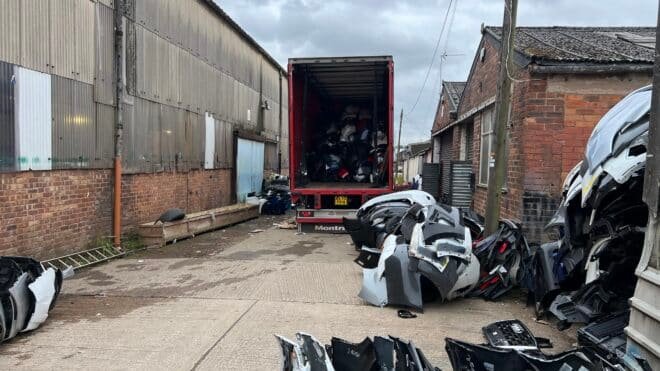
Searching for car bumper collection near me in the UK? The right service depends on your situation. Specialist automotive plastic recyclers collect, process, and legally dispose of end-of-life bumpers from bodyshops and workshops across England and Scotland. Professional collection services arrive within 3–10 working days, issue fully compliant Waste Transfer Notes, and handle everything from front bumpers to wheel arch liners and hard plastic trims. Costs range from free on scheduled trade arrangements to £195–£350+ for one-off national collections. Before booking, the collector must hold a valid Environment Agency waste carrier licence – and under UK law, you are legally responsible for verifying this before any bumper leaves your premises.
That Old Bumper Is a Legal Responsibility – Not Just a Storage Problem
You have just replaced a bumper at your bodyshop or workshop. The repair is done. The old one – cracked, scuffed, painted over, or simply end-of-life – is now stacked in a corner, taking up space you cannot afford to waste.
You are not alone. UK bodyshops, accident repair centres, and vehicle workshops generate hundreds of thousands of old bumpers every single month. The real challenge is not just finding car bumper collection near you – it is finding a service that is properly licensed, fully compliant, and actually reliable enough to show up when scheduled.
Here is what most workshops do not realise until it causes a problem: under the Environmental Protection Act 1990, every business has a legal Duty of Care over waste that leaves its premises. Hand that bumper to an unlicensed collector and your business can be held legally responsible if that waste ends up fly-tipped – even if you paid for the collection and had no knowledge of the dumping.
This guide covers everything your workshop, bodyshop, or repair centre needs to know:
- Why bumper disposal carries legal obligations that cannot be ignored.
- Which type of collection service matches your specific situation.
- How to find and verify a reliable, licensed car bumper collection service near you.
- What it should cost and where unexpected charges come from.
- How to stay fully compliant – from collection through to final recycling.
What Car Bumpers Are Made Of – and Why It Changes How They Must Be Disposed Of
Understanding what bumpers are made of explains immediately why you cannot put them in a general skip or leave them beside a wheelie bin.
The vast majority of modern car bumpers are manufactured from polypropylene (PP) – a category-5 thermoplastic that is technically recyclable but cannot be processed through standard commercial or household waste streams. It requires specialist granulation equipment and a certified processing facility.
Beyond the PP structure, a typical car bumper also contains:
- Layers of spray paint and primer coating applied during manufacture and any previous bodyshop repair.
- Adhesive bonding strips and plastic mounting clips that secure the bumper to the vehicle.
- Metal brackets and integrated fixing hardware built into the bumper’s internal frame.
- Parking distance control (PDC) sensors on the majority of vehicles manufactured in the past 15 years.
- Colour-coat and lacquer layers that must be separated before polypropylene can be granulated cleanly.
Each of these materials must be physically separated before the polypropylene itself can be processed. That separation requirement is precisely why general skips, kerbside bins, and most council waste sites are not equipped to accept automotive bumpers – they simply do not have the machinery or processing contracts in place to handle them.
The scale of this waste stream is significant:
- The automotive sector uses approximately 6 million tonnes of plastic per year in the EU alone, according to the European Commission’s Joint Research Centre.
- A single car contains around 240 kg of plastic – roughly 14–18% of its total mass.
- The current recycling rate for plastics from end-of-life vehicles sits at only 19% across Europe.
- The vast majority of automotive plastic still ends up incinerated or sent to landfill unnecessarily.
When bumper polypropylene is recycled correctly, it can be granulated and remoulded into new automotive components, construction materials, and industrial packaging – closing the loop without requiring any virgin plastic production. The environmental benefit is real, but only when the material reaches the right licensed facility.
Your Legal Duty of Care: What UK Waste Law Actually Requires
This is the section most guides gloss over. It should not be.
Under Section 34 of the Environmental Protection Act 1990, anyone who produces, carries, or disposes of controlled waste in the UK has a legal Duty of Care to ensure that waste is managed properly. This applies to every UK business without exception.
What This Means in Practice
You must only use a licensed waste carrier.
Any business or individual collecting your bumpers must be registered with:
- Environment Agency – for collections in England.
- Natural Resources Wales (NRW) – for collections in Wales.
- Scottish Environment Protection Agency (SEPA) – for collections in Scotland.
- Northern Ireland Environment Agency (NIEA) – for collections in Northern Ireland.
Using an unregistered collector – regardless of how professional they appear – creates direct legal liability for your business.
You must receive a Waste Transfer Note at the point of collection.
This legally required document records the formal transfer of waste from your premises to the collector. A valid Waste Transfer Note must include:
- Your full business name, address, and contact details.
- The collector’s registered business name, address, and Environment Agency licence number.
- A clear description of the waste – for example: “polypropylene car bumpers, damaged, spray-painted, 12 items.”
- The quantity or estimated weight of the waste.
- The date and exact location of the transfer.
- Signatures from both the waste producer and the collector.
UK law requires both parties to retain this document for a minimum of two years from the date of collection.
Ignorance is not a legal defence.
If the collector you used fly-tips the waste, your business can face prosecution even if you paid in good faith and had no knowledge of the illegal dumping. The Duty of Care remains with you until you can demonstrate compliant transfer through documented evidence.
The Penalties for Getting This Wrong
These are not theoretical outcomes – they are actively enforced:
| Offence Level | Penalty |
| Council fixed penalty notice (duty of care failure) | £150–£400 |
| Householder – waste traced to your address | £600 fine |
| Magistrates’ Court conviction | Up to £50,000 |
| Crown Court conviction | Unlimited fine |
| Custodial sentence | Up to 5 years |
| Vehicle used in fly-tipping | Seized and crushed |
In the year April 2024 to March 2026, local authorities in England recorded 1.26 million fly-tipping incidents – a 9% rise on the previous year. Automotive waste, including bumpers, is a recognised and growing component of this problem.
How to Verify a Waste Carrier Licence in 60 Seconds
Before booking any car bumper collection near you, follow these four steps:
- Go to gov.uk and navigate to the Environment Agency’s Public Register of Waste Carriers, Brokers, and Dealers.
- Enter the company name or their stated registration number.
- Confirm their registration status shows as active and current.
- Check the registration type: CB (lower-tier) or CBDU (upper-tier – required for automotive plastic waste collection).
This is the single most important verification step before any bumper leaves your premises.
The 4 Types of Car Bumper Collection Services Near You in the UK
Not every service offers the same outcome. Choosing the wrong type for your situation wastes time, money, and creates compliance gaps. Here are the four categories in the UK, and exactly when each one is the right choice.
Specialist Automotive Plastic Recyclers
Best for most bodyshops, workshops, and accident repair centres
Best for: Damaged, painted, or end-of-life bumpers that need compliant, permanent disposal.
Specialist recyclers are the correct choice for the vast majority of UK workshops and bodyshops. They hold active Environment Agency waste carrier registrations, collect directly from your site, issue Waste Transfer Notes as standard procedure, and process the polypropylene either at their own facility or through a verified partner site.
What a professional car bumper collection service near you typically includes:
- Collection of front and rear bumpers from all vehicle makes and models.
- Simultaneous collection of wheel arch liners, side skirts, and hard plastic trims in one visit.
- Scheduled service options – weekly, fortnightly, or monthly to suit your volume.
- One-off collections available for workshops without regular volumes.
- Purpose-built storage cages and stillages supplied to your site before collection.
- Fully compliant Waste Transfer Notes issued at the point of collection – never sent afterwards.
- Nationwide coverage across England and Scotland.
Pro tip: Always ask whether the recycler processes material at their own facility or subcontracts to a third party. On-site processing creates a traceable compliance chain and means your Waste Transfer Note accurately reflects where your bumpers end up.
Automotive Couriers
Best for sending bumpers for repair or delivery to online buyers
Best for: Bumpers being sent to a specialist repairer, sold on eBay or Facebook Marketplace, or transferred between bodyshop locations.
An automotive courier moves your bumper from one location to another. They are not a recycling service, they do not provide waste disposal documentation, and they cannot fulfil your Duty of Care obligations. If your goal is compliant end-of-life disposal, a courier is the wrong choice entirely.
When an automotive courier is the right choice:
- You have sold a bumper online and need it delivered to a buyer 100+ miles away.
- You are sending a repairable bumper to a specialist repair facility your workshop does not use locally.
- You need to transfer stock between multiple workshop sites.
Auto Dismantlers and Breaker Networks
Best for bumpers in good condition with genuine resale value
Best for: Undamaged bumpers in good condition from high-demand vehicle models where the part retains monetary value.
Dismantlers and breaker yards buy, catalogue, and resell usable second-hand parts. A front bumper in good condition from a popular model – a Ford Focus, VW Golf, or Vauxhall Astra in a common colour – may earn you money rather than cost you anything.
When calling a dismantler, have this information ready:
- Vehicle make, model, and exact year of manufacture.
- Bumper position – front or rear.
- Paint colour code – found on the sticker inside the driver’s door jamb.
- Honest condition description – any cracks, scratches, missing sensor holes, or paint fade.
Key UK licensed dismantler networks include Green Parts Specialists, Synetiq, and ASM Auto Recycling.
Local Council Household Waste Recycling Centres (HWRCs)
Free but inconsistent – not suitable for trade use
Best for: Private individuals with a single bumper, no urgency, and no budget.
Council HWRCs are the only genuinely free option for private individuals. However, acceptance of polypropylene car bumpers varies enormously between local authorities. There is no national standard.
Before making the journey:
- Use the Recycle Now postcode checker at recyclenow.com as a starting point.
- Call your specific HWRC directly to ask: “Do you accept polypropylene car bumpers?”
- Confirm whether a timed entry slot or pre-booking is required.
Important: Council HWRCs are entirely unsuitable for bodyshops, workshops, or any trade use. Businesses generating regular bumper waste require a licensed trade collection service with documented Waste Transfer Notes for every visit.
How to Find a Reliable Car Bumper Collection Service Near Me: Step by Step
Follow these six steps in order. Skipping any one of them is where problems typically arise.
Define Your Goal Before You Search
Use this decision guide before opening a search engine. Spend 60 seconds here – it saves considerable time later.
| Your Situation | The Right Action |
| Workshop or bodyshop with regular bumper volumes | Book a scheduled specialist car bumper collection service. |
| One-off disposal from a single visit or job | Request a one-off quote from a licensed specialist recycler. |
| Bumper sold online or going for repair | Book an automotive courier for transport. |
| Undamaged bumper from a popular model | Call a licensed dismantler first – you may be paid for it. |
| Private individual, single bumper, no budget | Call your local HWRC to confirm acceptance before travelling. |
| Mixed automotive plastic waste including arch liners and trims | Choose a service that covers automotive hard plastic collection alongside bumpers in the same visit. |
Use the Right Search Terms
Broad searches like “car bumper collection near me” return mixed results that include skip companies and general waste contractors. Sharper terms find better options faster.
More targeted search strings to use:
- “car bumper collection UK bodyshop”
- “automotive plastic recycling collection near me”
- “licensed waste carrier car bumpers [your city or county]”
- “scheduled bumper collection service England Scotland”
- “PP bumper disposal service near me”
When reviewing listings, specifically look for:
- A verified UK business address confirmed across multiple platforms.
- Reviews that mention Waste Transfer Notes or duty of care documentation by name.
- Clear reference to Environment Agency registration or licensed waste carrier status in the service description.
- Review volume that has accumulated gradually over time – not a sudden cluster of new entries.
Verify the Waste Carrier Licence Before Committing to Anything
Never skip this. A legitimate licensed waste carrier will provide their registration number without hesitation.
How to verify in four steps:
- Ask the company directly for their Environment Agency waste carrier registration number.
- Go to gov.uk and search the Public Register of Waste Carriers, Brokers, and Dealers.
- Confirm the registration status shows as active and current.
- Confirm the type is CBDU (upper-tier) – which specifically covers automotive plastic waste.
Immediate red flags that signal an unreliable operator:
- Hesitation or refusal when asked directly for a registration number.
- No verifiable UK business address or Companies House registration.
- Refusal or inability to provide a Waste Transfer Note at the point of collection.
- Cash-only payment with no written booking confirmation available.
- Pricing significantly below market rate with no explanation offered.
- Free collection” offered with no clear explanation of how the business model works.
Compare Quotes on the Right Factors
Price matters, but it is far from the only factor. When requesting quotes, assess each of the following before making a decision:
- Collection lead time – How many working days from booking to actual pickup?
- Waste Transfer Note – Is this issued automatically, or must you specifically request it?
- Storage equipment provided – Will they supply cages or stillages to your site before collection?
- Scheduling flexibility – Weekly, fortnightly, monthly, or on-demand options available?
- Material acceptance – Do they also collect hard plastics, wheel arch liners, and alloy wheels in the same visit?
- Coverage area – Do they reliably serve your specific postcode area?
- Multi-site capability – Can they service multiple workshop locations under one account?
Prepare Your Bumpers Before Collection Day
A small amount of preparation on collection day prevents surcharges and makes the process efficient.
Before the driver arrives:
- Stack bumpers in the provided cage, stillage, or as agreed at the time of booking.
- Remove all number plates – most services will not accept bumpers with plates attached.
- Detach any accessories not already transferred to the replacement bumper assembly.
- Note any significant contamination – heavy oil residue or chemical exposure – so the driver is informed on arrival.
- Photograph the stacked collection for your own records before handover.
- Ensure the collection point is accessible for the driver and vehicle on the scheduled day.
Request, Review, and File Your Waste Transfer Note
The Waste Transfer Note must be completed and signed at the point of collection – never promised as an email to follow later. Do not allow any collection to proceed without it.
A complete, legally valid Waste Transfer Note must contain all of the following:
- Your full business name, address, and contact details as the waste producer.
- The collector’s business name, registered address, and Environment Agency licence number.
- A clear description of the waste – type, condition, and number of items.
- The estimated quantity or weight of the waste being transferred.
- The exact date and location of the transfer.
- Signatures from both the waste producer and the collector.
File every Waste Transfer Note immediately and retain for a minimum of two years. This is a legal requirement – not optional guidance. It is your primary evidence of compliant disposal if waste is ever traced back to your premises.
What Does Car Bumper Collection Near Me Actually Cost in the UK?
Pricing in this sector is often deliberately opaque. Here is what the UK market genuinely looks like, broken down clearly.
UK Car Bumper Collection Cost Breakdown
| Service Type | Typical Cost Range | Key Notes |
| Specialist recycler – one-off collection | £195–£350+ | Waste Transfer Note included. England and Scotland coverage. |
| Specialist recycler – scheduled trade service | Free or heavily subsidised | Regular volume arrangements. Ask at enquiry stage. |
| Automotive courier (transport only) | £25–£80 | Distance and size dependent. Not a disposal service. |
| Licensed dismantler | Free or they may pay you | Depends entirely on bumper condition and model demand. |
| Council HWRC | Free | Private individuals only. Call ahead to confirm acceptance. |
What Drives the Price Higher
Understanding these cost drivers helps you negotiate a fair rate:
- Distance from the collector’s depot. Locations at the edge of a service zone attract higher quotes to account for extended routing.
- Bumper size and weight. A large SUV or van bumper costs more to collect and process than a compact hatchback bumper.
- Level of contamination. Heavy paint, oil residue, bonded adhesives, and attached metalwork complicate processing and attract surcharges from most recyclers.
- Volume. Single-item collections are always priced higher per unit than scheduled bulk collections. The more you batch, the lower the per-item cost.
- Urgency. Same-day or next-day collection consistently costs more than a standard lead-time booking.
Three Practical Ways to Reduce Your Collection Costs
- Move to a scheduled collection service. Workshops generating bumpers regularly almost always pay less per unit on a weekly or fortnightly arrangement than repeated one-off bookings. Ask any provider about their scheduled trade rates at the point of first enquiry.
- Combine materials in a single collection visit. If your workshop also generates automotive hard plastic waste – wheel arch liners, grilles, door trims, and dashboards – adding these to the same collection visit reduces the per-item cost for all materials. Many providers cover the full range of automotive plastics in one scheduled round.
- Use supplied storage equipment to maximise each collection. Some services provide waste bins and stillages to hold material between collections. This keeps your workshop floor clear, ensures a full load is ready for each visit, and means you are not paying premium rates for half-empty collections.
Car Bumper Recycling vs. Car Bumper Collection: What Is the Difference?
These two terms are used interchangeably across the internet, but they describe different parts of the same process. Understanding the distinction helps you ask the right questions when evaluating services.
Car bumper collection is the physical pickup of bumpers from your premises by a licensed waste carrier. It covers scheduling, loading, transport, and the issuance of your Waste Transfer Note.
Car bumper recycling describes what happens to the material after collection. The polypropylene is:
- Sorted by material type to separate PP from other components.
- Cleaned to remove paint residue, dirt, and contamination.
- Granulated into small, uniform 10mm pieces suitable for remanufacturing.
- Sold into automotive and industrial manufacturing as raw material for new products.
A fully compliant service covers both stages – not just the collection. When evaluating any provider, always ask:
- Where exactly is the material processed after collection?
- Is the recycling facility certified and licensed in the UK?
- Can they confirm the material does not go to landfill?
Polypropylene recycled through licensed processors achieves carbon savings of 75–86% compared to virgin plastic production, as independently verified by the Carbon Trust. That outcome is real – but only when the bumper reaches the right facility through the right service.
What to Look for in a Car Bumper Collection Service Near You
With multiple service types and providers across the UK, having a clear evaluation checklist prevents booking mistakes.
The Non-Negotiables – Every Reliable Service Must Offer These
- Active Environment Agency waste carrier registration (CBDU upper-tier) – verifiable on the gov.uk public register.
- Waste Transfer Note issued at the point of collection – not emailed afterwards.
- Written booking confirmation with a confirmed collection date and reference number.
- Verifiable UK business address and a traceable Companies House registration.
- Clear, itemised pricing with no surcharges introduced on the day of collection.
The Value-Adds That Separate Good Services from Great Ones
- Storage cages or stillages supplied to your site ahead of collection, so waste is stored safely and efficiently between visits.
- Flexible scheduling options – weekly, fortnightly, monthly, or fully on-demand to match your workshop throughput.
- Broad material acceptance – bumpers, automotive hard plastics, wheel arch liners, and alloy wheels collected in a single visit.
- Multi-site account management – essential for businesses operating across more than one workshop location.
- Prompt communication – a service that confirms bookings quickly, notifies you of driver arrival times, and follows up on documentation without chasing.
Questions to Ask Before Confirming Any Car Bumper Collection Booking
Keep this checklist open when calling or emailing providers. A genuinely reliable service will answer every question directly and without deflection.
- Are you a registered waste carrier? – What is your Environment Agency CBDU registration number?
- Will you provide a Waste Transfer Note at the point of collection? – Not emailed over the following day.
- Where is the material processed after collection? – Your own facility, or a named third-party partner?
- What is included in the quoted price? – Are there surcharges for paint, contamination, metal fixings, or single-item volumes?
- What scheduling options are available? – Can a weekly or monthly service be arranged for our volume?
- Do you provide storage cages or stillages? – Are these included in the service, or charged separately?
- How many working days from booking to first collection?
- Do you cover our specific location? – Confirm the postcode area is within your regular collection route.
Why Your Workshop’s Car Bumper Collection Arrangement Matters Beyond Compliance
Meeting the legal minimum – a licensed collector and a Waste Transfer Note – is necessary. But it is not sufficient to run an efficient bodyshop operation.
Workshops that manage bumper waste well consistently report three concrete operational benefits:
More Usable Floor Space
Bumpers are bulky. A single rear bumper from a large SUV occupies meaningful floor space that could be used for active repair work. Workshops running scheduled collections on a fixed cycle always have adequate storage capacity because waste never builds up unmanaged between visits. If you need a structured storage solution in place before your first collection, explore the waste bins and stillage service to keep materials contained and ready for pickup.
Faster Compliance Audits
Insurance repair networks, manufacturer-approved schemes, and fleet operators increasingly audit their approved repair partners on waste documentation. A complete, organised file of Waste Transfer Notes – ready to produce on request at any time – demonstrates environmental responsibility without scrambling for paperwork. A scheduled collection service with automatic documentation makes this effortless.
Protection Against Rogue Collector Approaches
Workshops without an established collection arrangement are significantly more vulnerable to opportunistic approaches from unlicensed operators offering “free removal.” These are a recognised route through which automotive waste ends up fly-tipped – with the original workshop held liable. A workshop that already has a scheduled car bumper collection arrangement in place has no reason to accept an informal offer, and the documentation to prove it.
You can explore the full range of automotive waste management services – including bumper collection, hard plastic recycling, alloy wheel collection, and storage equipment – at autobc.co.uk.
Frequently Asked Questions
How do I dispose of a car bumper in the UK?
Use a specialist automotive plastic recycler that holds an active Environment Agency waste carrier licence (CBDU upper-tier). They collect directly from your premises, process the polypropylene at a certified facility, and issue a Waste Transfer Note confirming compliant disposal. Private individuals can also check whether their local council HWRC accepts car bumpers – but acceptance varies significantly by authority, so always call ahead first.
Can you put a car bumper in a skip?
No. Standard skip hire companies do not accept car bumpers because polypropylene automotive plastic cannot be processed through general commercial waste streams. It requires specialist granulation equipment and a licensed processing facility. Placing bumpers in a general skip also creates a direct Duty of Care liability under the Environmental Protection Act 1990.
Who collects old car bumpers near me in the UK?
Licensed automotive plastic recyclers collect old car bumpers from bodyshops, workshops, salvage yards, and dealerships across England and Scotland. Some services offer free scheduled collections for trade customers generating regular volumes. For one-off collections, specialist national services are available from approximately £195. Always verify the collector holds an active CBDU waste carrier registration before booking.
Is it illegal to fly-tip a car bumper in the UK?
Yes – it is a criminal offence under Section 33 of the Environmental Protection Act 1990. Car bumpers are classified as controlled waste. Penalties range from a £150–£400 fixed penalty notice up to £50,000 in a Magistrates’ Court, unlimited fines in the Crown Court, and up to five years’ imprisonment for serious offences. Any vehicle used in the act of fly-tipping can be seized and crushed by enforcement authorities.
Do I need a Waste Transfer Note for car bumper collection?
Yes – it is a legal requirement with no exceptions. A Waste Transfer Note must be completed and signed at the point of collection, and both parties must retain it for a minimum of two years. It records the waste producer’s details, the collector’s licence number, the waste description, quantity, and the date of transfer. Any collection service that does not provide one automatically should not be used.
How much does car bumper collection cost in the UK?
Costs vary by service type, volume, and location. One-off specialist recycler collections typically start from £195–£350+. Scheduled trade collections for bodyshops generating regular volumes are often free or heavily subsidised. Private individuals can use their local council HWRC for free where accepted. Always compare on Waste Transfer Note provision, lead time, and material scope – not price alone.
Can bodyshops get free car bumper collection?
Yes – many specialist recyclers offer free or subsidised collections for bodyshops and workshops generating regular bumper volumes. This is structured as a scheduled weekly, fortnightly, or monthly service. Always confirm that a fully compliant Waste Transfer Note is provided at every visit, and that the collector holds an active CBDU Environment Agency registration before agreeing to any arrangement.
What happens to car bumpers after they are collected?
After collection, bumpers are transported to a licensed processing facility where they are sorted, cleaned, and granulated into 10mm polypropylene pieces. These are sold as raw material into automotive and industrial manufacturing – used in new bumpers, wheel arch liners, and construction components. Recycled PP achieves carbon savings of 75–86% compared to virgin plastic production, as independently verified by the Carbon Trust.
The Right Decision Depends on Knowing Your Situation
Finding a reliable car bumper collection service near you in the UK comes down to two things: matching your situation to the right type of service, and verifying that the service is properly licensed before anything moves.
Quick Decision Summary
| Your Situation | The Right Move |
| Bodyshop or workshop with regular bumper volumes | Arrange a scheduled car bumper collection with a licensed UK recycler. |
| One-off bumper disposal from a single job | Request a single-visit quote from a licensed specialist recycler. |
| Bumper being sent for repair or sold online | Use an automotive courier for transport. |
| Undamaged bumper with potential resale value | Contact a licensed dismantler network first – you may be paid. |
| Private individual, single bumper, zero budget | Call your local HWRC to confirm acceptance before making the journey. |
| Mixed automotive plastic waste alongside bumpers | Choose a service that covers automotive hard plastic collection in the same visit. |
Whatever route you take, one action protects your business legally above everything else: verify the collector’s Environment Agency waste carrier licence at gov.uk before the bumper leaves your premises. It takes 60 seconds. It is completely free. And it is the difference between a clean compliance record and an unexpected prosecution notice arriving at your workshop door.
If you run a bodyshop, accident repair centre, or automotive workshop and need a scheduled or one-off car bumper collection with full Waste Transfer Note documentation across England and Scotland, you can request a free pickup quote here.
[…] car bumper may look like a single piece of black plastic, but it typically consists […]
[…] WTN creates a legal chain of custody. If your waste carrier fly-tips the car bumpers, alloy wheels, or plastic materials you handed over, the WTN is the document that stands between […]
[…] a consistent, scheduled collection service for your recyclable […]
[…] that is noticeably cheaper than every other quote. Legitimate segregation, transport, and processing all cost money. A price that undercuts the […]
[…] to be a registered waste carrier itself. Most operations avoid this by using an already-registered collection service and simply verifying that registration before handing waste […]
[…] recycling stream instead of a skip. Anyone curious about coverage in their own area can check the bumper collection locations across the UK to see what is available […]
[…] contact a collection service when your storage area is full, or when a large job has produced an unusual volume of scrap […]
[…] car bumper is nothing like a milk bottle. It’s […]
[…] Collecting bumpers, hard plastics, and alloys from workshops across England and Scotland gives you a fairly unfiltered view of how compliance actually plays out – not how it’s described in a policy document, but how it looks at 4pm on a busy Thursday when three cars are booked in and nobody has time to think about waste segregation. […]
[…] bumper sat waiting for collection is occupying floor space that could be used for vehicles, tools, or staff movement. In a […]