
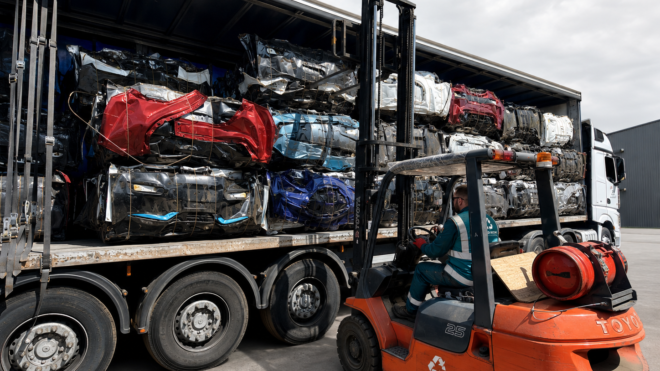
A typical UK bodyshop produces between 200 kg and 600 kg of waste every single week. That figure spans four legally distinct streams – plastic, general, metallic, and hazardous – each governed by different UK waste regulations, different disposal routes, and a very different cost per kilogram to handle correctly.
How much waste does a bodyshop produce in real terms? It depends almost entirely on workshop size and weekly repair volume:
- Small independent bodyshop (1–3 bays, 10–20 jobs per week) – typically 200 to 280 kg of waste weekly.
- Mid-sized regional bodyshop (4–8 bays, 30–50 jobs per week) – typically 350 to 480 kg of waste weekly.
- High-volume approved repairer (8+ bays, 60–100+ jobs per week) – regularly exceeds 500 kg per week, often crossing 600 kg.
At the current UK standard landfill tax rate of £126.15 per tonne (2025/26) – rising to £130.75 per tonne from 1 April 2026 – a mid-sized bodyshop sending all its waste to landfill carries a five-figure annual disposal bill before a single skip invoice is added. And that rate is legislated to keep rising every year.
Most bodyshop owners know waste is a cost. What far fewer have calculated is exactly how much, which streams are driving the most spend and compliance risk, and what a handful of operational changes would realistically save them.
Why Does a Bodyshop Produce So Much Waste?
Most commercial businesses have a straightforward waste footprint. A solicitor’s office fills a recycling bin. A plumbing contractor generates old fittings and packaging. Even a busy mechanical garage – dealing with oil changes, brake jobs, and exhaust work – produces a contained mix of used fluids, filters, and parts boxes.
A bodyshop producing waste is a different proposition entirely – and it comes down to the fundamental nature of the trade.
A bodyshop is not fundamentally a repair business. It is a replacement-and-refinish business. When a car arrives with collision damage, the bumper does not get repaired and refitted. It comes off and gets discarded. The same applies to panels, headlamp assemblies, trim sections, door cards, and mirror casings. Every job creates physical waste by design, across multiple streams simultaneously, with every single repair that passes through the workshop.
Three structural factors combine to create the bodyshop waste problem:
- The replacement model. Unlike mechanical repair – which restores existing components – body repair removes and discards entire damaged parts. Every repair job generates physical waste as a direct output of the work, regardless of how efficiently the job is run.
- The refinishing operation. Every paint job produces contaminated masking materials, solvent residues, VOC-saturated booth filters, aerosol cans, and solvent-soaked wipes. The hazardous waste profile of a bodyshop is categorically different from any other workshop type of equivalent size.
- The parts packaging volume. A workshop completing 40 repair jobs per week may receive 50 to 80 separate parts deliveries that same week. Each arrives in cardboard boxes, foam inserts, bubble wrap, and protective film – all of which needs somewhere to go before the next delivery lands.
This is why bodyshop waste regulations is a structural challenge, not an incidental one. The waste exists because every repair produces it – by design, consistently, across multiple regulated streams at once. That is precisely what makes a single general-purpose skip almost always the wrong tool for the job.
The One Metric Most Bodyshop Owners Never Calculate
Waste per job is the figure that converts a vague cost problem into something measurable and manageable. Here is what the numbers look like across different repair types:
- A minor cosmetic repair (scuffed bumper, repainted and refitted) – roughly 8 to 12 kg of waste across all streams.
- A standard accident repair (bumper and two panels) – typically 15 to 22 kg of waste.
- A full frontal impact repair (bumper, bonnet, wings, headlamps, grille) – 25 to 35 kg or more.
- A bodyshop completing 40 jobs per week at average complexity – generating over 700 kg of material weekly, much of which goes into a single general skip at full landfill tax rates without a segregation system.
That waste-cost-per-job figure is the clearest lens through which to judge whether your current approach is working or leaking money. The audit section of this guide explains exactly how to calculate yours.
How Much Waste Does a Bodyshop Produce Per Week – By Size?
How much waste a bodyshop produces varies significantly by repair volume and bay count. The three-tier model below gives every bodyshop owner a realistic benchmark to measure against – because a one-bay independent and a twelve-bay multi-brand approved repairer are operating in genuinely different waste categories, even though both face identical legal obligations under UK environmental law.
Tier 1 – The Independent or Sole-Trader Bodyshop
Operational profile:
- 1 to 3 bays.
- 10 to 20 repair jobs per week.
- Typically owner-operated with one or two additional staff.
- Mostly cosmetic repairs with local insurance referrals.
- Little or no dedicated waste storage infrastructure beyond a single skip position.
Weekly waste output: 200–280 kg
| Stream | Weekly Volume | Key Sources |
| Plastic | 30–50 kg | Trim offcuts, headlamp housings, wheel arch sections, occasional bumper replacements. |
| General | 100–130 kg | Parts packaging, masking materials, paper, workshop sweepings. Heaviest single stream by weight. |
| Metallic | 50–70 kg | Panel offcuts, fixings, brackets. Accumulates steadily even at low job volumes. |
| Hazardous | 20–30 kg | Paint residues, solvent rags, booth filters, aerosols, brake fluid, coolant. |
The primary pressure at Tier 1:
- The skip fills faster than expected and costs £200 to £350 per collection.
- Plastic waste – bulky and space-consuming – is the stream most likely to force an unnecessary extra lift.
- At 10 to 20 jobs per week, that cost hits hard against weekly job margin.
- Hazardous waste may be collected monthly, creating short-term storage compliance obligations.
Waste cost per job benchmark:
- Well-managed site with stream-specific contracts: £6 to £10 per repair.
- Site relying on one general skip for all streams: £14 to £20 per repair.
Tier 2 – The Mid-Sized Regional Bodyshop
Operational profile:
- 4 to 8 bays.
- 30 to 50 repair jobs per week.
- Likely holds at least one manufacturer approval or insurance network agreement.
- Dedicated wash and prep bay is standard.
- Waste managed reactively – the skip gets swapped when full, not on a planned schedule.
Weekly waste output: 350–480 kg
| Stream | Weekly Volume | Key Sources |
| Plastic | 60–100 kg | Daily bumper replacements. A single busy Monday can generate 15 kg of polypropylene before lunch. |
| General | 160–220 kg | Higher parts throughput means more cardboard daily. A baler pays for itself at this volume. |
| Metallic | 80–110 kg | Structural repairs more frequent. Alloy offcuts add a higher-value fraction to the scrap stream. |
| Hazardous | 30–50 kg | Booth filters may change multiple times per week. This tier almost certainly crosses the 500 kg annual hazardous registration threshold. |
The primary pressure at Tier 2:
- Balancing multiple streams within limited designated storage space.
- Bumpers stacked against the workshop wall consume bay-adjacent floor space with a real opportunity cost.
- Hazardous waste stored in an unlabelled or inadequate locker is among the most common Environment Agency inspection findings at this size of site.
- Collection schedules that do not match production volumes create mid-week bottlenecks.
Waste cost per job benchmark:
- Well-managed site with stream-specific contracts: £8 to £12 per repair.
- Site running everything through general skip hire: £18 to £25 per repair.
Tier 3 – The High-Volume or Multi-Brand Approved Repairer
Operational profile:
- 8 or more bays.
- 60 to 100 or more repair jobs per week.
- Full production spray booth facility.
- Multiple insurance company and manufacturer approvals.
- Dedicated waste management area, often with some stream segregation already in place.
- Waste management has become a formal operational function – but not always the most cost-effective one.
Weekly waste output: 500–600+ kg
| Stream | Weekly Volume | Key Sources |
| Plastic | 100–140 kg | Bumper replacements can reach 20–30 units per week. Trim assemblies and headlamp sets add significantly on top. |
| General | 240–300 kg | Parts packaging at this volume generates a near-constant stream of cardboard, foam, and protective film. |
| Metallic | 100–150 kg | Structural work involving sills, floor panels, and A-pillar sections is routine. Regular scrap merchant collections generate meaningful weekly revenue. |
| Hazardous | 40–50 kg | Booth filter changes two to three times per week during peak production. Annual volumes typically exceed 2,000 kg – four times the registration threshold. |
The primary pressure at Tier 3:
- Total waste disposal has become a P&L line item with real management accounts visibility.
- The Environment Agency directs proportionately more enforcement attention at larger, higher-volume waste producers.
- Consignment note management, carrier verification, and storage compliance are weekly administrative tasks requiring a named responsible person.
- Non-compliance risk is highest at this tier – and the consequences most commercially damaging.
Waste cost per job benchmark:
- Professionally managed with specialist stream contracts: £7 to £11 per repair.
- Site without optimised stream management despite its volume: £15 to £22 per repair.
UK Bodyshop Weekly Waste – Complete Benchmark Summary
| Tier | Bays | Jobs/Week | Total/Week | Plastic | General | Metal | Hazardous | Est. Annual Cost |
| Tier 1 – Independent | 1–3 | 10–20 | 200–280 kg | 30–50 kg | 100–130 kg | 50–70 kg | 20–30 kg | £4,000–£8,000 |
| Tier 2 – Mid-Sized | 4–8 | 30–50 | 350–480 kg | 60–100 kg | 160–220 kg | 80–110 kg | 30–50 kg | £10,000–£18,000 |
| Tier 3 – High-Volume | 8+ | 60–100+ | 500–600+ kg | 100–140 kg | 240–300 kg | 100–150 kg | 40–50 kg | £20,000–£35,000+ |
Representative estimates based on industry operational patterns and waste density calculations. Individual figures vary depending on repair mix, parts sourcing, and collection contracts in place.
What Type of Waste Does a Bodyshop Produce? The Four Streams Explained
Bodyshop waste falls into four legally distinct categories. They are not managed the same way, they do not cost the same per kilogram to dispose of legally, and they carry entirely different levels of regulatory risk. Understanding each stream – where it comes from, what it weighs, and what the law requires – is the foundation of any sensible waste management approach.
Stream 1 – Plastic Waste (30 to 140 kg per week) Low Regulatory Risk
Plastic is the fastest-growing and most commercially significant waste stream in UK bodyshops. With the right collection arrangement, it is also the one most capable of shifting from a disposal cost to a zero-cost – or even revenue-neutral – stream.
Where bodyshop plastic waste comes from:
- Front and rear bumper assemblies (polypropylene, typically 4 to 7 kg each).
- Side skirts and lower body mouldings.
- Wheel arch liners (polypropylene).
- Headlamp housings and rear lamp clusters.
- Wing mirror casings and cap sections.
- Grille assemblies and front valance sections.
- Interior door cards and trim panels (commonly ABS).
- Boot lid spoilers and rear diffuser sections.
A bodyshop replacing bumpers on just 15 of its weekly jobs puts 60 to 90 kg of polypropylene plastic into the waste stream from bumpers alone – before a single piece of trim or headlamp housing is counted.
The three main polymer types leaving a UK bodyshop:
- Polypropylene (PP) – the dominant bumper material across virtually all modern vehicles. Widely recyclable, with established secondary markets in automotive components, garden products, and industrial manufacturing.
- Acrylonitrile Butadiene Styrene (ABS) – common in interior trim panels, mirror housings, and some exterior fittings. Fully recyclable but requires polymer-sorting at the materials recovery facility before processing.
- Polyamide (PA / Nylon) – found in under-bonnet components and structural clip assemblies. Recyclable but lower in volume than PP or ABS at most sites.
Why clean segregation matters financially – not just environmentally:
- An uncontaminated PP bumper removed at the strip stage enters the recycling chain in better condition and at lower processing cost.
- A bumper that has been painted, sanded, and adhesive-patched requires an extra decoating step at the materials recovery facility – adding cost to the processor.
- Some specialist carriers price collections based on contamination level – making clean segregation directly beneficial to your disposal invoice.
- Segregating plastic at the point of removal – in the strip bay, before the vehicle moves to paint – has a measurable effect on what your plastic waste costs to collect.
When bodyshops move away from general skip hire and use a dedicated car bumper and plastic collection service, clean PP bumpers often attract zero-cost or reduced-cost collection – because the material has genuine secondary market value at the reprocessor.
Learn how scheduled bumper collection works: Car Bumper Collection Service
Stream 2 – General and Non-Recyclable Waste (100 to 300 kg per week) 🟢 Low Regulatory Risk
General waste is the heaviest stream by weight at most bodyshops, and the one where the most money leaks needlessly – not because it is expensive per kilogram, but because it fills skips at a rate that is often entirely avoidable.
Where general waste comes from at a typical bodyshop:
- Cardboard boxes from parts deliveries – by far the dominant volume contributor at most sites.
- Masking paper, masking tape rolls, and protective film from paint preparation.
- Foam inserts, bubble wrap, and plastic film from parts packaging.
- Disposable paper overalls, nitrile gloves, and single-use PPE.
- Paper job sheets, inspection checklists, and parts delivery notes.
- Floor sweepings – workshop dust, grit, broken clips, and general debris.
At a mid-sized bodyshop receiving 40 to 60 parts deliveries per week, the cardboard alone is substantial. A bumper delivery, a headlamp set, and three door panels can arrive in five separate boxes before 9am on a Monday morning.
The recyclable waste hiding inside the general skip:
More than half the weight inside a typical bodyshop’s general skip is actually recyclable with basic source separation at the point of production:
- Cardboard packaging not contaminated with solvents or paint is clean commercial card recycling – a separate collection route almost always cheaper per tonne than general skip disposal.
- Masking paper removed from vehicles after painting is, in the vast majority of cases, clean enough for paper and card recycling. It goes into the general skip only because there is no labelled alternative in the paint bay.
Two practical changes that cost nothing to implement:
- Place a cardboard flatpack station near goods-in – a labelled floor area and a set of cable ties for baling.
- Place a clearly labelled bin in the paint bay specifically for clean masking paper – separate from solvent-contaminated materials.
Both changes reduce skip fill rate, reduce collection frequency, and reduce skip invoices – with no capital expenditure and no disruption to production.
Stream 3 – Metallic Waste (50 to 150 kg per week) Low–Medium Regulatory Risk
Metal is the one bodyshop waste stream with a consistent secondary market value – and the one that most bodyshops either undersell or tip into general waste without a second thought.
Where metallic waste comes from:
- Pressed steel panels: boot lids, bonnets, doors, front wings, and rear quarter panels.
- Steel sill sections and inner arch panels from structural and heavy repairs.
- Alloy wheel offcuts and damaged rims – higher value per kilogram than ferrous steel.
- A-pillar, B-pillar, and C-pillar sections from heavy structural repairs.
- Reinforcement brackets, jacking points, and subframe components.
- Steel fixings, body clips, and fastener hardware in accumulated volume.
The metal from a single structural repair – a door, inner arch, sill, and associated fixings – can weigh 15 to 25 kg alone. At a Tier 3 bodyshop completing structural work on 20 or more vehicles every week, the accumulation is both significant and commercially valuable.
The revenue most bodyshops are not capturing:
- A licensed scrap merchant pays per tonne for ferrous steel and at a higher rate for aluminium alloy.
- A mid-sized bodyshop selling its scrap metal properly may generate £50 to £200 per week – or £2,600 to £10,400 per year – currently going out on skip invoices instead.
- Bodyshops working with premium or electric vehicles have a higher non-ferrous fraction, commanding better scrap rates.
For bodyshops already disposing of damaged alloy wheels, a dedicated alloy wheel collection service handles this higher-value fraction separately from general scrap metal.
Legal requirement: The receiving merchant must be registered under the Scrap Metal Dealers Act 2013. Using an unregistered buyer does not discharge duty of care – legal liability stays with the waste producer regardless.
Arrange alloy wheel collection: Alloy Wheel Collection Service
Stream 4 – Hazardous Waste (20 to 50 kg per week) High Regulatory Risk
Hazardous waste is the smallest stream by weight – but it carries the largest regulatory burden, the highest per-kilogram disposal cost, and the most serious legal consequences for mismanagement. It is responsible for the majority of Environment Agency enforcement actions against UK bodyshops.
Where hazardous waste comes from – with EWC codes:
- Paint booth extraction filters – VOC-saturated from spray operations. EWC 15 02 02* (contaminated absorbents containing hazardous substances).
- Solvent-based paint residues – thinners, reducers, and mixed paint in spray guns. EWC 08 01 11* (waste paint containing organic solvents). An absolute hazardous classification with no exceptions.
- Water-based paint residues – EWC 08 01 12 in non-hazardous form, but always cross-reference the product MSDS sheet.
- Used pressurised aerosol cans – EWC 16 05 04* (gases in pressure containers containing hazardous substances). Touch-up aerosols, silicone sprays, and penetrating oils all qualify.
- Contaminated wipes and rags – cloths used with solvents, thinners, or primers. EWC 15 02 02*. Cannot be disposed of with general workshop waste.
- Brake fluid – EWC 13 01 10* (mineral-based hydraulic oils). Even small volumes drained during accident repair are classified hazardous.
- Coolant containing hazardous substances – EWC 16 01 14*. Hazardous when glycol exceeds threshold concentration.
- Two-pack isocyanate primers – carcinogenic and sensitising. Must be stored separately and collected only by a carrier with a specific isocyanate permit. Cannot be co-mingled with any other hazardous stream.
The 500 kg annual threshold most bodyshops cross earlier than they realise:
- A Tier 1 site generating 20 to 30 kg per week crosses 500 kg in 17 to 25 weeks.
- A Tier 2 site generating 30 to 50 kg per week crosses it in 10 to 17 weeks.
- Both tiers typically breach the threshold before mid-year – meaning many sites are operating without the required Environment Agency registration without knowing it.
Consequences of mismanagement:
- Fixed Penalty Notice from £300.
- Magistrates’ court fine up to £50,000.
- Crown Court prosecution: unlimited fines and potential imprisonment.
- EA enforcement records published publicly – visible to insurers and insurance network compliance assessors.
Bodyshop Waste Streams – Regulatory Risk and Weekly Cost Summary
| Stream | Weekly Volume | EWC Type | Risk Level | Weekly Disposal Cost | Revenue Possible? |
| Plastic | 30–140 kg | Non-hazardous | LOW | £0–£80 | Yes – clean stream |
| General | 100–300 kg | Non-hazardous | LOW | £80–£200 | No |
| Metallic | 50–150 kg | Non-hazardous | LOW–MED | £0 or credit | Yes – £50–£200/wk |
| Hazardous | 20–50 kg | Hazardous – starred EWC | HIGH | £100–£350 | No |
What Does Bodyshop Waste Actually Cost? Beyond the Skip Invoice
Most bodyshop managers know what their skip costs per collection. Very few have calculated what bodyshop waste actually costs in total – once every direct expense and hidden overhead is included. The two numbers are rarely the same, and the gap between them is where the most meaningful savings sit.
Direct Disposal Costs – What Appears on Your Invoices
UK Landfill Tax – current and confirmed future rates:
The standard landfill tax rate for 2025/26 is £126.15 per tonne, confirmed by HMRC. From 1 April 2026 this rises to £130.75 per tonne, confirmed at Budget 2025 by HM Treasury. This rate is embedded in the gate fee charged by any landfill-accepting skip contractor – whether or not it appears as a separate line on your invoice.
| Year | Standard Rate per Tonne | Change |
| 2019/20 | £91.35 | – |
| 2022/23 | £98.60 | +£7.25 |
| 2024/25 | £103.70 | +£5.10 |
| 2025/26 | £126.15 | +£22.45 |
| 2026/27 | £130.75 | +£4.60 |
The rate has risen 38% since 2019 and shows no signs of reversing. Every tonne of avoidable waste sent to landfill costs more each April than the April before.
Skip hire costs in England (2025):
- 8-yard skip outside London: £200 to £350 per collection.
- 8-yard skip in London or South East: £350 to £500 per collection.
- 12-yard skip outside London: £280 to £450 per collection.
- A mid-sized bodyshop needing two lifts per week is paying £400 to £700 per week in skip hire alone – equivalent to £20,000 to £36,000 per year – before specialist stream collections are added.
Hazardous waste collection costs:
- Monthly uplift for 4 to 6 drums at a small site: £150 to £300 per collection.
- Weekly or fortnightly contract for a mid-to-large site: £300 to £600 per month.
- Ad hoc one-off uplift calls: typically 20 to 40% premium over contracted rates.
Specialist automotive plastic collection:
A specialist carrier removing bumpers and trim from a dedicated stillage often charges less than the equivalent general skip rate for the same volume – because the material has secondary market value that offsets collection cost. At sufficient clean PP volumes, some car bumper recycling services collect at zero cost.
Annualised direct disposal costs by tier:
- Tier 1 – Independent: £4,000 to £8,000 per year.
- Tier 2 – Mid-Sized: £10,000 to £18,000 per year.
- Tier 3 – High-Volume: £20,000 to £35,000 or more per year.
The Hidden Costs That Never Appear on a Waste Invoice
These are real costs. They simply do not arrive in a separate envelope.
- Storage opportunity cost:
- Stacked bumpers, overflowing bins, and unsegregated waste blocking a workshop corner or yard bay have a calculable opportunity cost.
- A bay-adjacent area occupied by accumulated plastic waste cannot be used for vehicle staging or additional throughput.
- At £40 to £80 per bay per productive day, even a modest persistent storage bottleneck carries a real financial loss.
- Technician time spent on waste handling:
- Moving waste to the skip, stacking bumpers, shuffling containers, and informally separating materials during the working day consumes skilled labour hours that are never captured on a job card.
- At £16 to £22 per hour for an experienced technician, just 30 minutes of daily waste-adjacent activity across three technicians costs £70 to £100 per week in paid labour.
- Annualised, that is £3,500 to £5,000 per year of wages spent on waste management that does not appear anywhere in the waste management budget.
- Non-compliance financial penalties:
- Fixed Penalty Notice for a duty of care breach: from £300.
- Magistrates’ court prosecution for illegal waste disposal: fines up to £50,000.
- Crown Court prosecution: unlimited fines and potential imprisonment.
- EA enforcement records are published publicly and remain visible to insurers and insurance repair network compliance teams.
- Missed recyclate value and cost avoidance:
- Unsegregated plastic tipped into a general skip is disposed of at landfill tax rates – you pay to get rid of a material that has genuine market value.
- The same plastic through a specialist automotive plastic recycling service costs less or nothing at all.
- The difference is not an environmental choice. It is the commercial consequence of not having a designated bin in the strip bay.
See how much you could save on plastic disposal: Automotive Plastic Recycling
The Segregation Dividend – What Smart Waste Management Saves You
The Segregation Dividend is the financial saving a bodyshop achieves when it moves from single-stream skip disposal – everything into one container – to segregated collection with specialist contracts matched to each stream.
How the saving builds, stream by stream:
- Plastic collected separately → avoids general skip and embedded landfill tax costs entirely.
- Cardboard collected separately → reduces skip fill rate and collection frequency.
- Hazardous waste on a regular contract → eliminates premium ad hoc uplift charges.
- Scrap metal sold to a registered merchant → revenue in, instead of cost out.
- General residual → what remains after separating the other streams is a smaller, less-frequent skip that costs proportionately less.
The numbers:
- Bodyshops implementing basic stream segregation consistently reduce total waste disposal cost by 20 to 35% compared to all-in-skip approaches.
- At a Tier 2 site currently spending £14,000 per year, that represents £2,800 to £4,900 in annual savings.
- The physical equipment required – a stillage for plastic, a flatpack area for cardboard, a compliant hazardous locker – typically pays for itself within 12 months.
The Segregation Dividend is not a sustainability aspiration. It is a margin improvement with a measurable payback period and no meaningful capital risk.
UK Legal Requirements for Bodyshop Waste – What the Law Requires
Bodyshop waste management is governed by specific UK legislation that applies to every site regardless of size, tenure, or ownership structure. Compliance is not optional. Here is what the law requires, in operational terms.
The Duty of Care – Your Baseline Legal Obligation
Every UK business producing waste is bound by Section 34 of the Environmental Protection Act 1990. This Duty of Care applies to every bodyshop in England, Scotland, and Wales – regardless of how much waste it produces or how small the operation.
Four non-negotiable obligations apply to every waste producer:
- Store waste securely – so it cannot escape the site, pollute drains or watercourses, or be accessed by unauthorised persons.
- Transfer waste only to an authorised person – a registered waste carrier or permitted waste management facility.
- Complete a waste transfer note for every transfer of non-hazardous waste at the time of the transfer.
- Take all reasonable steps to ensure your waste is managed lawfully after it leaves your premises – not just up to the point it goes on the truck.
The fourth obligation is the one most bodyshop owners underestimate. If you hand waste to a carrier who turns out to be unregistered, or who fly-tips the load, your duty of care is not automatically discharged. Legal liability can follow the waste back to your premises – and to you personally as the site operator. You cannot contract away your Duty of Care to a third party.
Waste Transfer Notes – Required for Every Single Collection
A waste transfer note (WTN) is a legal document required for every non-hazardous waste collection from your premises. It must be completed at the time of transfer and retained at your site for a minimum of two years.
A legally compliant WTN must include all of the following:
- A clear, accurate written description of the waste – material-specific, not “general rubbish.”
- The correct EWC code for the waste type being transferred.
- An estimated quantity in weight or container count.
- Your business name and full premises address as the waste producer.
- The waste carrier’s full business name, address, and Environment Agency registration number.
- The date of the transfer.
- Signatures from both the producer and the carrier.
Key EWC codes for UK bodyshop waste:
| Waste Type | EWC Code | Hazardous? |
| Plastic bumpers and trim components | 16 01 19 | No |
| Ferrous scrap (steel panels, fixings) | 16 01 17 | No |
| Non-ferrous scrap (alloy wheels, aluminium) | 16 01 18 | No |
| Cardboard and paper packaging | 15 01 01 | No |
| Solvent-based paint waste | 08 01 11* | Yes |
| Contaminated absorbents and wipes | 15 02 02* | Yes |
| Paint booth extraction filters | 15 02 02* | Yes |
| Used pressurised aerosol cans | 16 05 04* | Yes |
| Brake fluid | 13 01 10* | Yes |
| Coolant containing hazardous substances | 16 01 14* | Yes |
Starred codes () are absolute hazardous classifications requiring consignment note management – not standard WTNs.*
Practical tip: For regular repeat collections from the same registered carrier, a season ticket WTN covering 12 months is legally valid. It removes the need for individual documentation at every visit and significantly reduces admin workload for bodyshops on consistent weekly or fortnightly schedules.
Hazardous Waste Regulations – The Higher Standard
Primary legislation by region:
- England and Wales: Hazardous Waste (England and Wales) Regulations 2005.
- Scotland: Environmental Authorisations (Scotland) Regulations 2018 (from November 2025).
- Wales: Hazardous Waste (Wales) Regulations 2005, enforced by Natural Resources Wales.
The 500 kg registration threshold:
- Any premises producing more than 500 kg of hazardous waste per year must notify the Environment Agency and receive a premises code before the first hazardous collection of that registration year.
- The notification must be renewed annually.
- Most bodyshops with active paint operations breach this threshold within the first quarter of the year.
- Failure to register before a collection is a criminal offence under the Hazardous Waste Regulations 2005.
Consignment note requirements – one for every hazardous uplift:
Every hazardous waste movement from your premises requires a completed six-part consignment note before the waste leaves the site. The note must include:
- Waste producer details – name, address, and EA premises code.
- Precise waste description and EWC code.
- Quantity and physical form of the waste.
- Hazard classification.
- Carrier details including EA permit number.
- Consignee (receiving facility) details and EA permit.
Your copy must be retained for a minimum of three years.
Hazardous waste storage compliance – what is required:
- Containers must be clearly labelled with waste type, EWC code, and accumulation start date.
- The storage area must include appropriate bunding or spill containment.
- Incompatible hazardous streams – solvents and oxidising aerosols – must be physically separated.
- Storage must prevent contact with drains, surface water, and watercourses at all times.
- EA Pollution Prevention Guidance PPG26 applies specifically to vehicle repair premises.
Isocyanate warning: Two-pack primers containing isocyanates are carcinogenic and sensitising. They require a COSHH risk assessment, must be stored separately from all other hazardous waste, and must be collected only by a carrier holding a specific isocyanate permit. This is one of the most common compliance failures found during EA inspections at otherwise well-managed bodyshops.
How to Verify a Registered Waste Carrier
Before any carrier removes waste from your site, check their registration on the appropriate public register:
- England: Environment Agency public register at environment.data.gov.uk.
- Wales: Natural Resources Wales register.
- Scotland: SEPA public waste carrier register.
You are looking for an upper-tier registration. Lower-tier only covers businesses carrying their own waste – it is not valid for commercial collections from third-party premises.
Red flags that should prompt immediate refusal:
- Cash-only payment offered or requested at collection.
- No paperwork prepared or offered before loading begins.
- Refusal to provide a registration number or show a certificate.
- Unliveried vehicles with no visible company identification.
- Quoted prices dramatically below every other quote you have received.
Good practice: Keep a copy of every carrier’s registration certificate filed alongside your WTNs. During an EA inspection, demonstrating that you verified every carrier before use is the single strongest piece of evidence of a functioning compliance culture.
2026 Regulatory Changes – What to Prepare For Now
- Mandatory Digital Waste Tracking:
- Under Section 58 of the Environment Act 2021, DEFRA’s Digital Waste Tracking Service (DWTS) is replacing paper WTNs entirely.
- The system went live for voluntary use on 28 April 2026.
- Mandatory compliance for waste receiving sites begins 1 October 2026.
- Carriers, brokers, and dealers follow in October 2027.
- Bodyshops building good digital record-keeping habits now will find the transition significantly less disruptive than those who wait.
- Landfill Tax – the confirmed escalation continues:
The trajectory is clear from the rate table above. Every tonne of avoidable waste sent to landfill costs more each April. Bodyshops with stream segregation in place are protected from this escalation on their recyclable streams – those without it pay more on every single collection.
- Extended Producer Responsibility (EPR):
- The Packaging EPR regulations came into force on 1 January 2025.
- They are reshaping demand for recycled polymer across manufacturing supply chains.
- For bodyshops, this strengthens the commercial case for plastic segregation – the secondary market for clean automotive plastic recyclate is increasingly active and commercially attractive.
Bodyshop Waste Compliance Checklist – Print This and Keep It On-Site
Use this as a working operational tool, not a document to file and forget.
Waste Transfer Notes:
- Every non-hazardous collection has a signed, completed WTN (or season ticket WTN) covering the EWC code and quantity.
- WTNs are retained on-site for a minimum of two years and accessible for inspection at any time.
Hazardous Waste:
- Hazardous waste consignment notes are retained on-site for a minimum of three years.
- EA hazardous waste premises registration is in place if producing 500 kg or more of hazardous waste per year.
- All hazardous waste is stored in labelled, sealed, compatible containers with accumulation start dates visible.
- Incompatible hazardous streams – solvents and oxidising aerosols – are stored in physically separate units.
- Isocyanate-containing waste is stored separately and collected only by a carrier with a specific isocyanate permit.
Waste Carriers:
- All waste carriers are verified on the EA, NRW, or SEPA register before their first collection.
- Registration certificates for every current carrier are filed alongside WTNs.
- Scrap metal goes only to a merchant registered under the Scrap Metal Dealers Act 2013.
Site Operations:
- Plastic and non-hazardous waste is separated at the point of production – not at the skip.
- A named responsible person is assigned for waste compliance oversight.
- All waste records are accessible on-site for inspection at any time.
How to Audit Your Bodyshop’s Weekly Waste Output – A Four-Step Framework
Most bodyshop owners cannot tell you what their waste costs per repair job. A weekly waste audit changes that. It requires no specialist software, no external consultants, and no significant time investment – just a log sheet, a nominated person, and four consistent steps carried out each week.
Step 1 – Designate a Waste Log Point and a Responsible Person
Assign one person to weekly waste logging. This is typically the workshop controller, office manager, or a senior technician. The role needs 15 minutes per week – not a dedicated position.
Set up a simple log sheet – paper or a shared spreadsheet – with the following columns:
- Date of collection.
- Waste stream type.
- Volume or weight estimate.
- Carrier name and registration number.
- WTN or consignment note reference number.
Establish physical waste collection points for each stream within the workshop:
- A dedicated stillage or clearly labelled bin in the strip bay – plastic bumpers and trim panels only.
- A flatpack and bale area near goods-in for cardboard and clean paper.
- A labelled, bunded hazardous locker for paint waste, solvents, and contaminated materials.
- A clearly marked scrap metal staging area for steel panels and alloy components.
Each physical point needs a visible label. For hazardous storage, labelling is not optional – it is a legal requirement.
Bodyshops that need suitable storage containers – including stillages and bins designed specifically for automotive plastic waste – can find purpose-built options through a waste bin and stillage providing service that understands the footprint and volume requirements of a working bodyshop.
Find the right waste storage for your workshop: Waste Bins and Stillage Providing
Step 2 – Measure or Estimate Each Stream’s Weekly Output
You do not need a weighbridge in the car park. Practical measurement uses reliable proxies accurate enough to generate actionable weekly benchmarks.
Plastic – count and calculate:
- PP front bumper assembly: 4 to 6 kg.
- PP rear bumper assembly: 3 to 5 kg.
- Trim panels and headlamp housings: 0.5 to 2 kg each.
- Count units removed during the week and multiply by average weight. Accuracy: within 10–15% of actual.
General waste – use skip fill percentage:
- Estimate visually at each collection and apply waste density.
- Compacted general workshop waste: approximately 150 to 200 kg per cubic metre.
- Standard 8-yard skip (approximately 6 m³) at 75% fill: approximately 650 to 900 kg total.
- Divide by collection frequency to arrive at a weekly figure.
Hazardous waste – use container size as a proxy:
- 205-litre drum of contaminated solvents (full): approximately 175 to 200 kg.
- 25-litre container of paint residue: approximately 20 to 25 kg.
- Log each container removed at each uplift and apply the appropriate weight.
Metal – weigh at the point of sale:
- The scrap merchant produces a weight receipt at every collection – retain this for both financial records and duty of care documentation.
- Between sales, use panel type as a proxy: steel door ≈ 10–15 kg; bonnet ≈ 8–14 kg; front wing ≈ 4–8 kg.
Step 3 – Calculate Your Waste Cost Per Repair Job
Once you have weekly weights and all disposal invoices, calculate the number that matters most.
The formula:
Total weekly disposal cost (all streams combined) ÷ Total jobs completed that week = Waste cost per repair
Target benchmarks – and warning signals – by tier:
| Tier | Target Cost Per Job | Warning Signal | Action Required |
| Tier 1 – Independent | £6–£10 | Above £14 | Review skip frequency and plastic segregation. |
| Tier 2 – Mid-Sized | £8–£12 | Above £18 | Introduce stream contracts; review hazardous schedule. |
| Tier 3 – High-Volume | £7–£11 | Above £15 | Audit all stream contracts; appoint compliance lead. |
If your cost per job is above the warning signal, three things are almost certainly happening simultaneously:
- More waste than necessary is going into general skip disposal.
- The plastic stream is not being separately collected – or collected frequently enough.
- At least one stream is being collected on premium ad hoc rates rather than a contracted regular arrangement.
Step 4 – Review Trends Monthly and Act on What You Find
Monthly review – key patterns to look for:
- Rising plastic volumes week on week almost always mean that collection frequency is not keeping pace with production. The plastic is accumulating, consuming space, and eventually going into the general skip because there is nowhere else to put it. The solution is increased collection frequency – not a larger skip.
- General waste spikes in a single week may trace to a large parts delivery or a high-panel job. Single-week anomalies are less concerning than a four-week rising trend.
- Hazardous volume increases warrant investigation before the next collection. A new paint product, a filter change schedule alteration, or an unusual primer volume may have compliance implications worth documenting.
Annual benchmark – the 2% rule:
A well-run bodyshop should spend no more than 1.5% to 2% of total workshop revenue on waste disposal annually. If your figure exceeds that threshold, it almost always traces to a single cause: over-reliance on general skip hire for streams that have better, cheaper, and often zero-cost collection routes available.
Retain all records on-site. During an EA inspection – planned or unannounced – a documented audit history, filed and legible, is the most powerful evidence of a genuine compliance culture. Inspectors look for systems, not perfection.
How to Reduce Bodyshop Waste and Cut Disposal Costs – Five Changes That Work
Every change below can be implemented without significant capital expenditure, without disrupting production throughput, and without external expertise. Each has a measurable and specific financial return.
Change 1 – Consolidate Parts Orders to Cut Packaging Waste at Source
The problem: Bodyshops ordering parts on an as-needed, daily basis generate significantly more cardboard, foam, and plastic film than those batching to two or three supplier runs per week. Each additional delivery is another set of boxes heading directly to the skip.
How to implement this:
- Talk to your main parts suppliers about batching to twice-weekly delivery windows. Most factor accounts can accommodate this without affecting parts availability for planned repairs.
- For vehicles booked in advance, order parts three to five days ahead and consolidate into a single scheduled delivery.
- Ask suppliers whether they operate return-to-vendor packaging programmes. Some OEM networks already run pallet and container return schemes – the question rarely gets asked.
- Add a cardboard flatpack station near goods-in – a labelled floor area and cable ties for baling converts scattered boxes that fill a skip in two days into a tidy bale ready for separate, cheaper cardboard recycling collection.
Result: Reduced skip fill rate, reduced collection frequency, and lower general waste invoices – with no capital expenditure.
Change 2 – Segregate Plastic in the Strip Bay, Not at the Skip
The problem: At most bodyshops, bumpers and trim panels travel to the skip in the same way as everything else coming off the vehicle – placed in whatever container is nearest. By the time the material reaches skip level, it is mixed with fixings, packaging, and debris. That mixed load is processed as general waste at landfill tax rates.
How to implement this:
- Place a dedicated stillage cage or clearly labelled bin in the strip bay – for plastic panels and bumpers only.
- Label it clearly: PLASTIC BUMPERS AND PANELS ONLY.
- Brief technicians on the commercial logic: a clean PP bumper in the stillage attracts a specialist collection that costs less or nothing. The same bumper in the general skip costs skip hire plus embedded landfill tax.
- Arrange a scheduled car bumper recycling collection from the dedicated stillage. The material enters a compliant recycling pathway, waste transfer paperwork is handled by the carrier, and the plastic stream disappears from your skip invoice.
For bodyshops generating larger volumes of mixed automotive hard plastics – dashboards, grilles, door cards, and arch liners – a separate automotive hard plastic collection provides the appropriate stream-specific route for those materials alongside bumper collections.
Set up scheduled bumper collection from your strip bay: Car Bumper Recycling Service
Change 3 – Implement the Clean Masking Paper Recovery Loop
The problem: Masking paper removed from vehicles after paint is, in the overwhelming majority of cases, clean paper. Yet it goes into the general skip because there is no alternative container in the paint bay.
How to implement this in one working day:
- Place a clearly labelled bag or bin in the paint bay for clean masking paper only – physically separate from solvent-contaminated or hazardous materials.
- Brief the paint team: clean paper goes in the bag; anything contaminated follows the appropriate hazardous or general stream.
- Arrange for accumulated clean masking paper to go for paper and card recycling – at a lower cost per tonne than general waste disposal.
Result: A mid-sized bodyshop on a full daily paint schedule typically diverts 10 to 20 kg per week from the general waste stream. Over a full year, that is 500 to 1,000 kg shifted to a lower-cost route – with no capital investment and zero impact on production.
Change 4 – Switch to Water-Based Paint Systems Where Practicable
Water-based basecoat systems generate significantly lower VOC emissions per repair than solvent-based equivalents – meaning less contamination on booth filters, less solvent residue in equipment cleaning, and less volume of contaminated absorbent waste overall.
Key facts:
- The hazardous waste stream from a bodyshop running water-based basecoat is typically 30 to 50% lower by volume across paint-related hazardous categories than an equivalent site on solvent-based products.
- The capital requirement for a full water-based conversion includes spray booth heating and humidity management modifications.
- The practical starting point: switch basecoat only, retaining solvent-based clearcoat. The basecoat is the highest-volume product in a standard refinish and the primary driver of hazardous residue. Switching it alone delivers most of the hazardous waste reduction benefit at a fraction of the full-conversion capital cost.
Change 5 – Replace General Skip Hire With Stream-Specific Contracts
The structural change that delivers the Segregation Dividend in full.
General skip hire accepts everything and processes it all at the same cost: landfill tax plus gate fee plus collection. It is efficient for the waste contractor. It is almost never efficient for the bodyshop paying the invoice.
The right collection structure, matched to your four streams:
| Stream | Right Collection Route | Cost vs. Skip |
| Plastic bumpers and trim | Specialist car bumper recycling service from dedicated stillage | Less expensive, often zero-cost |
| Cardboard and paper | Separate dry recycling collection | Lower cost per tonne |
| Hazardous waste | Contracted EA-permitted carrier at fixed rates | Eliminates ad hoc premium rates |
| Scrap metal / alloy | Licensed scrap merchant at accumulation | Revenue generating |
| Residual general waste | Smaller, less-frequent skip | Lower frequency = lower cost |
The administrative overhead for four or five separate collection arrangements is genuinely modest – a spreadsheet with carrier details, collection schedules, and WTN references, reviewed quarterly. The annual financial saving is not modest at all.
For specialist automotive plastic collection across England and Scotland – the stream with the clearest and most immediate commercial case for switching – a full automotive waste collection service covering bumpers, hard plastics, alloy wheels, and associated materials can replace the fragmented multi-skip approach most bodyshops currently use.
See what a full automotive waste collection service covers: Automotive Recycling Services
What Happens to Bodyshop Plastic Waste After It Is Collected?
Many bodyshop owners have been told their collected plastic goes to recycling. Not all of them believe it – and that scepticism is not unreasonable. The commercial waste sector has produced its share of operators who accept material under a recycling banner and landfill it anyway. Here is what genuinely happens when automotive plastic is collected by a legitimate specialist carrier.
The complete journey from your strip bay to secondary manufacturing:
Stage 1 – Collection and Transport
- A registered specialist carrier collects plastic from the designated stillage.
- The carrier holds an EA waste management licence or registration covering this specific waste stream.
- The material travels to a materials recovery facility (MRF) under a completed waste transfer note.
Stage 2 – Sorting at the MRF
- Mixed automotive plastic is sorted by polymer type.
- PP bumpers are segregated from ABS trim and PA structural clips.
- Some facilities use near-infrared (NIR) spectroscopy sorting technology, which identifies polymer types automatically at conveyor speed.
- Clean, single-stream PP collections – from a dedicated bumper-only stillage – skip this sorting stage entirely, reducing processing cost and improving collection economics for both parties.
Stage 3 – Shredding
- Sorted polymer is fed through industrial shredders and reduced to granular fragments.
- Paint-contaminated surfaces require an additional processing step – the coating must be separated from the underlying polymer.
- Clean, uncontaminated plastic passes through this step faster and at lower cost, reflecting the commercial value of strip-bay segregation.
Stage 4 – Granulation and Secondary Manufacturing
- Shredded polymer is granulated – melted and extruded into uniform small pellets.
- These pellets are the secondary raw material sold to product manufacturers.
- Recycled PP from automotive plastic feedstock is used in producing:
- Automotive under-tray components and replacement wheel arch liners.
- Garden furniture and outdoor storage products.
- Drainage channels and construction products.
- Industrial bins, pallet bases, and storage containers.
- Agricultural equipment and irrigation components.
Stage 5 – The Market Pulling This Material
- The UK Plastics Packaging Tax – currently £217.19 per tonne on packaging containing less than 30% recycled content – has materially increased commercial demand for recycled polymer feedstock.
- Manufacturers needing to meet the 30% recycled content threshold actively seek recycled PP and ABS.
- Automotive plastic from bodyshops – particularly clean, segregated PP – enters supply chains that are genuinely pulling for this material.
- This is why specialist automotive plastic recycling services can price competitively: the material they collect has a confirmed buyer.
How to verify a collector is operating a genuine recycling pathway:
- Ask for the collector’s EA registration number – verify at environment.data.gov.uk.
- Ask for the name and address of the MRF they send material to.
- Ask for that facility’s EA environmental permit number.
A legitimate specialist will provide all three without hesitation. If any of these details are refused or unavailable, that is the answer to your due diligence question.
Understand how automotive plastic recycling works end-to-end: Automotive Plastic Recycling
Frequently Asked Questions
How much waste does a bodyshop produce per week?
A typical UK bodyshop produces 200 to 600 kg of waste per week, depending on size and repair volume. Small independents (1–3 bays) produce 200–280 kg. Mid-sized regional workshops (4–8 bays) produce 350–480 kg. High-volume approved repairers (8+ bays) regularly exceed 500 kg per week across plastic, general, metallic, and hazardous streams combined.
What type of waste does a bodyshop produce?
UK bodyshops produce four main waste streams:
- Plastic waste – bumpers, trim panels, headlamp housings, wheel arch liners.
- General waste – parts packaging, masking materials, PPE, paper, workshop sweepings.
- Metallic waste – steel panels, alloy wheel sections, structural brackets, fixings.
- Hazardous waste – paint residues, solvents, booth filters, brake fluid, aerosols, contaminated wipes.
Each stream has different disposal requirements and regulatory obligations under UK waste law.
Is bodyshop waste classed as hazardous?
Not all of it. Plastic, metal, and general packaging waste from a bodyshop is non-hazardous controlled waste. However, the following are classified as hazardous waste under the Hazardous Waste Regulations 2005:
- Solvent-based paint residues (EWC 08 01 11*).
- Paint booth extraction filters (EWC 15 02 02*).
- Contaminated wipes and rags (EWC 15 02 02*).
- Used pressurised aerosol cans (EWC 16 05 04*).
- Brake fluid (EWC 13 01 10*).
- Coolant containing hazardous substances (EWC 16 01 14*).
Hazardous streams require a permitted carrier and consignment note documentation for every single uplift.
Do bodyshops need a waste transfer note?
Yes – always. A waste transfer note is legally required for every non-hazardous waste collection from a UK bodyshop under Section 34 of the Environmental Protection Act 1990. It must include the waste description, EWC code, quantity, your business details, and the carrier’s registration details. WTNs must be retained for a minimum of two years. Hazardous waste requires a six-part consignment note instead, retained for three years.
What is the duty of care for bodyshop waste?
Under Section 34 of the Environmental Protection Act 1990, every bodyshop must:
- Store waste securely on-site.
- Transfer it only to a registered carrier or permitted facility.
- Complete a waste transfer note for every non-hazardous collection.
- Take all reasonable steps to ensure waste is managed lawfully after leaving the premises.
The duty of care cannot be delegated. If a carrier mishandles your waste, you remain legally liable.
How do I dispose of bodyshop waste legally in the UK?
Legal disposal requires all of the following:
- Using an upper-tier registered waste carrier for all collections (verify at environment.data.gov.uk).
- Completing a waste transfer note for every non-hazardous collection.
- Using an EA-permitted hazardous waste carrier for paint residues, booth filters, solvents, aerosols, brake fluid, and coolant.
- Completing a consignment note for every hazardous uplift.
- Registering with the Environment Agency if producing more than 500 kg of hazardous waste per year.
How much does bodyshop waste disposal cost in the UK?
Annual disposal costs range from £4,000 to £8,000 for a small independent to £20,000 to £35,000 or more for a high-volume approved repairer. An 8-yard general waste skip costs £200 to £350 per collection outside London. Hazardous waste uplifts cost £150 to £600 per collection. Bodyshops using specialist stream contracts for plastic and cardboard typically reduce total waste costs by 20 to 35% compared to routing all waste through general skip hire.
Can you recycle car bumpers in the UK?
Yes. Polypropylene (PP) car bumpers are among the most recyclable materials a bodyshop produces. Clean, segregated PP bumpers are collected by specialist automotive plastic carriers, processed at UK materials recovery facilities, and granulated into recycled PP pellets used in manufacturing. Bodyshops using a dedicated car bumper recycling collection often pay less per collection than equivalent general skip rates – or nothing at all – because the material has genuine secondary market value.
Book a car bumper recycling collection: Car Bumper Recycling
What EWC code applies to car bumpers from a bodyshop?
Car bumpers and plastic trim components removed during bodyshop repairs are classified under EWC code 16 01 19 (plastics from vehicle dismantling). This is a non-hazardous classification. Paint-contaminated bumpers carry the same code but may attract different pricing from specialist collectors due to additional decoating requirements at the recycling facility.
How often should a bodyshop have its waste collected?
Recommended collection frequencies by stream:
| Stream | Tier 1 | Tier 2 | Tier 3 |
| General waste | Fortnightly to monthly | 1–2 lifts per week | 2+ lifts per week |
| Plastic waste | Monthly | Weekly to bi-weekly | Weekly |
| Hazardous waste | Monthly minimum | Fortnightly to monthly | Weekly to fortnightly |
| Scrap metal | Quarterly | Monthly to quarterly | Monthly |
Allowing any stream – particularly hazardous – to exceed your designated storage capacity creates both a compliance risk and a physical safety risk on-site.
Managing Bodyshop Waste in the UK – The Bottom Line
How much waste does a bodyshop produce? Between 200 and 600 kg every week – across four streams, four different cost structures, four different regulatory obligations, and four different collection routes that most bodyshops in the UK are not yet using to their full advantage.
The numbers that matter most:
- Total annual disposal costs range from £4,000 (small independent, well-managed) to over £35,000 (high-volume repairer, unoptimised streams).
- A well-managed bodyshop at any tier should target £6 to £12 waste cost per repair job. Anything above £15 signals over-reliance on general skip hire.
- The Segregation Dividend – moving plastic, cardboard, metal, and hazardous waste onto stream-specific collection routes – consistently delivers 20 to 35% reduction in total waste disposal cost.
- The equipment and operational changes required to capture that saving typically pay for themselves within 12 months.
The regulatory picture is tightening on three fronts simultaneously:
- UK landfill tax is legislated to rise every year – it is 38% higher in 2025/26 than in 2019/20 and still climbing.
- Mandatory digital waste tracking under the Environment Act 2021 is rolling out from October 2026, replacing paper WTNs permanently.
- Extended Producer Responsibility is making the secondary market for clean recycled automotive plastic increasingly commercially active – benefiting bodyshops with segregated plastic streams and bypassing those without.
The cost of unmanaged bodyshop waste will not reduce over the next five years. Every bodyshop that builds a systematic, stream-specific approach now is operating ahead of the regulation rather than reacting to it.
Getting the plastic stream right is the single highest-return first step for most UK bodyshops. Moving bumpers and trim panels off the general skip and onto a compliant, scheduled specialist collection – with registered carrier documentation and waste transfer notes handled as standard – removes a meaningful cost from the disposal bill while satisfying duty of care obligations in a single operational change.
Explore what a full automotive waste collection service covers for your workshop: Automotive Waste Collection and Recycling Services
The waste leaving your workshop every week is a cost you can measure, reduce, and – in the case of metal and clean automotive plastic – a cost that does not have to exist at all.
[…] waste stream below requires separate storage and separate documentation. No two streams may be […]
[…] Use this as a working checklist the next time you review a current provider or vet a new one for garage, dealership, or bodyshop waste across the UK. […]
[…] collection frequency against actual volume once a quarter usually reveals at least one stream that’s being collected more often than it […]
[…] failures up to an unlimited fine for more serious breaches, and the liability sits with the bodyshop as the waste producer, not just the […]
[…] of care: Under the Environmental Protection Act 1990, any business producing waste has a legal duty of care to ensure it’s handled, stored, and passed on to a properly […]
[…] one of the fastest routes to a waste crime investigation a bodyshop can […]