
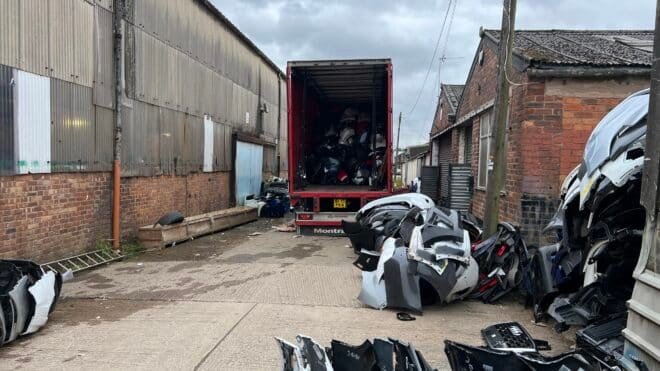
A compliant bumper collection is the legally documented transfer of waste car bumpers and automotive hard plastics from a UK bodyshop or workshop to a certified reprocessing facility. To be fully compliant, every collection must meet these three conditions:
- It must be carried out by an Upper Tier registered waste carrier.
- A signed Waste Transfer Note must be issued at every single visit – no exceptions.
- The material must be delivered to a facility holding a valid Environment Agency Environmental Permit.
This is not optional guidance. It is a statutory obligation under Section 34 of the Environmental Protection Act 1990, and it applies to every UK bodyshop, accident repair centre, vehicle dealership, and automotive workshop – regardless of size, collection frequency, or how long the business has been operating.
The complete compliant bumper collection process runs through six documented stages:
- Booking a registered waste carrier and receiving purpose-built storage equipment on-site.
- Accumulating bumpers and related hard plastics correctly during normal workshop operations.
- The collection visit and completion of a legally valid Waste Transfer Note.
- Transport of the material to an authorised treatment or reprocessing facility.
- Granulation, washing, compounding, and pelletising at the processing facility.
- Re-entry of recycled polypropylene into the wider manufacturing supply chain.
Each stage carries its own legal requirements. Most bodyshops manage some of them correctly without realising it – and fail on others without knowing they are failing at all. This guide walks through every stage in full.
The Legal Foundation – What Makes a Bumper Collection Compliant
Most bodyshops treat bumper removal as a logistics task. The workshop floor fills up, a carrier is called, and the material disappears. That model works fine – until an Environment Agency officer arrives and asks for the Waste Transfer Notes from the last two years.
Under UK law, a car bumper becomes controlled waste the moment it is removed from a vehicle during a commercial repair. From that moment, the Environmental Protection Act 1990 governs everything that happens to it. Section 34 of that Act places a Duty of Care on every business that produces, holds, transports, treats, or disposes of controlled waste.
That duty does not transfer when you hand the material to a carrier. It travels with your business, and it lasts until the waste reaches a licensed facility for recovery or disposal.
The GOV.UK Waste Duty of Care Code of Practice is explicit: producing businesses cannot discharge responsibility simply by handing waste to a third party.
What the Duty of Care Requires in Practice
Every compliant bumper collection from a UK bodyshop must satisfy all four of the following non-negotiable legal requirements:
- A registered waste carrier. The company collecting your bumpers must hold an Upper Tier waste carrier registration with the Environment Agency – or SEPA in Scotland. Upper Tier registration is required for any business that collects, transports, or deals in waste produced by others. Lower Tier registration only covers a business moving its own waste. It is not sufficient for a professional collection service of any kind.
- A Waste Transfer Note at every single visit. A signed Waste Transfer Note (WTN) must be completed, signed by both parties, and retained by both parties every time controlled waste changes hands. There is no provision in the legislation for a blanket annual document to cover multiple collections. Every individual transfer requires its own legal record.
- A correct EWC code. Every WTN must carry a European Waste Catalogue (EWC) code identifying the waste type. For polypropylene car bumper fascias, the correct code is 16 01 19 – plastics from end-of-life vehicles and vehicle maintenance. This is a non-hazardous classification. Using a vague or incorrect code on a WTN is itself a compliance failure.
- An authorised treatment facility. The waste must be transported to, and processed at, a site holding a valid Environmental Permit issued by the Environment Agency. The carrier cannot deposit it at an unlicensed yard, a general recycling skip, or any unapproved intermediate location.
Where Car Bumpers Sit in UK Waste Law
Car bumpers are classified as controlled waste under the Controlled Waste (England and Wales) Regulations 2012 – specifically as industrial waste arising from a trade or business. That classification has direct practical consequences for every bodyshop in the UK:
- Car bumpers cannot be placed in a domestic household waste stream.
- Car bumpers cannot go into a general commercial skip without a proper WTN and a licensed carrier.
- Car bumpers do not require hazardous waste procedures in standard uncontaminated condition.
- Car bumpers must be transferred only to an Upper Tier registered waste carrier.
The Waste (England and Wales) Regulations 2011 also introduced the Waste Hierarchy, which ranks disposal options from most preferred to least preferred:
- Prevention – avoid generating the waste in the first place.
- Reuse – use the material again without processing.
- Recycling – recover the material through reprocessing.
- Recovery – extract energy or other value from the waste.
- Disposal – landfill as the last resort.
A compliant bumper collection that routes polypropylene to a specialist reprocessor sits at the recycling level – three positions above landfill disposal. That is not only the legally preferred outcome. It is the most commercially sensible one.
The Financial Case for Getting This Right
The numbers make a direct argument for compliant collection over general skip disposal:
| Cost factor | General skip disposal | Compliant bumper collection |
| Landfill Tax (from April 2026) | £130.75 per tonne – passed on through skip fees | £0 – recycling is not subject to landfill tax |
| Waste Transfer Note | Often absent or incomplete – leaving you exposed | Issued on every visit, automatically |
| EA enforcement risk | High if documentation is absent | Eliminated when all four legal requirements are met |
| Material value recovered | Zero – material goes to landfill | Polypropylene re-enters manufacturing supply chain |
For a mid-sized bodyshop generating two to three tonnes of polypropylene waste per year, the landfill tax saving alone is measurable and recurring every year.
What the Enforcement Picture Looks Like
Waste compliance failures in the UK automotive sector are not rare edge cases. According to the Environment Agency’s National Waste Crime Survey 2025 and the House of Lords Library report on Waste Crime (February 2026):
- 749 new illegal waste sites were identified in 2024/25 – equivalent to ten new cases every week.
- This was a significant rise from 427 new illegal sites found in the previous reporting year.
- An estimated 20% of all waste in England may be illegally managed.
- Only 27% of waste crimes are reported to regulators.
- Waste crime costs the UK economy an estimated £1 billion per year.
Many cases involve small and medium businesses – including bodyshops – that failed to check carrier credentials, accepted no documentation, or disposed of material without understanding their legal obligations. Getting a compliant bumper collection wrong is not a theoretical risk. It is a real and documented one with real financial consequences.
What Qualifies as Bumper Waste – Accepted and Excluded Materials
A compliant bumper collection is not simply a matter of putting anything plastic into the stillage. The material scope matters – both for legal classification purposes and for the quality of the recycled output at the other end of the chain.
Materials Accepted in a Compliant Bumper Collection
The following materials are accepted in a standard automotive plastic collection and can be placed directly into the provided stillage or storage bin:
| Material | Condition Accepted | Notes |
| Front and rear bumper fascias | All makes, models, ages | Cracked, shattered, and impact-damaged units all accepted |
| Painted bumpers | Any colour | Paint removed during washing at the reprocessor – no stripping needed |
| Bumper reinforcement bars | Plastic-dominant only | Steel or aluminium bars are a separate waste stream |
| Energy absorbers and foam impact blocks | Any condition | Removed alongside bumpers in normal workshop workflow |
| Wheel arch liners and inner arch panels | Any condition | Same PP polymer family – collected as part of a hard plastic collection |
| Side skirts and front splitters | Any condition | Polypropylene – accepted in the standard bumper stream |
| Lower valances and grilles | Any condition | PP and ABS – accepted by most specialist reprocessors |
| Headlight and rear light housings | Any condition | Polycarbonate – accepted as a secondary stream alongside PP bumpers |
Materials That Must Be Removed or Kept Separate
Putting the wrong materials into a bumper stillage can cause an entire load to be rejected or downgraded at the reprocessing facility. The following must not enter the bumper waste stream:
- Metal brackets, bolts, and fixings. Metal contamination damages granulator machinery and reduces recycled polymer purity. Removing fixings before placing bumpers in the stillage takes seconds and prevents a costly downstream problem.
- Number plates. These are a separate waste stream. They contain an aluminium backing and a different polymer substrate. Mixing them with bumper waste contaminates the polypropylene output.
- Rubber seals, foam strips, and adhesive tape. These should be stripped from the bumper before it goes into storage.
- Bumpers contaminated with oil, coolant, or hazardous fluids. A bumper soaked in oil from an engine bay impact cannot enter the standard plastic waste stream. It must be assessed and treated as potentially hazardous waste, with separate documentation. If in doubt, set it aside and confirm with your carrier before collection day.
The practical rule: A clean polypropylene fascia removed in the normal course of bodyshop work goes straight into the stillage. Anything attached to it that is not polypropylene should come off first.
Stage One – Booking Your Compliant Bumper Collection and Equipment Setup
Before the first bumper lands in a stillage, several things need to be confirmed. This stage sets the compliance foundation for everything that follows. Get it right here and every subsequent stage is significantly simpler.
Pre-Booking Checklist – Five Questions to Ask Every Carrier
Do not book on price alone. The questions that matter are about legal status and documentation. Before committing to any waste collection arrangement, confirm all five of the following:
- Does the carrier hold a current Upper Tier EA waste carrier registration? Ask for the registration number and verify it yourself on the Environment Agency’s public register at publicregister.environment-agency.gov.uk. The search confirms whether the registration is current, whether it is Upper Tier, and whether the registered name matches the company you are dealing with. For businesses in Scotland, the register is held by SEPA at sepa.org.uk.
- Will a Waste Transfer Note be issued and signed on every single collection? Some operators only produce paperwork when asked. A compliant carrier treats every transfer as a legal document requiring completion before the vehicle leaves the site – without exception.
- Which permitted facility does the material go to? A legitimate carrier can name the reprocessing facility and, if pressed, provide its Environmental Permit reference number. Vague or inconsistent answers are a warning sign.
- Are collections scheduled or on-demand? For most bodyshops, a scheduled collection – weekly, fortnightly, or monthly depending on volume – is more reliable than calling when a stillage is full. Both models can be compliant, but a regular schedule prevents waste accumulating on-site longer than necessary.
- What storage equipment is provided, and does it fit the site? Confirm the equipment dimensions, loading requirements (forklift, pallet truck, or manual handling), and whether the collection vehicle can physically access the proposed storage location on your premises.
Equipment Delivery and Storage Setup
A specialist automotive plastic collection service will typically provide purpose-built storage equipment as part of the arrangement – either a steel stillage cage or a large wheeled bin, depending on your workshop volume.
Why stillages work better than bins for most bodyshops:
- They hold bumpers upright or stacked, significantly reducing floor footprint.
- They allow a full cage to be exchanged for an empty one on collection day without disrupting workflow.
- They are purpose-built for automotive plastics – better suited to large, irregular-shaped items than standard bins.
- They can be moved to accommodate changes in workshop layout.
Stillage positioning – legal and operational requirements:
The storage location must meet all five of the following criteria to be compliant:
- On hard standing – not soil, grass, or permeable gravel – to comply with outdoor waste storage requirements under the Environmental Permitting Regulations.
- Under cover or sheltered from the elements where possible, to prevent weather-related leachate risk.
- With clear, unobstructed vehicle access. Confirm vehicle type – van, flatbed, or curtainsider – and check whether height clearances or turning radii on your site create restrictions.
- Away from surface water drains, drainage channels, and gullies. Leachate from stored plastic waste must not enter the water system.
- Clearly signed as a designated recycling collection point. A visible sign ensures all workshop staff know exactly where bumpers go after removal, reducing the risk of floor storage or waste mixing between collections.
Getting the location right at this stage prevents delays, safety incidents, and storage compliance problems later. Ten minutes of planning at this point avoids weeks of disruption.
Workshops needing purpose-built containment can find out more about waste bins and stillage provision – including what sizes and configurations are available for different workshop volumes.
Stage Two – On-Site Accumulation and Correct Storage
The period between collection visits – whether weekly, fortnightly, or monthly – is when storage compliance either holds or breaks down. It is the stage most bodyshops overlook, and the stage where enforcement action most commonly originates.
The Compliance Gap Most UK Bodyshops Do Not Know About
The Duty of Care under the Environmental Protection Act 1990 applies from the moment waste is generated – not from the moment it is collected. The way bumpers are stored between removal and pickup is fully within scope of the legislation. It is auditable and enforceable.
Many bodyshops assume compliance is purely about documentation at the collection point. It is not. A workshop with correctly documented collections but non-compliant storage between visits still has a Duty of Care failure on its hands.
Five-Step On-Site Storage Rules for Compliant Bumper Collection
Follow all five of the following steps consistently throughout normal workshop operations:
- Place bumpers directly into the designated stillage or bin immediately after removal from the vehicle. Do not leave them on the workshop floor for tidying up later. Temporary floor storage creates trip hazards, blurs the audit trail, and increases the risk of cross-contamination with other waste streams.
- Keep the storage area clearly marked. A simple sign identifying the area as an automotive plastic recycling point is sufficient. It helps new staff follow the correct procedure without needing instruction each time.
- Do not mix bumpers with hazardous waste. Oil-contaminated components, batteries, used filters, and brake fluid containers must go into separate, clearly labelled hazardous waste storage. Mixing waste streams is a specific Duty of Care failure and can result in the entire mixed load being classified and managed as hazardous waste – at significantly higher cost.
- For outdoor storage, hard standing is a legal requirement, not a preference. The Environmental Permitting (England and Wales) Regulations 2016 require that outdoor waste storage must not cause leachate to enter ground or surface water. A stillage on soil or permeable aggregate does not meet this requirement. If only permeable ground is available, the stillage must be moved indoors or hard standing must be laid before use.
- Do not allow bumpers to accumulate in an unapproved area of the site. Bumpers piled against an external wall with no documentation trail constitute non-compliant stored waste – even if they are subsequently collected by a registered carrier.
How Long Can Waste Be Stored On-Site?
There is no fixed maximum duration in the legislation. However, the EA’s Duty of Care Code of Practice states that waste should be stored only for as long as is necessary before collection. In practice, that means matching your collection schedule to your generation rate:
| Workshop bumper output (per week) | Stillage capacity | Recommended collection frequency |
| Up to 10 bumpers | 20–25 units | Monthly |
| 10–20 bumpers | 30–40 units | Fortnightly |
| 20+ bumpers | 40+ units | Weekly |
One additional risk most bodyshops are unaware of: Some commercial premises liability insurers require segregated waste storage as a condition of cover. A non-compliant arrangement – loose waste on the floor, hazardous and non-hazardous materials mixed, outdoor storage on permeable ground – could affect the validity of a claim if a fire, spill, or environmental incident occurs on site. It is worth reviewing your policy documentation against the storage requirements described above.
Stage Three – The Collection Visit and Waste Transfer Note
This is the stage most people associate with waste compliance. It is also the most document-intensive, and the stage where the most common legal failures occur. Understanding exactly what the Waste Transfer Note must contain turns a piece of paper into genuine legal protection for your business.
What Happens on a Compliant Bumper Collection Day
A compliant collection visit follows a specific three-step sequence. Every step is legally significant:
Step 1 – The carrier arrives in a suitably enclosed or covered vehicle. The Environmental Protection (Duty of Care) Regulations 1991 require that waste in transit must be contained in a vehicle or container that prevents material escaping during transport. An open flatbed with loose bumpers and no sheeting or fixed sides does not meet this requirement. If a carrier arrives in an uncovered vehicle and loads bumpers into an open load area, note it before signing anything.
Step 2 – The carrier’s operative loads the stillage or exchanges it for an empty one. In a cage exchange model, the full cage is taken and a clean empty one left in its place. In a bin service, the contents are tipped directly into the collection vehicle. Either model is acceptable, provided the WTN accurately reflects the quantity transferred.
Step 3 – Both parties complete and sign the Waste Transfer Note before the vehicle leaves site. The WTN is a legal transfer document, not a delivery receipt. It must be signed at the point of collection – not emailed through later in the day or filled in retrospectively.
What a Waste Transfer Note Must Legally Contain
The mandatory content of a Waste Transfer Note is set out in the Environmental Protection (Duty of Care) Regulations 1991. Every field listed below is a legal requirement. A WTN missing any of these fields is incomplete and does not fully satisfy your Duty of Care:
- Full name and address of the waste producer – your bodyshop’s trading name and registered site address.
- Full name and address of the waste carrier.
- The carrier’s Environment Agency waste carrier registration number and expiry date.
- A written description of the waste, sufficient to identify it without physical inspection. An acceptable example: “Waste polypropylene bumper fascias and automotive hard plastic components removed during vehicle repair.”
- The EWC code. For polypropylene car bumpers, this is 16 01 19 – plastics from end-of-life vehicles and vehicle maintenance. If the WTN shows no EWC code, it is non-compliant.
- Quantity – stated by weight in kilograms or tonnes, or by container count where weight cannot be measured at the point of transfer.
- Date of transfer.
- Signature of both parties – the waste producer and the carrier.
- The address of the collection site, if different from your registered business address.
Both parties must retain their signed copy for a minimum of two years from the date of transfer. Failure to produce a WTN on request from the Environment Agency, Natural Resources Wales, or a local authority enforcement officer is itself a separate fixed penalty offence – independent of any other compliance failure.
Digital Waste Transfer Notes – What Is Legally Valid
The Environment Agency accepts electronic and digital Waste Transfer Notes as fully legally valid. Many carriers now issue these via email, a mobile app, or a dedicated digital portal immediately after collection.
Recommended digital filing practice:
- Save every WTN into a dedicated compliance folder – on your server or in cloud storage.
- Name each file with the collection date and carrier name so the archive is searchable (e.g. 2026-06-15_AutoBC_WTN.pdf).
- Retain all files for a minimum of two years from the date shown on each document.
- Confirm who in your business is responsible for this filing task and make it part of the collection-day procedure.
A searchable two-year digital archive satisfies the legal retention requirement in exactly the same way as a physical paper file.
Waste Transfer Note vs Consignment Note – Know the Difference
These are two distinct legal documents, and using the wrong one is itself a compliance error:
| Document | Used for | Required when |
| Waste Transfer Note (WTN) | Non-hazardous controlled waste | Every standard compliant bumper collection |
| Consignment Note | Hazardous waste only | Only if a bumper is contaminated with oil, coolant, brake fluid, or another hazardous substance |
Car bumpers in standard uncontaminated condition are non-hazardous. A WTN is the correct and only required document. If a bumper has been contaminated with a hazardous substance, a Consignment Note is required for that specific item before it can be collected.
Pre-Signing Checklist – Six Checks Before You Sign Every WTN
Before signing any Waste Transfer Note, run through all six of these checks without exception:
- The carrier’s EA registration number is present and matches a live Upper Tier registration on the public register.
- Your business name and address are correctly stated.
- The waste description is specific – not just “plastic waste” or “mixed plastics.”
- An EWC code (16 01 19 or equivalent) is present.
- A date and quantity are both recorded.
- Both parties have signed.
A compliant carrier will not object to any of these checks. An uncooperative response to straightforward documentation questions is, in itself, a meaningful warning sign about the legitimacy of the arrangement.
Stage Four – Transport to an Authorised Treatment Facility
Once your bumpers leave the site, they are out of your hands physically. Legally, the picture is more complicated.
Why Your Responsibility Does Not End at Collection
The Duty of Care Code of Practice is explicit: the producing business has a responsibility to take reasonable steps to ensure the waste is managed correctly throughout its entire journey – not just at the point of transfer. This matters for one important reason:
If you handed waste to an unregistered carrier with no documentation, and that carrier fly-tipped it on farmland three miles away, you would face enforcement action alongside the carrier. The pre-booking checks described in Stage One are not bureaucratic formality. They are your legal protection if something goes wrong after the vehicle drives away.
What an Authorised Treatment Facility Is
An authorised treatment facility (ATF) is a site holding a valid Environmental Permit or Waste Management Licence issued by the Environment Agency. The permit must specifically authorise the storage and treatment of automotive plastics under EWC 16 01 19.
Three things to understand about ATF requirements:
- Not every industrial yard or general recycling centre holds the correct permit for automotive plastic waste.
- A carrier that delivers bumpers to an unpermitted location commits an offence under Section 33 of the Environmental Protection Act 1990, regardless of intent.
- You have the right to ask your carrier to confirm the name and permit reference of the receiving facility. A legitimate carrier provides this without hesitation.
The Second Waste Transfer Note in the Chain
When the carrier transfers your bumpers to a third-party facility – which is common, as many carriers consolidate loads from multiple bodyshops before delivering to a specialist reprocessor – a second Waste Transfer Note must be issued between the carrier and the receiving facility.
This creates a complete, unbroken chain of custody documentation from your workshop gate to the reprocessor’s intake. You will not typically see this second WTN unless you request it, but its existence is a reliable indicator that the chain is being managed correctly.
Carriers, Brokers, and What the Difference Means for Your Business
If the company arranging your collection does not physically collect the waste themselves – if they sub-contract the physical collection to another company – they are acting as a waste broker, not a carrier.
| Role | What they do | Registration required |
| Waste carrier | Physically transports waste | Upper Tier carrier registration with the EA |
| Waste broker | Arranges transfers without handling waste | Separate broker registration with the EA |
| Both roles | Arranges and transports | Both registrations required and verifiable |
Ask directly before booking: “Are you collecting this yourselves, or will it be sub-contracted?” If the answer is the latter, ask to see both the broker registration and the carrier registration of the sub-contracted collector. Both are verifiable on the EA public register at no cost.
Stage Five – Processing, Granulation and Material Recovery
This is the stage most articles about car bumper recycling either skip entirely or summarise in a single vague sentence about “responsible recycling.” The detail of what happens at the reprocessing facility matters – both because it validates the compliance chain and because it explains why the preparation steps at the bodyshop stage make a measurable difference to the quality of the recycled output.
What Car Bumpers Are Made Of
The vast majority of car bumper fascias manufactured for the UK market since the early 1990s are made from polypropylene (PP) or PP-EPDM blends – polypropylene combined with ethylene propylene diene monomer rubber for impact flexibility.
Why this matters for recycling:
- Polypropylene is a thermoplastic, which means it can be melted, reformed, and remoulded without fundamental chemical change.
- This makes it ideally suited to mechanical recycling – unlike thermoset plastics, which cannot be remelted once cured.
- PP is one of the most widely recycled polymers in the world, with established commercial demand for the recycled output.
The Seven-Stage Reprocessing Process
Here is exactly what happens once a load of bumpers arrives at an authorised treatment facility:
Stage 1 – Incoming Inspection and Sorting Loads are checked on arrival for contamination. A load containing significant metal fixings, number plates, oil-contaminated units, or non-PP plastics will be identified immediately. Heavily contaminated loads may be quarantined for manual sorting before processing can begin.
This is why removing fixings and separating contaminating materials at the bodyshop stage is not optional good practice – it directly determines whether the load flows straight into processing or sits in a holding area pending rework.
Stage 2 – Manual Stripping Trained operatives remove remaining metal fixings, foam absorbers, rubber seals, and any non-plastic attachments not removed at the source workshop. This step protects the granulator machinery from metal ingestion damage and ensures the highest possible polymer purity in the finished granulate.
Stage 3 – Shredding Whole bumper fascias – which can be up to 1.5 metres wide – are fed into industrial shredders that reduce them to coarse fragments, typically 50 to 100mm in size. At this stage the bumper ceases to exist as a recognisable object and becomes a volume of plastic fragments.
Stage 4 – Granulation Shredded material passes through granulators – high-speed rotating blade mills – that reduce fragment size further to uniform chips of approximately 8 to 12mm. This granulate is the intermediate form of the recycled material, and it is at this stage that polymer identity becomes practically assessable for quality control.
Stage 5 – Washing The granulate is processed through a wet wash system using water and detergent to remove paint residue, surface contamination, adhesive deposits, and soiling. Bodyshops do not need to strip or sand-blast bumpers collection. The wash process handles paint removal entirely. Spent wash water is processed and managed under the facility’s Environmental Permit.
Stage 6 – Drying Washed granulate is passed through centrifugal or thermal drying equipment to reduce moisture content to below 0.1% by weight – the level required for extrusion. Residual moisture in the granulate disrupts the extrusion process and weakens the pellet structure of the finished product.
Stage 7 – Compounding and Pelletising Dried granulate is fed into an industrial extruder, where it is melted under controlled heat and pressure. The molten polymer is forced through a die and cut into uniform recycled polypropylene pellets, typically 3 to 5mm in diameter. These pellets – marketed as rPP (recycled polypropylene) – are the finished commercial product. They are tested for material properties and sold into the manufacturing market.
Why NIR Sorting Raises the Quality Ceiling
Advanced reprocessing facilities now use near-infrared (NIR) spectroscopy to automatically identify and sort polymer types before or after granulation. Polypropylene, polycarbonate, ABS, and HDPE each produce distinct spectral signatures under NIR scanning, allowing facilities to separate them at speeds and accuracy levels that manual sorting cannot match.
The link between bodyshop preparation and final rPP grade:
- A pre-sorted, de-fixed, contamination-free load of PP bumpers → highest-grade rPP output.
- A mixed, metal-contaminated, multi-polymer load → lower-grade material.
- Lower-grade material → reduced environmental and commercial value of the recycling chain.
The quality of the recycled material starts with the decisions made in your workshop.
Stage Six – Re-entry into the Manufacturing Supply Chain
After pelletising, the recycled polypropylene is not waste. It is a commodity with commercial value. The rPP pellets produced from bumper reprocessing re-enter the commercial market as a raw material input for manufacturers, directly replacing virgin polypropylene derived from petrochemical feedstocks.
Where Recycled Bumper Material Goes
The end applications for rPP from automotive bumpers span several industries:
- New automotive components. Non-structural interior trim panels, underbody covers, wheel arch liners, exterior cladding, and – in some cases – new bumper fascias. A bumper recycled today may contribute material to a bumper manufactured next year.
- Construction and infrastructure. Drainage channels, cable ducting, outdoor furniture, manhole surrounds, and access covers.
- Industrial packaging. Pallet boxes, storage crates, and transit containers. These are high-volume consumers of rPP from automotive sources.
- Agriculture. Plant trays, growing systems, and outdoor storage equipment.
The Carbon Saving Behind Every Compliant Bumper Collection
A lifecycle assessment published by the Association of Plastic Recyclers (Franklin Associates, 2020) quantified the environmental benefit of recycled PP versus virgin PP:
| Environmental metric | Recycled PP vs Virgin PP |
| Greenhouse gas emissions | ~71% lower for recycled PP |
| Energy consumption in production | ~88% lower for recycled PP |
| CO₂ saving per kilogram recycled | ~1.3 kg CO₂ equivalent avoided per kg of rPP |
Scaled to a real bodyshop:
- A mid-sized workshop replacing 15 to 20 bumpers per week generates approximately 2 to 3 tonnes of polypropylene waste per year.
- Routing that through a compliant recycling collection rather than general waste landfill avoids approximately 2.6 to 3.9 tonnes of CO₂ equivalent per year from that single business.
That figure is a direct, auditable, verifiable environmental credential – not a marketing claim. It is the downstream result of every WTN signed, every correctly prepared stillage, and every registered carrier engaged at the booking stage.
The full process behind how collected automotive plastics are recycled and re-enter the supply chain is covered in detail on the automotive plastic recycling service page.
The Growing Market for Traceable rPP
Extended Producer Responsibility (EPR) obligations are expanding across UK manufacturing. Manufacturers are increasingly required to demonstrate that recycled content in their products is verified and traceable – not just nominally present.
Why this matters for UK bodyshops:
- Automotive bumpers with a documented waste chain from bodyshop to reprocessor are well-positioned to supply verified rPP into this market.
- As EPR requirements grow, the commercial value of properly documented automotive plastic recycling increases alongside them.
- The compliance chain maintained at the bodyshop stage contributes directly to the verified status that commands a market premium at the other end of the supply chain.
What Makes a Bumper Collection Non-Compliant – and the Consequences
The most important thing to understand about compliance failures in the bodyshop sector is that most of them are not deliberate. The businesses that face EA enforcement for Duty of Care breaches are overwhelmingly not operators who knew the rules and chose to ignore them. They are operators who did not know what the rules required – and found out when an enforcement officer arrived.
Seven Specific Failures That Make a Bumper Collection Non-Compliant
- Using a carrier without a valid Upper Tier EA waste carrier registration. An unregistered carrier – or one with only a Lower Tier registration – cannot legally collect your bumpers. Engaging them creates a Duty of Care breach regardless of whether the waste was ultimately managed correctly at the end of the chain.
- Accepting no Waste Transfer Note. No documentation means no legal record that the transfer occurred correctly. It also means no defence if the carrier subsequently disposes of the material illegally.
- Accepting an incomplete Waste Transfer Note. A WTN missing the EWC code, the carrier’s registration number, or a signature does not fully satisfy the Duty of Care. The EA checks document completeness, not just document existence.
- Waste deposited at an unpermitted site. Even if you did not arrange it, if the carrier you hired takes your bumpers to an unlicensed location, you can face enforcement action if you failed to take reasonable steps to verify where the material would go.
- Mixing bumpers with hazardous waste. A bumper in the same container as used oil filters, battery acid, or solvent-soaked rags creates a mixed waste problem. The entire container’s contents may need to be managed as hazardous waste – at considerably greater cost and with far more complex documentation requirements.
- Burning bumpers or other automotive plastics on-site. This is a specific criminal offence under Section 33 of the Environmental Protection Act 1990. Burning plastic without a valid Environmental Permit is illegal regardless of quantity, location, or how long it has been common practice on a given site.
- Storing bumpers on unapproved surfaces. Outdoor waste storage on soil or permeable ground that allows leachate to enter surface water or groundwater is an Environmental Permitting breach – independently of any carrier-related failures.
The Consequences – in Order of Severity
| Consequence | Trigger | Financial impact |
| Fixed Penalty Notice | WTN failure | Up to £300 per incident |
| EA Enforcement Notice | Ongoing or systemic failures | Requirement to correct – non-compliance escalates |
| Civil Sanction | Serious breaches | Up to £100,000 |
| Criminal prosecution (summary conviction) | Illegal waste disposal, burning, fly-tipping | Unlimited fine |
| Criminal prosecution (Crown Court) | Serious illegal disposal | Unlimited fine + custodial sentence |
| Public enforcement record | Any conviction | Searchable by name – affects licences, insurance, and network memberships |
One point that many bodyshop owners do not appreciate: EA convictions are published and publicly searchable by business name. Motor trade licensing bodies, fleet operators, insurance underwriters, and manufacturer-approved repairer networks check these records. A waste crime conviction can affect operating licences, insurance premiums, and approved network memberships in ways that significantly outlast the original financial penalty.
How to Verify a Waste Carrier Is Legitimate Before Every Compliant Bumper Collection Booking
Checking a carrier’s registration takes under two minutes and costs nothing. It is the single most important step in establishing a compliant bumper collection arrangement.
Using the Environment Agency Public Register – Step by Step
- Go to publicregister.environment-agency.gov.uk
- Select “Waste Carriers, Brokers and Dealers” from the register list.
- Search by company name or by the registration number the carrier has provided.
- Check all four of the following fields in the results:
- Registration tier: Must show Upper Tier. Lower Tier is insufficient for professional collection services.
- Registration status: Must show active and current – not expired, suspended, or revoked.
- Business name: Must match the name of the company you are dealing with exactly.
- Expiry date: Registrations must be renewed. An expired registration is not valid, regardless of when it was last legitimate.
Five Questions to Ask a Carrier Before Signing Any Service Agreement
A legitimate registered carrier answers all five of these immediately and confidently:
- What is your Environment Agency waste carrier registration number?
- Do you issue a Waste Transfer Note on every collection visit, without exception?
- Which permitted reprocessing facility receives the bumpers after collection?
- Are you registered as a waste broker as well as a carrier? If so, what is your broker registration number?
- Can you provide a sample completed WTN from a recent collection so I can confirm it contains all required fields?
A carrier who hedges, deflects, or cannot answer these questions promptly has told you something important. These are everyday questions for any legitimate registered carrier. They do not require time to check.
Build Annual Verification Into Your Compliance Calendar
Once you have verified credentials and begun regular collections, do not assume those credentials remain valid indefinitely. Registrations expire and must be renewed.
Ongoing verification checklist:
- Set an annual calendar reminder to re-check the carrier’s EA registration status.
- Re-check before renewing any service agreement.
- If the carrier’s registered name or company structure changes, re-verify immediately.
- Keep a record of each verification check – date, result, and who carried it out.
The responsibility for ongoing verification remains with your business throughout the entire duration of the arrangement. This is not optional. It is part of the Duty of Care.
Frequently Asked Questions
How do I dispose of a car bumper legally in the UK?
Use a registered waste carrier who issues a signed Waste Transfer Note at every collection. Under Section 34 of the Environmental Protection Act 1990, the carrier must hold an Upper Tier EA registration, and your business must retain the WTN for at least two years. For bodyshops generating regular volumes, a scheduled car bumper collection service is the correct, compliant, and most cost-effective route available.
Is car bumper collection free for bodyshops?
For bodyshops generating regular, consistent volumes of bumper waste, a specialist car bumper collection is typically available at no charge. The recovered polypropylene has commercial value as a recycled raw material, and that value supports the cost of collection for regular volumes. One-off or very low-volume collections may be priced differently. The key point is that a compliant specialist collection is always more cost-effective than the landfill tax exposure of general waste skip disposal.
Do I need a Waste Transfer Note for every bumper collection?
Yes. A Waste Transfer Note is legally required every time controlled waste changes hands under Section 34 of the Environmental Protection Act 1990. A “season ticket” WTN can cover regular collections between the same two parties within a twelve-month period, provided the waste type, quantity, and schedule are clearly described – but both parties must hold a copy, and a new document is needed if anything changes. In practice, most compliant carriers issue a separate WTN on every visit.
What EWC code applies to car bumpers?
The correct EWC code for polypropylene bumper fascias is 16 01 19 – plastics from end-of-life vehicles and vehicle maintenance. This is a non-hazardous code. It must appear on every Waste Transfer Note issued during a compliant bumper collection.
Are car bumpers classified as hazardous waste?
No. Standard polypropylene bumper fascias are non-hazardous controlled waste. EWC code 16 01 19 carries no asterisk – in the European Waste Catalogue, an asterisk denotes hazardous status. A Waste Transfer Note is the correct document. The exception is a bumper contaminated with oil, coolant, or brake fluid, which must be separately assessed and documented.
Can I put car bumpers in a general waste skip?
No. Car bumpers are controlled waste generated in the course of a business. Placing them in a general commercial skip without a proper WTN from an Upper Tier registered carrier is a Duty of Care failure. Most general skip operators are not registered for automotive plastics. Bumpers in a general skip are also likely to end up in landfill, attracting the full landfill tax rate of £130.75 per tonne from April 2026. A specialist car bumper collection is the legally correct and considerably more cost-effective alternative.
What other automotive plastics can be collected alongside bumpers?
Wheel arch liners, side skirts, grilles, front splitters, headlight housings, and all other automotive hard plastic components can be collected in the same visit. This is covered under a dedicated automotive hard plastic collection service. Consolidating multiple plastic waste streams into one scheduled collection simplifies documentation, reduces the number of carrier relationships to manage, and ensures consistent compliance standards across all your workshop waste.
What happens to car bumpers after they are collected?
Collected bumpers go through a seven-stage reprocessing process:
- Incoming inspection and sorting.
- Manual stripping of metal fixings and non-PP components.
- Shredding to coarse 50–100mm fragments.
- Granulation to uniform 8–12mm chips.
- Washing to remove paint residue and surface contamination.
- Drying to remove residual moisture.
- Compounding and pelletising to produce recycled polypropylene pellets.
Those rPP pellets are sold into manufacturing as a raw material input. For the full breakdown, the automotive plastic recycling service page covers the complete process in detail.
Can I store bumpers outside at my workshop?
Yes, but only on hard standing – not soil, grass, or loose gravel. Under the Environmental Permitting (England and Wales) Regulations 2016, outdoor waste storage must not cause leachate to enter ground or surface water. Purpose-built waste bins and stillages are designed for both indoor and outdoor compliant storage and are provided to workshops as part of a standard collection arrangement.
How long do I need to keep Waste Transfer Notes?
- Non-hazardous waste (including all standard car bumpers): minimum two years from the date of transfer.
- Hazardous waste: minimum three years from the date of transfer.
Notes must be produced within seven days of a request from the Environment Agency, Natural Resources Wales, or a local authority enforcement officer. Failure to produce a WTN on request is an independent fixed penalty offence.
What is the difference between a waste carrier and a waste broker?
A waste carrier physically transports waste. A waste broker arranges transfers without physically handling the material. Both require separate registrations with the Environment Agency. If the company arranging your collection sub-contracts the physical pickup, they must hold a broker registration in addition to – or instead of – a carrier registration. Always confirm which role applies before signing any service agreement.
From the Workshop Floor to the Supply Chain – Compliance Is the Starting Point
A compliant bumper collection moves automotive plastic waste through six documented stages: booking and equipment setup, on-site accumulation, a legally documented collection visit, transport to an authorised facility, granulation and reprocessing, and re-entry into the manufacturing supply chain as recycled polypropylene pellets.
At every one of those stages, UK legislation has something precise to say about how it must be conducted. Section 34 of the Environmental Protection Act 1990 does not give bodyshops discretion about whether to comply – it imposes a duty that begins the moment a bumper is removed from a vehicle and ends only when the waste reaches a licensed recovery facility. That duty travels with the waste producer throughout the entire chain.
Compliance is not a burden layered on top of running a bodyshop. It is a defined set of steps – most of them straightforward – that deliver four measurable outcomes for every UK automotive business that gets them right:
- Legal protection – a documented compliance chain that holds up to EA scrutiny at any point.
- Cost savings – landfill tax eliminated on every tonne of polypropylene diverted from general waste disposal.
- A clear workshop – a scheduled collection cadence that keeps the site organised and free from plastic waste build-up.
- Environmental credentials – verified, traceable material entering a supply chain that avoids approximately 1.3 kg of CO₂ per kilogram of polypropylene recycled, compared to virgin plastic production.
For bodyshops, accident repair centres, vehicle dealerships, and automotive dismantlers across England and Scotland, the practical starting point is a scheduled car bumper collection with a registered carrier. From there, correctly positioned waste bins and stillages keep on-site storage compliant between visits. A Waste Transfer Note on file for every single collection keeps the audit trail intact. And for workshops that also generate wheel arch liners, side skirts, headlight housings, and other automotive hard plastics, combining those materials into a single automotive hard plastic collection simplifies the entire compliance arrangement into one scheduled service.
[…] compliant operator segregates at the point of collection, not later at a sorting facility that may or may not exist. Here is what to look for […]
[…] licensed waste carrier collects the bumpers, loose or stacked, with no special preparation required beyond keeping them dry and free from oil […]
[…] bodyshops sits well within the kind of trade waste this activity touches, which is exactly why a properly documented, single-provider process matters more than it might first […]
[…] bumper collection and recycling […]