UK automotive waste regulations in 2026 mean four major compliance frameworks now apply to every workshop simultaneously: mandatory digital waste tracking (October 2026), tightened End-of-Life Vehicle (ELV) rules, Simpler Recycling enforcement, and Extended Producer Responsibility (EPR) for packaging (from April 2026). The Environment Agency has moved from a period of education into active, data-driven enforcement. Non-compliance carries unlimited fines, insurance complications, and serious commercial consequences including the loss of fleet contracts.
Introduction: 2026 Is When Automotive Waste Regulations UK Start Biting
Picture a Tuesday morning in September 2026. A garage in Greater Manchester is three cars deep into its working day when an Environment Agency inspector arrives unannounced. The owner knows the new digital waste tracking rules are coming. He assumed there was more time. The paper Waste Transfer Notes are still in a drawer. The used oil and brake fluid containers are labelled, but not with the correct EWC codes. There is a single general waste bin in the customer waiting area – no separated dry recyclables, no segregation in sight. The battery storage area at the back of the workshop has not been updated in four years.
What follows is not an on-the-spot fine. It is a compliance notice, a 28-day remediation order, and a formal entry on the EA’s active monitoring database – the beginning of a process that can escalate to prosecution if left unresolved. Several months later, that same garage loses a fleet contract with a leasing company that now requires documented automotive waste compliance evidence from every repairer on its approved network.
None of this is far-fetched. It is the reality UK workshop owners are walking into in 2026 – most of them without adequate preparation.
This article is written specifically for:
- Independent garages and motor vehicle service centres.
- Bodyshops and accident repair centres across England and Scotland.
- Tyre fitters and fast-fit operators.
- MOT testing centres.
- Mobile mechanics operating from a fixed yard or unit.
- Franchised dealership service departments.
The UK’s automotive waste regulations landscape has been building since the Environment Act 2021 set the legislative foundation. Between 2022 and 2025, the regulatory framework was a period of consultation, phased rollout, and education. 2026 is the enforcement year. Multiple overlapping compliance frameworks are switching from voluntary adoption to legally mandatory compliance – and the Environment Agency has confirmed it is actively monitoring waste movements in real time, without needing to visit a site first.
This is not purely a compliance matter, either. Fleet managers and corporate leasing companies are now requiring documented waste management evidence from their approved workshop networks. Non-compliance in 2026 is a commercial risk as much as a legal one. The workshops that get ahead of these regulations will have something their competitors do not: documented proof that they operate professionally, responsibly, and to a standard that fleet clients, insurers, and audit networks increasingly demand.
Why 2026 Is Different: The Regulatory Context UK Workshops Must Understand
Understanding why 2026 is a turning point requires a brief look at how UK automotive waste regulations have evolved – and why the automotive sector is now a specific enforcement priority.
The Post-Brexit Shift in UK Waste Regulation
When the UK left the EU, it retained the core principles of EU waste frameworks – including the End-of-Life Vehicle Directive – but moved away from automatic alignment with future EU updates. The UK is now building its own independent waste enforcement infrastructure, with a national digital tracking system at its centre that has no direct EU equivalent. Rather than inheriting a paper-based patchwork, the UK is moving to a real-time, data-transparent system where the Environment Agency can monitor every waste movement as it happens. This is a fundamental change, and it raises the risk profile for every waste-producing business operating in the UK – including automotive workshops across England, Scotland, and Wales.
The Environment Agency’s New Enforcement Posture
For years, EA enforcement was largely reactive: a complaint came in, an inspector visited, and a minor breach might receive a verbal warning. That model has changed significantly. With digital waste tracking going live, the EA can identify discrepancies between what a workshop declared, what the carrier logged, and what the receiving facility accepted – all without setting foot on the premises. An inspector can be deployed based on data alone.
This matters because the government has been explicit: waste crime costs the UK economy an estimated £1 billion every year. The digital tracking system is a centrepiece of the government’s Waste Crime Action Plan. Businesses with accurate, complete records benefit. Those with gaps will be identified faster than ever before.
Why Automotive Workshops Are a Priority Sector
The automotive repair sector produces a disproportionately high volume of hazardous and controlled waste relative to its business size. A typical five-bay independent garage in England generates all of the following in a standard working week:
- Used engine oil, gear oil, and lubricants – multiple EWC-coded hazardous streams.
- Brake fluid and power steering fluid – separately classified hazardous waste.
- Engine coolant and antifreeze – hazardous if contaminated.
- Air conditioning refrigerant – requires specialist recovery.
- Lead-acid and lithium-ion batteries – different disposal routes and storage rules.
- Used tyres – banned from landfill since 2006.
- Contaminated rags, absorbents, and floor sweepings – classified as hazardous waste.
- Aerosol cans and spent chemicals – hazardous waste stream.
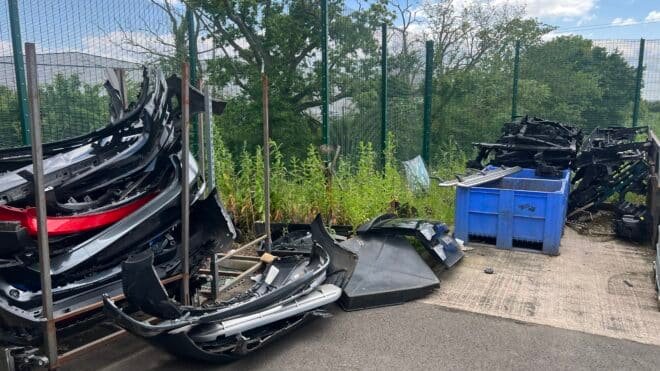
- Car bumpers, wheel arch liners, and automotive hard plastics – controlled waste requiring a licensed carrier and documented transfer.
- Catalytic converters and oil filters – hazardous components with specific EWC codes.
Approximately 2 million end-of-life vehicles arise in the UK each year. The dismantling and depollution of those vehicles creates a hazardous waste chain that begins at the point a vehicle is classified as waste – not at the point it reaches an Authorised Treatment Facility.
It is also a sector where compliance has historically been inconsistent. Paper Waste Transfer Notes are easily lost or incorrectly completed. EWC codes are frequently wrong. Contractors are used without verification of their licensing status. This combination of high hazardous waste volume and patchy historical compliance makes UK automotive workshops a natural and logical focus for proactive EA enforcement in 2026.
The Four Automotive Waste Regulation Frameworks Activating Together in 2026
What makes 2026 uniquely demanding is not one new rule – it is four overlapping regulatory frameworks activating simultaneously, each with its own obligations and enforcement consequences.
| Automotive Waste Regulation Framework | Key Date | Who It Affects | Core Obligation |
| Mandatory Digital Waste Tracking | October 2026 | All waste producers, carriers, receivers | Replace paper WTNs with centralised digital records. |
| Tightened ELV and Hazardous Waste Rules | EA inspections intensifying throughout 2026 | ATFs and workshops handling ELV-adjacent work | Weight-based vehicle records, battery handling, infrastructure standards. |
| Simpler Recycling Enforcement | Active since March 2025 for 10+ FTE businesses | All workshops with 10 or more staff | Segregate dry recyclables from general waste. |
| EPR for Packaging | April 2026 | Workshops importing or selling packaged goods | Report packaging data and pay applicable producer fees. |
Most published guides treat each of these as separate subjects. For a workshop owner running a busy operation, they all land together. This article addresses all four in the context of a working automotive workshop.
Mandatory Digital Waste Tracking – The Biggest Shift in UK Automotive Waste Regulations
Direct Answer: From October 2026, all permitted waste receiving sites in England, Wales, and Northern Ireland must digitally log every waste movement through a centralised government platform, replacing paper Waste Transfer Notes. As a workshop and waste producer, you must ensure every waste movement you initiate is accurately described so it can be logged at the receiving end. If your records do not match the carrier’s or receiving facility’s logs, the discrepancy traces directly back to you.
This is the most significant single change in UK automotive waste regulations in years, and it is the one most workshops are least prepared for.
What Is Actually Changing in UK Waste Documentation
For decades, UK automotive waste regulations required paper-based documentation. Every transfer of waste from a workshop to a carrier required a Waste Transfer Note (WTN), signed by both parties and retained for two years. Hazardous waste – which covers the majority of automotive workshop waste – required a Hazardous Waste Consignment Note involving the producer, carrier, and receiving facility. The Environment Agency had no visibility of any of this unless it physically requested records during a site visit.
The previous voluntary electronic system, eDOC, saw negligible uptake. Paper remained standard. Paper has a fundamental problem: it can be fabricated, misfiled, or simply lost. There is no real-time audit capability.
From 1 October 2026, the Digital Waste Tracking (England) Regulations 2026 require every permitted waste receiving site to log all incoming waste movements through the government’s centralised digital platform. A voluntary public beta opened on 28 April 2026, allowing receiving sites to begin testing processes ahead of the mandatory deadline.
The rollout timeline across the UK is:
- 28 April 2026 – Public beta opens for all permitted and licensed receiving site operators.
- October 2026 – Mandatory for all permitted waste receiving sites (Phase 1: approximately 12,000 sites).
- Autumn 2026 – Private beta opens for waste carriers and collectors.
- Spring 2027 – Public beta available for all waste collectors.
- October 2027 – Mandatory digital logging for all waste carriers, brokers, and dealers.
As a workshop and waste producer, your mandatory start date for directly logging into the system is expected to follow in a later phase. However, this does not mean you can delay preparation. From October 2026, every waste movement you send out must be accurately described and coded so that receiving sites can log it correctly. A discrepancy automatically flags your business for investigation.
How the Digital Waste Tracking System Works
Each waste movement receives a unique digital tracking reference, replacing the paper WTN with a digital record that both parties complete and that the EA can access in real time.
Each digital waste record must include:
- EWC code – the six-digit European Waste Catalogue code identifying the exact waste type.
- Quantity – weight or volume, depending on the waste material.
- Point of origin – your workshop premises with full registered address.
- Carrier details – name, company number, and Environment Agency licence number.
- Destination facility – full details of the permitted receiving site.
Once submitted, the system assigns a unique record number. The EA can cross-reference producer declarations, carrier records, and receiving facility logs in real time. Any gap or mismatch triggers an automatic alert.
The Data Responsibility Chain – Where Most UK Workshops Get This Wrong
The most important and least-discussed aspect of the new automotive waste regulations is this: using a registered contractor does not transfer your legal duty of care.
If your carrier logs the waste movement with the wrong EWC code, or records the wrong quantity, and the receiving facility’s record reflects something different, the system flags the inconsistency. The investigation begins with the original waste producer – your workshop. You cannot point to the contractor. You remain legally responsible for ensuring that what leaves your premises is accurately described and traceable at every point in the chain.
Every UK workshop must now do the following:
- Actively verify that every waste contractor is not only licensed but digitally ready for October 2026.
- Ask each contractor directly which platform they are using for the Digital Waste Tracking service.
- Confirm whether the contractor’s system is integrated with the DEFRA API.
- Understand the handover process for each collection from October 2026 onwards.
If your contractor cannot answer these questions clearly, that is a risk that requires immediate action – not a situation to revisit in the autumn.
The Designated Waste Record Keeper Role
This is a practical staffing implication absent from virtually all published guidance on UK automotive waste regulations, and it is one of the most immediately actionable steps available to any workshop.
Someone inside your business must own the waste logging process – a named individual responsible for:
- Recording every waste movement at the point of transfer.
- Verifying that EWC codes match the correct classification for each waste type.
- Confirming the contractor has collected exactly what was logged.
- Retaining records in an accessible format for EA requests.
- Flagging discrepancies or missing documentation immediately.
In a five-bay garage, this is typically the workshop manager or owner. In a larger site, a service advisor or office manager may take the role. The key is that the role belongs to one person, consistently. When the EA investigates a discrepancy, their first question is always: who logged this, and when?
EWC Codes for UK Automotive Workshops – The Reference Tables
Wrong EWC codes are among the most common automotive waste regulation compliance failures in the sector. Using an incorrect code, even inadvertently, constitutes a duty of care breach. The following tables are based on GOV.UK’s official Vehicle and Oily Wastes classification guidance, last updated August 2025.
Critical rule before reading the tables: You must never mix mineral oils, halogenated oils, brake fluids, antifreeze, or washer fluids in the same container. Each must be stored and transferred separately with its own correct EWC code.
Vehicle Fluids – All Classified as Hazardous:
| Waste Type | EWC Code | Hazardous | Common Mistake to Avoid |
| Engine / gear / lubricating oil (mineral, non-chlorinated) | 13 02 05* | Yes | Grouping with synthetic oil under a single generic code. |
| Engine / gear / lubricating oil (synthetic) | 13 02 06* | Yes | Classifying as non-hazardous. |
| Other engine oils | 13 02 08* | Yes | Using as a catch-all instead of the correct sub-code. |
| Brake fluid | 16 01 13* | Yes | Mixing with other fluids – must be stored and transferred separately at all times. |
| Antifreeze containing hazardous substances | 16 01 14* | Yes | Using non-hazardous code 16 01 15 for contaminated coolant. |
| Antifreeze not containing hazardous substances | 16 01 15 | No | Incorrectly applying the hazardous * designation. |
| Fuel oil and diesel | 13 07 01* | Yes | Mixing diesel with petrol. |
| Petrol | 13 07 02* | Yes | Mixing petrol with diesel or other fuels. |
| Interceptor sludge | 13 05 03* | Yes | Overlooked entirely and not logged as a separate waste stream. |
| Oily water from workshop interceptor | 13 05 07* | Yes | Incorrectly classified as general non-hazardous water. |
Vehicle Components and Other Workshop Waste:
| Waste Type | EWC Code | Hazardous | Common Mistake to Avoid |
| End-of-life tyres | 16 01 03 | No | No EWC code applied at transfer. |
| Lead-acid car batteries | 16 06 01* | Yes | Stored or transferred alongside non-hazardous waste. |
| Catalytic converters (with refractory ceramic fibres) | 16 01 21* | Yes | Using non-hazardous code 16 01 22 for RCF-containing converters. |
| Oil filters | 16 01 07* | Yes | Disposed of in general waste rather than hazardous waste containers. |
| Air bags (explosive components) | 16 01 10* | Yes | Treated as standard scrap metal. |
| Contaminated cloths and absorbents | 15 02 02* | Yes | Placed in dry recycling or general waste bins. |
| Brake pads (non-asbestos) | 16 01 12 | No | – |
| Un-depolluted ELV | 16 01 04* | Yes | Stored on site without the required hazardous waste controls. |
| Depolluted ELV | 16 01 06 | No | – |
One waste stream that is often overlooked entirely by UK workshops is automotive plastics. Car bumpers, wheel arch liners, side skirts, grilles, and interior trim panels removed during repairs are classified as controlled waste under Section 34 of the Environmental Protection Act 1990. They cannot go into a general commercial skip and must be transferred to a licensed waste carrier with a completed Waste Transfer Note. Specialist automotive plastic recycling services exist specifically to handle this waste stream compliantly – and they are often more cost-effective than workshop owners expect.
What Digital Compliance Costs a Typical UK Workshop
- Software or platform access. Some waste contractors will absorb digital tracking into their service contract at no additional charge. Purpose-built waste compliance platforms for small producers cost between £120 and £400 per year.
- Staff time for logging. If the Designated Waste Record Keeper spends more than 15 to 20 minutes per week on waste logging, the process needs simplifying. The goal is to make it as routine as recording a vehicle registration on a job card.
- Contractor switching costs. If your current contractor is not digitally ready for October 2026, allow four to six weeks to switch: quotes, licence verification, and contract set-up.
A fixed penalty for a Duty of Care breach starts at £300 per offence. Serious or repeated breaches are referred to magistrates’ court, where fines are unlimited. A compliance platform costing £200 per year is a fraction of one penalty notice – and a very small fraction of losing a fleet account worth £20,000 or more per year.
Tightened ELV and Hazardous Waste Rules – New Physical Standards in UK Automotive Waste Regulations
The EA’s tightened ELV automotive waste regulations apply primarily to Authorised Treatment Facilities, but they also affect any workshop that stores end-of-life vehicles on site, drains fluids from trade-ins, strips parts from accident write-offs, or handles lithium-ion batteries from electric or hybrid vehicles – regardless of ATF status. Un-depolluted vehicles on your premises are classified as hazardous waste in England and Wales, and must be managed accordingly from the moment they arrive.
Which UK Automotive Workshops These Rules Apply To
The widespread assumption that ELV regulations only concern scrap yards and ATFs is incorrect – and costly. An un-depolluted vehicle, meaning one whose fluids, battery, and hazardous components have not been removed, is legally hazardous waste in England and Wales from the moment it becomes waste – not from the moment it enters a licensed ATF.
The ELV automotive waste regulations touch your workshop if you:
- Store a customer’s written-off vehicle on site while awaiting collection.
- Drain fluids from a trade-in before sending it to auction.
- Strip usable parts from an accident vehicle before disposal.
- Receive an un-depolluted vehicle for any period, however brief.
- Store more end-of-life vehicles on site than your permit or exemption covers.
EA inspectors are increasingly checking yards and workshop areas specifically for vehicles that should have gone directly to an ATF. The threshold that triggers permit requirements is low, and the EA’s proactive enforcement posture means inspectors are looking for these situations rather than waiting for a complaint.
Weight-Based Vehicle Treatment Records – A New Level of Detail Required
Under the EA’s tightened automotive waste regulation standards, aggregate records are no longer sufficient. It used to be acceptable to note that three vehicles were processed in a given week. The new requirement is that each vehicle has its own individual treatment record, capturing the weight of residues removed and materials extracted from that specific vehicle.
For non-ATF workshops, a basic logging practice per vehicle is what is required. The following template can be implemented in a standard spreadsheet as an interim measure.
Vehicle Treatment Log – Minimum Fields Required:
- Vehicle registration number and VIN.
- Full details of the registered keeper presenting the vehicle.
- Date received on site.
- Date of fluid removal and depollution.
- Volume and weight of each fluid removed – engine oil, brake fluid, coolant, fuel.
- Battery type removed (lead-acid, lithium-ion, or other) and condition at point of removal.
- Carrier name, EA licence number, and collection date for each waste stream.
- EWC code assigned to each waste stream.
A single spreadsheet row per vehicle, completed at the time of processing, meets the requirement and provides a clear audit trail if the EA visits.
Lithium-Ion Battery Handling – The Highest-Risk Element of 2026 Automotive Waste Regulations
Every workshop servicing or receiving electric and hybrid vehicles must treat this section as an operational priority. Lithium-ion batteries are fundamentally different from the lead-acid batteries that workshops have handled for decades. The EA’s guidance on their handling, storage, and disposal is significantly stricter in 2026 – and the consequences of getting it wrong extend beyond regulatory penalties into insurance liability.
The four mandatory steps under current automotive waste regulations are:
Step 1 – Immediate removal or disconnection. When an EV or hybrid arrives after a collision, flood exposure, or with visible thermal indicators, the battery must be disconnected from the vehicle’s electrical system immediately. This is not discretionary.
Step 2 – Terminal taping or capping. All battery terminals, both positive and negative, must be insulated with appropriately rated material before the battery is moved or stored. Standard workshop electrical tape is not sufficient for high-voltage EV battery packs. A short-circuit in a lithium-ion battery can initiate thermal runaway – a self-sustaining cascade of heat and fire that is extremely difficult to suppress once started.
Step 3 – Quarantine storage for damaged batteries. A battery showing any of the following must go immediately into designated quarantine storage:
- Physical deformation or swelling of the casing.
- Burn marks or heat discolouration on any surface.
- Electrolyte leakage or an unusual chemical odour.
- Confirmed or suspected immersion in water.
Step 4 – Compliant quarantine storage specifications. A compliant quarantine area for damaged lithium-ion batteries must include all of the following:
- A non-conductive containment tray rated for the battery size.
- Temperature maintained between 0°C and 50°C.
- Positioned away from combustible materials and flammable storage.
- Clear UN hazard labelling – UN3480 for lithium-ion cells and packs; UN3481 for lithium-ion batteries in equipment.
- Fire suppression equipment rated for electrical and lithium fires, accessible within the same zone.
The insurance risk most workshop owners do not know about:
Commercial property insurance policies are increasingly incorporating automotive waste compliance conditions into their terms. If an EV battery fire occurs on workshop premises and the insurer can demonstrate that the battery was stored in a non-compliant manner – uninsulated terminals, wrong containment, incorrect temperature – they have grounds to reject the claim. This is not theoretical. Insurers are directly responding to the growth of EV volumes across UK fleets. Review your policy renewal documentation specifically for waste storage and hazardous materials compliance conditions before your next renewal date.
Pre-Acceptance Checks Under UK Automotive Waste Regulations
Under the EA’s tightened ELV rules, EWC codes and vehicle data must be assigned at point of acceptance – when the vehicle arrives – not at the point of disposal.
A compliant intake process must record the following at vehicle arrival:
- Full name and contact details of the registered keeper.
- Vehicle registration number and VIN.
- Visible condition of the vehicle, including battery status for EVs and hybrids.
- Whether any fluids are actively leaking on arrival.
- EWC code at intake: 16 01 04* for un-depolluted; 16 01 06 for depolluted.
- Expected waste streams arising from treatment.
Front-loading this information means the records chain is established before treatment begins, rather than reconstructed under pressure when a collection is being arranged.
EA Physical Site Inspection – What an Inspector Actually Checks
When an EA inspector visits a workshop, the first action is always a physical walkthrough of the site before any paperwork is reviewed. Use the following as a self-audit checklist for your premises. Every item receiving a “no” answer is a specific remediation action that needs completing before an inspection makes it compulsory.
Impermeable Surfaces:
- Is the workshop floor fully impermeable, with no cracks, gaps, or unsealed joints?
- Are all liquid storage and handling areas positioned on impermeable surfaces?
Drainage:
- Is a sealed interceptor fitted in all areas where oil or fluids could enter the drainage system?
- Is the interceptor functioning and maintained – not blocked or overflowing?
- Are there any uncontrolled drain points in fluid-handling areas?
Bunded Liquid Storage:
- Are all hazardous liquid containers within a bunded area with raised containment walls?
- Does the bunded area hold at least 110% of the volume of the largest single container within it?
- Is the bunded area clean, with no standing liquid or residue from previous spills?
Container Labelling:
- Is every waste container clearly labelled with the waste type and its correct EWC code?
- Are hazardous and non-hazardous containers clearly separated and individually identified?
- Are all containers in sound condition – no cracks, damaged seals, or unsecured lids?
Hazardous Waste Records:
- Can you produce a complete Hazardous Waste Consignment Note for every hazardous waste movement in the past 12 months?
- Are all three sections – producer, carrier, receiver – completed on every note?
- Do EWC codes on consignment notes match the actual waste types transferred?
Battery Storage:
- Are lithium-ion EV/hybrid batteries stored separately from lead-acid batteries?
- Is any damaged battery in a compliant quarantine area with appropriate containment?
- Are all battery terminals insulated with appropriately rated material?
Waste Segregation:
- Is hazardous waste fully separated from non-hazardous waste in all storage areas?
- Are different hazardous waste categories stored separately – oil apart from coolant, brake fluid apart from fuel?
If you cannot answer yes to every item today, those gaps are your action list. Work through each one methodically before enforcement makes the timeline someone else’s decision.
Simpler Recycling – What UK Automotive Waste Regulations Mean for Garages Specifically
Simpler Recycling rules for businesses in England with 10 or more full-time equivalent employees have been legally in force since 31 March 2025. In 2026, the EA has moved into active enforcement. A charge of £118 per hour applies for regulatory time spent on non-compliant businesses, with fixed penalties of £110 rising to £5,000 for serious or repeated non-compliance. For a garage, the rules apply primarily to the office, reception, waiting area, and staff welfare facilities – not to the workshop floor, which is governed by separate hazardous waste rules.
What Simpler Recycling Means Specifically for an Automotive Workshop
Almost every published explanation of Simpler Recycling focuses on offices, restaurants, and retail. Almost none address what it means inside an automotive workshop. This section does.
Simpler Recycling requires businesses to separate waste into distinct streams before collection.
The mandatory waste streams are:
- Dry recyclables – paper, cardboard, glass bottles and jars, metal cans, and plastic bottles and containers.
- Food waste – where the premises generates it, such as in a staff kitchen or customer lounge.
- General and residual waste – everything that cannot be separated into the streams above.
For a garage, these rules directly apply to:
- The office and administration area – paper, cardboard, and packaging from office consumables.
- The customer waiting room – cups, bottles, and product packaging.
- The parts counter – cardboard boxes and plastic packaging from parts deliveries.
- Any staff kitchen or welfare facility – food waste and food packaging.
The workshop floor operates under different rules entirely. Oily rags, contaminated absorbents, used filters, and aerosol cans are classified as hazardous waste and must follow dedicated hazardous waste disposal routes. They must never be placed in a dry recyclables bin or a general waste bin.
Many garages have a single commingled general waste bin in their reception area and have never separated recycling. That straightforward oversight is now an enforceable automotive waste regulation failure.
The Enforcement Sequence Under Simpler Recycling Rules
Simpler Recycling enforcement does not begin with an automatic financial penalty. It follows a structured, escalating sequence.
The enforcement sequence is:
- Trigger – A contaminated bin is refused by a waste collector, a complaint is received, or an EA inspector attending for an unrelated reason observes non-compliance on site.
- Regulatory engagement – The EA or local authority contacts the business and documents the issue.
- Compliance notice – If unresolved, a formal compliance notice is issued specifying remedial action and a completion deadline.
- Active monitoring – The business is placed on the EA’s active monitoring list. Further visits can occur without a new complaint.
- Financial enforcement – From 3 February 2026, the EA charges £118 per hour for regulatory time. Fixed penalties of £110 apply for identified breaches, rising to £5,000 for repeated or serious non-compliance.
The most common Simpler Recycling contamination scenarios in automotive workshops are:
- An oil-contaminated rag placed in the dry recyclables bin – a routine occurrence where no system has been communicated to staff.
- An aerosol lubricant or brake cleaner can disposed of in general waste instead of the hazardous waste stream.
- Parts packaging with residual lubricant contaminating the cardboard recycling.
- A disposable cup with engine fluid residue placed in the customer-area recycling bin.
None of these are unusual events. They are routine occurrences in workshops without clear, communicated segregation systems.
Why UK Micro-Businesses Should Not Wait Until 2027
If your garage employs fewer than 10 full-time equivalent employees, your mandatory Simpler Recycling deadline is 31 March 2027 – and this headcount is calculated across the entire business, not per site.
However, there is a clear strategic reason to act in 2026 regardless. Simpler Recycling exemptions apply to that regulation specifically. They do not provide immunity from EA inspection for other reasons. If an inspector attends your premises because of a battery storage complaint, an incorrect consignment note, or any other issue, they will observe and record everything on site – including recycling non-compliance – regardless of your formal exemption deadline.
Setting up a clearly labelled dry recyclables bin and a food waste caddy where needed, then briefing your team on what goes where, takes one afternoon and removes an entire category of risk. That is a straightforward decision.
Extended Producer Responsibility for Packaging – Does Your Workshop Qualify?
Direct Answer: From 1 April 2026, the updated EPR scheme for packaging applies across the UK. Whether it affects your workshop depends entirely on your activities. Workshops that import parts in packaging from outside the UK, or that sell packaged goods to customers, may be in scope if they meet the thresholds. Workshops that only receive deliveries, strip packaging on arrival, and dispose of it as business waste – without passing packaged goods to end customers – are most likely outside the main producer obligations.
Three Clear Paths to Determine Your Workshop’s EPR Position
Path 1 – You import parts or accessories from outside the UK. If you source parts directly from EU suppliers or non-UK manufacturers in packaging – boxes, plastic wrap, foam inserts – you may be the “first UK buyer” under EPR. If you handle more than 25 tonnes of packaging per year and your annual turnover exceeds £1 million, full reporting obligations apply.
Path 2 – You sell packaged goods to customers. If you sell lubricants, cleaning products, accessories, or parts to customers with original packaging intact, you may be treated as a producer placing packaging on the market. Check whether packaging passes to end consumers through your business.
Path 3 – You receive deliveries and strip packaging yourself. If you order parts from UK distributors, remove packaging on arrival, and the packaging never reaches a customer, you are most likely outside the main EPR producer obligations. This is the most common scenario for independent workshops in England and Scotland.
The threshold test: Businesses handling over 25 tonnes of packaging annually and with turnover above £1 million are fully in scope. Businesses below those thresholds have reduced or no obligations.
If April 2026’s registration deadline has passed and your business is in scope but unregistered, act immediately. Late registration carries fees and places your business on the EA’s non-compliance register for the packaging scheme.
What to Ask Your Parts Supplier Right Now
Some parts distributors are already including packaging weight declarations on delivery documentation to help workshop customers with EPR data requirements. This is not yet universal, but it is growing.
If you suspect you may be in scope, ask your top three suppliers these questions:
- Can you provide packaging weight data broken down by material type?
- Do you include this information on invoices or delivery notes?
- In what format is the packaging data available?
This practical step can save significant administrative time if EPR data filing is required, and it positions your business as a well-organised procurement partner in a supply chain increasingly focused on environmental accountability.
The Real Cost of Ignoring UK Automotive Waste Regulations
Direct Answer: EA fixed penalties for Duty of Care breaches under UK automotive waste regulations start at £300 per offence. Simpler Recycling non-compliance carries fixed penalties of £110 rising to £5,000. Serious offences prosecuted via magistrates’ court carry unlimited fines, with company directors facing personal criminal liability. But the direct penalties are only part of the picture – the hidden commercial and financial costs consistently run higher.
What UK Automotive Waste Regulations Say About Penalties
Digital Waste Tracking and Duty of Care: Under Section 34 of the Environmental Protection Act 1990, a Duty of Care breach carries a fixed penalty starting at £300. Where the breach is serious – systematic use of incorrect EWC codes, waste transferred to an unlicensed carrier, missing hazardous waste consignment notes – the EA refers the case to magistrates’ court where fines are unlimited. In cases involving deliberate evasion or serious environmental damage, company directors can face personal criminal liability.
Simpler Recycling: From 3 February 2026, the EA charges £118 per hour for all regulatory time on non-compliant businesses. Fixed penalties of £110 apply for identified breaches, escalating to £5,000 for repeated or serious violations.
ELV and Hazardous Waste: Operating a site that accepts ELVs without the required environmental permit, failing to use consignment notes for hazardous waste movements, or storing hazardous waste without adequate controls all carry unlimited fines when prosecuted via magistrates’ court.
EA enforcement notices are part of the public record – searchable online against your business name and address. That visibility has commercial consequences that do not appear in any penalty calculation.
The Hidden Costs of Non-Compliance with Automotive Waste Regulations
Loss of fleet and corporate contracts. Fleet managers for leasing companies, utilities, and corporate vehicle operators are incorporating waste compliance requirements into approved repairer criteria. Some already require documented evidence of waste management systems, carrier licensing, and disposal routes. A workshop that cannot produce that documentation does not fail an inspection – it loses a contract on renewal to a competitor that can.
Insurance premium increases. An EA compliance notice – even one subsequently resolved – is a notifiable event for most commercial insurers. It signals elevated environmental risk on the premises. At the next renewal, expect questions about EA contacts and a premium loading applied in response.
Emergency infrastructure remediation. If an EA inspection identifies a non-impermeable workshop floor, inadequate drainage, or insufficient bunded storage, the cost of making those physical changes falls entirely on the workshop – within the deadline set by the compliance notice. Depending on site size and scope, impermeable flooring, bund installation, and drainage works can cost £5,000 to £25,000 without any prior budget preparation.
Reputational exposure. EA enforcement notices are indexed by search engines. If a fleet manager, insurance network, or potential trade customer searches your business name and finds an open enforcement notice, that conversation becomes significantly more difficult to manage. In a sector where trust and professional credibility drive contract retention, reputational exposure has a measurable commercial cost.
The Compliance vs. Risk Comparison for a Typical UK Workshop
Compliance preparation costs – five-bay independent workshop:
| Action | Estimated Cost |
| Digital waste tracking software or contractor platform | £150–£300 per year |
| Bin segregation for office and waiting area | £80–£150 |
| Internal staff training session (half-day, no external facilitator) | Staff time only |
| Waste audit and EWC code review (internal) | No direct cost |
| Waste audit (using an external consultant) | £200–£500 |
| Bunded storage upgrade where needed | £500–£2,500 |
| Battery quarantine storage setup | £200–£800 |
| Total first-year compliance investment | Approximately £1,000–£4,000 |
Minimum realistic non-compliance risk exposure:
| Risk | Estimated Cost |
| EA Duty of Care fixed penalty | £300 per offence |
| Simpler Recycling escalating fines | Up to £5,000 |
| Loss of one fleet account on renewal | £10,000–£50,000 per year |
| Commercial insurance premium loading | £500–£2,000 per year |
| Emergency infrastructure remediation | £5,000–£25,000 |
| Legal costs if prosecuted | £5,000 and above |
The numbers speak clearly. The compliance investment is a fraction of the minimum realistic downside from being found non-compliant with UK automotive waste regulations – before accounting for the commercial development opportunity that documented compliance creates.
Month-by-Month Automotive Waste Compliance Action Plan: May to December 2026
No published guide on UK automotive waste regulations provides a dated, workshop-specific action roadmap. This one does. Work through the phases in order and treat each deadline as fixed.
May–June 2026: Audit and Assess
Action 1 – Conduct a complete automotive waste stream audit. Walk every area of your workshop and list every type of waste your business generates. Be specific: engine oil, brake fluid, coolant, and gear oil are separate streams – they cannot be grouped as “oily waste.” For each stream, record how it is currently stored, which contractor collects it, how frequently, and what documentation currently accompanies each collection. This audit is the foundation for every subsequent step.
Action 2 – Contact every waste contractor you currently use. This is the most time-sensitive action on the entire list. Contact every contractor – oil collector, scrap metal dealer, general waste contractor, tyre recycler – and ask them three direct questions:
- Are you registered as a licensed waste carrier with the Environment Agency? Ask for their licence number and verify it at environment.data.gov.uk.
- Are you prepared for the October 2026 mandatory digital tracking requirement?
- What will the handover process look like for our waste collections from October – what information do we need to provide for each collection?
If any contractor cannot answer questions two and three specifically, begin looking for an alternative immediately. Switching contractors takes four to six weeks when quotes, due diligence, and contract set-up are factored in.
Action 3 – Designate your Waste Record Keeper. Formally identify the named individual responsible for waste documentation from this point forward. Communicate the role clearly. Make sure this is the person who will be trained when the digital system goes live for your business.
July–August 2026: Infrastructure and Systems
Action 4 – Set up your digital waste logging system. If your contractor is providing a platform, create your account and run a test record. If you are using a standalone compliance tool, subscribe and configure your waste streams. If you need an interim measure, build a structured spreadsheet using the fields outlined in the EWC section above – but treat this as temporary and confirm your permanent digital solution before October 2026.
Action 5 – Conduct your physical site audit. Use the EA inspection checklist in Section 4 of this article. Walk every area of your site with the checklist in hand. Every “no” answer is a remediation action with a deadline. If the floor surface is cracked, arrange repair. If bunded storage does not hold 110% of your largest container, expand it. If containers lack EWC code labels, print and apply them – this takes approximately one hour and eliminates a clear compliance failure immediately.
Action 6 – Document your EV and hybrid battery procedures. If your workshop services any electric or hybrid vehicles, write down your battery handling procedure. What happens when a potentially damaged EV arrives? Where does the battery go? Who verifies it has been stored correctly? A single written page demonstrates process and intent if an inspector visits.
Action 7 – Implement Simpler Recycling bin segregation. Place clearly labelled bins in every non-workshop area of the premises – one for dry recyclables, one for food waste where applicable, and one for general waste. Brief all staff on what goes in each one. This takes one afternoon and removes an entire category of automotive waste regulation compliance risk.
September 2026: Pre-Go-Live Review
Action 8 – Run a mock EA inspection walkthrough. Go through the full physical inspection checklist in Section 4 as if you are an EA inspector. Be entirely honest. Any failing item must be corrected before October 2026. September is the month to catch everything the July–August phase may have missed.
Action 9 – Verify EWC codes across every waste stream. Cross-reference every waste type in your audit against the GOV.UK tables in Section 3 of this article. If uncertain about any code – particularly for contaminated materials – contact the EA’s National Customer Contact Centre at enquiries@environment-agency.gov.uk or call 03708 506 506. Establishing correct codes before the digital system goes live is far easier than correcting a pattern of inaccurate data once it has been submitted.
Action 10 – Train your Waste Record Keeper. By the end of September, your designated person must be able to – without referring to notes:
- Identify the correct EWC code for every waste stream the workshop produces.
- Complete a digital waste record with all required information.
- Verify a carrier’s EA licence number on the public register.
- Know what to do if a collection does not match the logged quantity.
- Know who to contact at the EA if a query or discrepancy arises.
A two-hour internal session using this article as the basis is entirely sufficient. A formal course is not required.
October 2026: Digital Tracking Goes Live
From 1 October 2026, every permitted waste receiving site uses the government’s digital tracking system for all incoming waste. Every collection leaving your workshop from this date must be accurately described and documented so that the receiving facility’s digital record is correct.
Your actions from 1 October 2026:
- Produce a digital waste record for every waste movement going forward.
- Verify that each contractor is operational on the digital system.
- Retain a copy of each record reference number.
- File your first quarter of EPR packaging data if your business is in scope.
November–December 2026: Review and Prepare for 2027
Action 11 – Review your Q4 digital records for consistency. Check that your logs match your contractors’ records. Discrepancies – wrong EWC code, weight estimate error, missing collection record – need to be identified and corrected before they compound into 2027.
Action 12 – Prepare for the 2027 carrier and broker digital phase. From October 2027, waste carriers must also log digitally. Your records and your contractor’s records will need to align precisely. Use Q4 2026 to establish that alignment as a working baseline.
Action 13 – Create your Waste Compliance Summary document. This one-page internal document covers:
- Name, company number, and EA licence number of every waste contractor you use.
- EWC codes assigned to each waste stream your workshop produces.
- Collection frequency for each waste stream.
- Bunded storage and drainage arrangements for hazardous waste on site.
- Name and contact details of your Designated Waste Record Keeper.
This document costs nothing to create and can be shared with fleet clients, insurers, or EA inspectors on request. It is the practical difference between a workshop that manages its automotive waste compliance and one that simply reacts to enforcement.
Frequently Asked Questions
What are the automotive waste regulations in the UK?
UK automotive waste regulations are a combination of legislation that governs how workshops, garages, and bodyshops must handle, store, document, and dispose of waste. The key frameworks are: the Duty of Care under Section 34 of the Environmental Protection Act 1990, the End-of-Life Vehicles Regulations 2003, the Hazardous Waste (England and Wales) Regulations 2005, the Simpler Recycling reforms (active from March 2025), and the Digital Waste Tracking (England) Regulations 2026 (mandatory from October 2026). Every workshop must hold correct documentation for every waste transfer and use only licensed waste carriers.
What waste does a car garage produce?
A typical UK car garage produces multiple waste streams including: used engine oil, brake fluid, coolant, and antifreeze (all hazardous); lead-acid and lithium-ion batteries (hazardous); used tyres; contaminated rags and absorbents (hazardous); aerosol cans; catalytic converters and oil filters; car bumpers and automotive hard plastic components (controlled waste); alloy wheels; and general office and packaging waste. Each stream has its own EWC code, storage requirements, and disposal route.
Is automotive waste classed as hazardous waste in the UK?
Many automotive waste types are classified as hazardous under UK law: engine oil, brake fluid, antifreeze, lead-acid batteries, lithium-ion batteries, oil filters, contaminated rags and absorbents, and catalytic converters all carry hazardous EWC codes (marked with an asterisk *). Un-depolluted end-of-life vehicles are also classified as hazardous waste in England and Wales. Non-hazardous automotive waste includes depolluted vehicle components, used tyres, and vehicle plastics such as car bumpers – though all controlled waste still requires a licensed carrier and documented transfer.
How do I dispose of automotive waste legally in the UK?
To dispose of automotive waste legally, you must: classify every waste type using the correct EWC code; store hazardous waste in appropriate, labelled, bunded containers; transfer waste only to a carrier registered with the Environment Agency as a licensed waste carrier; ensure a Waste Transfer Note is issued for non-hazardous waste and a Hazardous Waste Consignment Note for hazardous waste at every transfer; and retain all documentation for a minimum of two to three years. From October 2026, all waste movements must also be recorded through the government’s digital waste tracking platform.
Do garages have to separate their waste?
Yes. UK automotive waste regulations require garages to separate waste into distinct streams. Hazardous waste – oils, fluids, batteries, contaminated materials – must be stored and disposed of separately from non-hazardous waste at all times. Additionally, from 31 March 2025, businesses with 10 or more full-time equivalent employees must comply with Simpler Recycling rules, separating dry recyclables from general waste in all business areas. Mixing waste streams is a Duty of Care breach that can result in fines and enforcement action.
What is a Waste Transfer Note and do UK workshops need one?
A Waste Transfer Note (WTN) is a legally required document that must accompany every transfer of non-hazardous controlled waste – including car bumpers, automotive plastics, and alloy wheels – from a workshop to a licensed waste carrier. It is completed and signed by both parties and must be retained for at least two years. Hazardous waste such as used oil, brake fluid, and batteries additionally requires a Hazardous Waste Consignment Note completed by the producer, carrier, and receiving facility, retained for three years. Every UK workshop generating controlled waste must have correct documentation for every collection, without exception.
What happens if a UK workshop does not comply with automotive waste regulations?
Non-compliance with UK automotive waste regulations carries escalating consequences. Minor paperwork breaches carry fixed penalty notices starting at £300. Serious or repeated violations are prosecuted via magistrates’ court where fines are unlimited. Company directors can face personal criminal liability in cases involving deliberate evasion or environmental damage. Beyond direct penalties, workshops face EA compliance notices (public record), commercial insurance loading, loss of fleet and corporate contracts, and emergency infrastructure remediation costs that can run into tens of thousands of pounds.
How does digital waste tracking affect my workshop from 2026?
From October 2026, the receiving sites used by your waste contractors must digitally log all incoming waste movements through the government’s centralised platform. This means every waste collection leaving your workshop must be accurately described and EWC-coded so that receiving sites can log it correctly. Discrepancies between your records, your contractor’s records, and the receiving site’s records are automatically flagged and traced back to you as the original waste producer. Workshops must ensure their contractors are digitally ready for October 2026 – and must have a Designated Waste Record Keeper logging accurate waste information for every collection from that date.
Do I need a licensed waste carrier for automotive plastics like bumpers?
Yes. Car bumpers, wheel arch liners, grilles, headlight housings, and all automotive hard plastic components removed during repairs are controlled waste under UK automotive waste regulations. They cannot legally be placed in a general commercial skip, taken to a household recycling centre by a business, or handed to any carrier not registered with the Environment Agency. A fully completed Waste Transfer Note must accompany every collection. Specialist car bumper collection and automotive plastic recycling services provide compliant collection with Waste Transfer Notes issued on every visit.
What is the duty of care for waste under UK regulations?
The Duty of Care under Section 34 of the Environmental Protection Act 1990 requires every UK business that produces, stores, handles, or transfers controlled waste to take all reasonable steps to ensure the waste is managed correctly. For automotive workshops, this means: storing waste safely and securely; transferring waste only to a licensed carrier verified on the EA’s public register; ensuring a Waste Transfer Note or Hazardous Waste Consignment Note is issued at every transfer; and retaining all records for the required period. The Duty of Care cannot be delegated to a contractor – it remains with the workshop as the original waste producer.
Compliance as a Competitive Advantage for UK Automotive Workshops
Most guides on UK automotive waste regulations end with a list of penalties and a caution. This one ends with the commercial reality that most workshop owners are not yet seeing clearly.
The workshops treating 2026 purely as a compliance burden to manage are missing an opportunity that is sitting in plain sight. The workshops using it as a moment to professionalise their operations will be in a measurably stronger commercial position by the end of the year.
Here is why. Fleet managers, leasing companies, and corporate vehicle operators are under significant ESG pressure from their own shareholders and regulators. Part of how they manage that pressure is by ensuring their approved workshop networks can demonstrate documented environmental standards. That expectation is moving from aspirational to contractual. Approved repairer agreements coming up for renewal in 2026 and 2027 will increasingly include automotive waste compliance evidence as a condition of continued participation. This is already happening with some national fleet networks.
A workshop that can produce a clean Waste Compliance Statement – covering contractor licensing, EWC codes by waste stream, hazardous waste disposal routes, infrastructure compliance, and staff training records – is not simply meeting a legal minimum. It is providing exactly what procurement and sustainability teams at leasing companies are actively requesting. That is a commercial differentiator, not a cost.
The trajectory of electric vehicle adoption reinforces this point. As EVs become a larger share of UK workshop throughput, regulatory scrutiny on lithium-ion battery handling, high-voltage safety compliance, and chemical waste disposal will only intensify. Workshops that build fully compliant processes now – before EV servicing dominates their workload – are future-proofing their operations in a way that competitors who wait are not.
The practical steps that separate forward-thinking workshops from reactive ones:
- Maintain a current Waste Compliance Statement that can be shared with clients at any time.
- Use compliance documentation proactively in approved repairer tender submissions.
- Brief fleet customers annually on waste management practices as part of the account relationship.
- Build compliant EV battery handling processes now, ahead of EV volumes increasing.
- Ensure every controlled waste stream – including car bumpers and automotive plastics, alloy wheels, and hard plastic components – is collected by a licensed carrier with documented Waste Transfer Notes on every visit.
One further practical consideration. Many workshops handle the automotive plastic waste and alloy wheel side of compliance in an ad hoc way – a skip they are not entirely sure is licensed, a collector who does not always leave paperwork. The reason compliance documentation matters to fleet clients is that it proves the full waste chain is clean, not just the parts they can see. If your plastic waste and scrap alloy wheels are not going through a properly documented route, that gap undermines everything else you have put in place.
There is also something more immediate: the straightforward peace of mind that comes from knowing you will pass an unannounced inspection. When your records are accurate, your storage is correct, and your team knows exactly what they are doing and why, an EA visit becomes a professional verification of a well-run operation rather than a source of anxiety. That shift is genuinely worth something, even if it does not appear on a balance sheet.
[…] waste such as general workshop waste, packaging, and scrap […]
[…] Act 1990, and it applies to every UK bodyshop, accident repair centre, vehicle dealership, and automotive workshop – regardless of size, collection frequency, or how long the business has been […]
[…] is why bodyshop waste regulations is a structural challenge, not an incidental one. The waste exists because every repair produces […]
[…] For automotive plastics specifically, waste is classified under European Waste Catalogue (EWC) codes. […]
[…] receiving the waste at the end of the chain also needs to hold the correct permit under the Environmental Permitting Regulations 2016. A workshop can do everything right on its own side and still end up exposed if the waste is […]
[…] a bodyshop generating a steady volume of bumper waste every month, the difference between paying by the tonne for mixed skip disposal and arranging a […]
[…] compliance. Under UK waste regulations, businesses have a Duty of Care to store waste – including vehicle parts – in a way […]
[…] the Controlled Waste Regulations 2012, alloy wheels destined for recycling are classed as controlled waste, and moving them without […]
[…] bumper collection schedule treats these spikes as expected, not exceptional. Rather than fixing every workshop to a once-a-month slot regardless of season, a good arrangement allows […]