
Walk into any working bodyshop on a Tuesday morning and the waste picture tells its own story. A skip half full of cracked bumpers, a pallet stacked with buckled alloys, a drum of used solvent behind the spray booth, and several bags of general rubbish that somehow all ended up in the same corner. Nobody planned it that way. It accumulated, collection by collection, over years of trading.
Why a Bodyshop Waste Stream Audit Matters More Than You Think
Waste crime in the UK is a genuine and growing risk for businesses that produce recyclable material, and bodyshops sit squarely in its path. Under the duty of care provisions of the Environmental Protection Act 1990, legal responsibility for waste does not end when it leaves the premises. If a collector turns out to be operating illegally, liability can still land back on the producer.
The scale of the problem, according to Environment Agency and government figures, includes:
- An estimated 20% of all waste in England is illegally managed, costing the economy roughly £1 billion a year
- At least £150 million lost in Landfill Tax revenue in 2023-24 due to evasion
- Only 27% of waste crime incidents are ever reported, meaning the true scale is likely far higher
- The Environment Agency’s enforcement budget increased by 50%, with a further £45 million committed over three years
- 1,205 illegal sites stopped and 122 prosecutions secured between July 2024 and the end of 2025, including 10 immediate custodial sentences
- A new digital waste tracking service rolling out from October 2026, with the waste carrier registration system moving to a stricter permitted regime from 2027
These figures are not abstract regulatory noise. They change the practical risk calculation for any bodyshop that has not reviewed its waste arrangements in years, particularly one that still relies on informal or undocumented collection habits built up over a long period of trading.
A proper audit protects a bodyshop in three concrete ways:
- Legally, by confirming every collector handling the waste is properly authorised
- Financially, by identifying material currently sent to general disposal that could be collected separately, often at reduced cost
- Reputationally, particularly for shops working within manufacturer-approved networks or insurer panels that increasingly expect demonstrable environmental compliance
What Actually Comes Out of a Working Bodyshop
Most bodyshop owners underestimate the range of waste they generate, largely because it is produced in small quantities across different bays over time. A complete audit starts with an honest inventory.
Plastic and polymer waste, usually the largest stream by volume:
- Car bumpers, front and rear, typically PP, ABS or PC/ABS
- Interior and exterior trim, wheel arch liners, brackets, grilles
- Headlamp and light cluster housings
- Bumper foam inserts and energy absorbers
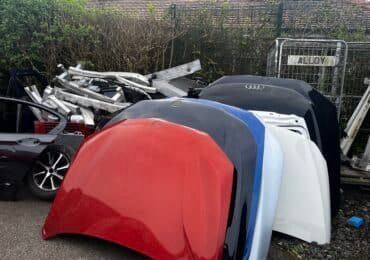
A shop generating even a handful of damaged bumpers a week can accumulate serious volume over a quarter, which is exactly why dedicated car bumper collection and car bumper recycling routes exist, rather than lumping this material in with general skip waste.
Metal waste:
- Alloy wheels, damaged or replaced during repair work
- Steel wheels and wheel trims
- Scrap steel panels removed during structural repair
- Exhaust sections, catalytic converter housings, brake discs and calipers
Hazardous and special waste, the category carrying the highest compliance risk:
- Used solvents and thinners from paint preparation
- Waste paint and uncured paint residue
- Isocyanate-containing materials from two-pack paint systems
- Used oils, filters, antifreeze, brake fluid
- Lead-acid batteries and aerosol cans
- Contaminated rags and absorbents
General waste, glass and tyres:
- Packaging, masking materials and abrasives
- General workshop rubbish
- Windscreens and glazing, which need separate handling from mixed general waste
- Damaged or replaced tyres, which cannot legally go to landfill
Seen laid out in full like this, it becomes obvious why a single skip and a single general waste contract were never going to cover a working bodyshop properly. Each of these streams carries a different legal classification, a different value, and in several cases a different collector entirely.
The Legal Framework Behind Every Waste Stream
Knowing what a bodyshop produces is only half the audit. The other half is understanding what UK law says about each stream, because this determines who may legally collect it and what paperwork must exist.
- Environmental Protection Act 1990 (Section 34, Duty of Care) – requires producers to prevent unauthorised disposal, ensure waste only goes to an authorised person, and retain a written waste transfer note for every transfer
- Environmental Permitting (England and Wales) Regulations 2016 – controls who may legally store, treat, transport or dispose of waste, and requires waste carriers and brokers to be registered
- Controlled Waste Regulations 2012 – classifies waste types and sets documentation requirements for non-hazardous transfers
- Hazardous Waste (England and Wales) Regulations 2005 – governs consignment notes and producer registration for hazardous streams such as solvents, paint residue and batteries
- Environment Act 2021 – introduced tighter producer responsibility and traceability requirements, now being operationalised through digital waste tracking and the move to a permitted carrier system from 2027
Taken together, these frameworks make clear that responsibility does not simply transfer the moment a skip is emptied or a van drives away. The producer remains part of the paper trail, which is precisely why checking a collector’s credentials before, rather than after, a problem arises matters so much.
The consistent direction across all of this legislation is more traceability and less tolerance for informal, undocumented waste arrangements. A bodyshop that has not reviewed its stream classifications recently is increasingly out of step with where regulation is heading.
How to Conduct Your Own Bodyshop Waste Stream Audit
A practical audit does not require a large workshop or a dedicated compliance team. It requires a structured walk-round and an honest look at existing arrangements.
- Walk the site and list every waste point – bodywork removal, paint prep, spray booth, mechanical bay, parts store, general skip, and any informal collection corner
- Classify each stream against the legal categories above, noting material type, hazardous status, and approximate volume
- Identify who currently collects each stream, cross-referenced against invoices and collection schedules
- Confirm each collector’s registered waste carrier number on the Environment Agency’s public register, and check the registration is current
- Flag any informal or undocumented arrangements, particularly cash collections for alloys or scrap metal
- Check the paperwork trail – waste transfer notes retained for at least two years, consignment notes for hazardous waste retained for at least three years
- Identify consolidation and cost opportunities, such as material currently paying general waste rates that a specialist collector would take separately
Do not rely on memory alone for the walk-round stage. It is common to discover a stream during a physical check that nobody had actively thought about, such as a drum of old antifreeze in a back corner or a pallet of glass that has been waiting to be dealt with for months.
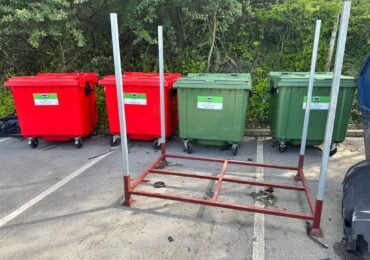
This is also the point at which most shops realise that matching specific waste bins and stillage to specific material streams, rather than relying on one general skip for everything, reduces both handling time and disposal cost.
Set a review cycle rather than treating the audit as a one-off:
- Annual full audit covering every stream and every collector
- Quarterly check on collector registration status and paperwork completeness
Bodyshop Waste Streams at a Glance
The table below summarises the most common streams, their typical legal classification, and the collection route that should be in place for each.
| Waste Stream | Typical Classification | Collection Requirement |
| Bumpers (PP, ABS, PC/ABS) | Non-hazardous, controlled waste | Registered waste carrier; waste transfer note |
| Interior/exterior trim & hard plastics | Non-hazardous, controlled waste | Registered waste carrier; waste transfer note |
| Alloy wheels | Non-hazardous, controlled waste (scrap metal) | Registered waste carrier; waste transfer note or scrap metal dealer licence |
| Steel panels & ferrous scrap | Non-hazardous, controlled waste | Registered waste carrier; waste transfer note |
| Used solvents & thinners | Hazardous waste | Registered carrier authorised for hazardous waste; consignment note |
| Waste paint & uncured residue | Hazardous waste | Registered carrier authorised for hazardous waste; consignment note |
| Used oils & filters | Hazardous waste | Registered carrier authorised for hazardous waste; consignment note |
| Batteries (lead-acid) | Hazardous waste | Registered carrier authorised for hazardous waste; consignment note |
| Windscreens & glazing | Non-hazardous, controlled waste | Registered waste carrier; waste transfer note |
| Tyres | Non-hazardous, controlled waste (landfill-banned) | Registered waste carrier with tyre disposal route; waste transfer note |
| General mixed waste | Non-hazardous, controlled waste | Registered waste carrier; waste transfer note |
Why Bumpers and Hard Plastics Deserve Special Attention
Plastic waste is the stream where audits most often reveal both the biggest compliance gap and the biggest missed opportunity. Bumpers are produced in genuine volume by any bodyshop doing collision repair, and they are valuable enough as a clean, sorted material stream that dedicated automotive plastic recycling routes exist specifically to process them.
Separating bumpers, trim and hard plastics from general waste rather than sending them to landfill affects:
- Disposal cost, since mixed general waste is typically charged at a higher rate per tonne than sorted recyclable plastic
- Compliance clarity, since a dedicated collector issuing correct paperwork for a defined stream produces a cleaner audit trail
- Environmental credentials, increasingly relevant to manufacturer bodyshop approval schemes and insurer panels
If an audit reveals that hard plastics are going into a general skip rather than to a specialist automotive hard plastic collection route, this is usually the single highest-value change to make first, both for disposal cost and for the clarity it brings to the wider compliance picture.
Common Mistakes Bodyshops Make With Waste Stream Classification
Having reviewed a large number of workshop waste setups over the years, the same handful of mistakes recur again and again, often in shops that would otherwise describe themselves as well organised:
- Treating all plastic as general waste, when bumpers, trim and hard plastics are a recyclable material stream in their own right
- Assuming a cash collection is a compliant collection, when informal alloy or scrap metal collections sit outside the duty of care framework entirely
- Not checking carrier registration status regularly, since a previously registered contractor may have let their registration lapse
- Misclassifying hazardous waste, treating solvents, uncured paint or isocyanate-contaminated material as general rubbish
- No retained paperwork trail, leaving no evidence that reasonable care was taken to check a collector’s credentials
- Using one collector for everything, when a single non-specialist contractor rarely offers the right terms or specialism for every stream produced
What Good Practice Actually Looks Like
None of this requires a large workshop or a dedicated compliance department to achieve. It requires an accurate list, a bit of checking, and a habit of reviewing it rather than letting arrangements calcify over years. A well-run bodyshop waste operation tends to share the same characteristics, regardless of size:
- Separated waste streams at source – bumpers and hard plastics kept apart from general rubbish, alloys kept apart from ferrous scrap
- Named, registered collectors for each stream, with registration numbers on file and checked periodically
- Waste transfer notes or consignment notes retained for the legally required period
- Appropriately sized bins and stillage matched to each material, rather than one skip handling everything
- A designated person responsible for waste compliance, even as a part-time role alongside other duties
- An annual audit, refreshed whenever repair volumes, staff or suppliers change materially
Bringing It All Together
Given the current scale of regulatory attention on waste crime, the bodyshops in the strongest position are the ones that have already reviewed their arrangements rather than the ones scrambling to catch up once a collector’s credentials are questioned.
Before treating this as complete, confirm the following:
- Every waste stream on site has been physically identified and classified
- Every collector’s waste carrier registration has been checked on the public register
- Waste transfer notes and consignment notes are being retained for the correct legal periods
- A review date has been set for the next audit
For bodyshops looking to consolidate specialist streams under one properly registered partner, get in touch to talk through what a tailored collection setup would look like for your workshop. More detail on how collections are structured is also available on the why choose us page.
Frequently Asked Questions
What is a bodyshop waste stream audit?
A bodyshop waste stream audit is a systematic review of every type of waste a bodyshop produces, matched against its correct legal classification and the collector responsible for removing it, to confirm compliance with UK waste law.
Do bodyshops need a licence to produce waste?
Bodyshops do not need a licence simply to produce waste, but they do have duty of care obligations under the Environmental Protection Act 1990 to ensure waste is only handed to an authorised, registered collector.
How often should a bodyshop review its waste arrangements?
A full audit is best carried out annually, with a lighter check on collector registration status and paperwork completeness at least once a quarter.
Is car bumper waste classed as hazardous?
No, standard car bumpers made from PP, ABS or PC/ABS are classified as non-hazardous controlled waste, though they should still only be transferred to a registered waste carrier with proper documentation.
What paperwork is required when waste leaves a bodyshop?
Non-hazardous waste requires a waste transfer note retained for at least two years, while hazardous waste requires a consignment note retained for at least three years.
How can I check if a waste collector is registered?
Registration status can be checked free of charge on the Environment Agency’s public register, searchable by company name or registration number.
What happens if my waste collector turns out to be unregistered?
Under the duty of care, the original waste producer can still be held liable if waste is later found to have been handled illegally, even without prior knowledge of the collector’s status.
Can alloy wheels be collected separately from general waste?
Yes, alloy wheels have scrap value and can be collected separately by a registered metal recycler or alloy wheel collection service, generally more compliant and more cost-effective than including them in general mixed waste.
[…] bodyshop waste is not one waste stream. It behaves differently depending on weight, shape, and whether it retains recycling or scrap value […]
[…] and shredded tyres since 2006. If wheels leave your yard with tyres attached, you are moving two waste streams in one load. That […]
[…] Bunded liquids and segregated waste streams […]